| xxx |
| How can I Evaluate Kids' Writing? |
 |
 |
|
| Children are learning machines! They start learning informally through communication with those around them, the moment they are born. As they progress through school, children's learning becomes more formalized, but the vehicle for learning continues to be communication. Through written communication, children in grades K-12 -- learn to write -- learn about written language -- learn through writing Children can monitor their own learning in all of these areas through self-evaluation as they conciously engage in the writing process and reflect on the effectiveness of their written communication. Self-evaluation is an important form of evaluation for improving writing a particular piece of writing and for learning to be a better writer. The ultimate goal of wrfiting instruction is for students adopt the habit of on-going, independent self-evalutation. |
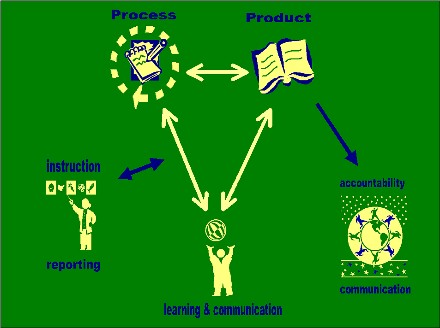
| The Writing Process involves all the things that a writer does to create the writing product. It is a collection of ACTIONS DIRECTED BY DECISIONS a weriter makes concerning what they want to write about, the words , style and organization that they use, and how they will prsent their writing. Few writers follow a linear series of steps when they write. Instead, they tend to cycle through the various activities of writing repeatedly. The writing process begins by generating ideas and finishes with publishing a final product in some form. How a writer utilizes the writing process can also be analyzed. This analysis is a valuable tool for improving writing quality. See LINK for an overview of stages in the writing process and what happens at each stage. |
| xx |
| The Writing Product is what writers write and what readers read. It is words on paper and words in digital format. It is SOMETHING TANGIBLE that can be measured and analyzed. Traditionally, only final writing products have been the sole focus of writing evaluation. However, writing products can also be evaluated during the process of writing. See LINK for more about the types of writing products and good/bad writing. |
| We can only do the best we can with what we have. That, after all, is the measure of success: what we do with what we have. Brother Luke in The Door in the Wall by Marguerite de Angeli |
|
| When will evaluation happen? |
| Why will evaluation happen? |
 |
|
| There are a number of useful tools and strategies for evaluating student writing posted on this website (scroll down for hotlink). But to help you choose which tool to use, FIRST think about... |
| Who will do the evaluation? |
| What will they evaluate? |
 |
|
|
| In effective writing programs meaningful response to student writing happens everyday, all day, in a variety of ways. Kids who write everyday for expressing thoughts, opinions and feelings, exploring new ideas, confirming knowledge, and reflecting on learning become more fluent in their use of written lanaguage. They produce a variety of formal and informal writing products. Some of this writing will be read only by themselves and the teacher or their peers. Other writing will be published in a vareity of ways for selected audiences. When daily assessment of both the writing process and writing product is a component of instruction, quality is added to quantity. Improvement is measurable. Assessment and instruction go hand-in-hand. This idea contrasts with the common conception of assessement as a one-time (or infrequent) event. Responses to adolescent writing tends to become more focused on end product assessments as they progress toward graduation. However, students continue to need both evaluative and non-evaluative feedback about their written efforts to communicate in addition to ongoing formal and informagives to the reader BOTH have their place in an effective writing program for students of all ages. It is not an either/or decision. |
| Teachers and tutors who want to help students improve their writing provide feedback about BOTH the writing product and the writing process. In doing so, they gather a variety of information that can be used to report student progress, assess development, and inform instruction. In a non-traditional school setting, teaching parents can also gather the same information to inform instruction. Teachers also gather information about student performance in order to report student progress. The education system uses grades to do this. |
| When will evaluation happen? |
| The outside world includes anyone who is outside of the instructional relationship with the student. In a school setting, the outside world is outside of the classroom environment. In a Non-Traditional setting, where the home is often the focal point of instruction, the outside world is anyone outside of the home teaching environment. The outside world includes the educational world of school administrators, school boards, community watch groups, and college admissions boards. It also includes the personal world of potential readership: extended family members, family friends, school mates in other classess, penpals, peers in other school settings, newspaper editors, magazine publishers,...the list is limited only by your imagination. |
| Identifying the purpose for writing evaluation in any particular situation will determine how the evaluation is done and which tools are used. Many people think of writing evaluating as grading papers. This point of view usually equates a "good grade" with "good writing". But many experts question whether good grades and good scores actually reflect writing quality. And studies show that a narrow view of writing evaluation has limited impact on actual improvement of student writing. An expanded view of the purpose for writing evaluation is needed in order to be effective in helping kids develop expertise in wielding the written word. So the answer to this key question about "why" is impacted by what aspect of writing is being evaluated and who is doing the evaluating. In addition, the answer is also influenced by foundational understanding about the nature of written language. For a quick look back at what the research says writing is, see Writing is Language is Learning. Move on down the page to explore the interaction between -- what will be evaluated (Writing Product & Writing Process) -- and who does the evaluation (Students, Teachers, Outside World) |
| Why will evaluation happen? |
| What will be evaluated? |
| Who will evaluate? |
|
| xx |
| All doors are hard to unlock until you find the key.
Mrs. Frisby, remembering her husband�s words in Mrs. Frisby and the Rats of NIMH by Robert C. O'Brien |
|
 |
 |
 |
 |
 |
|
|
 |
 |
 |
|
| Now that you've thought about these important questions ...Go to the Writing Evaluation Workroom to choose from a collection of strategies and tools for assessing product and process.... |
|
|
|
| Writing Evaluation Workroom |
| xx |
 |
|