| xxx |
| xxx |
| xxx |
| ...good observation, the most critical component in evaluation is
only as good as the teacher�s knowledge base. We have to be able to observe and value strengths more than deficits. We have to know what to look for� |
| Routman (1991) |
| Writing Evaluation Workroom |
 |
 |
|
| MEASUREMENT TOOLKIT |
| Assessment Tools for Evaluating Student Writing at All Levels |
| Contents Description: Objective Criteria that define a good writing (product) and what writers do (process) are used for both formal and informal measuring instruments. Measurable evidence of quality is quantifiable data about student performance. These are Criterion Referenced Tools. Quantifiable Data. |
 |
| Purpose: Formal Assessment Tools Provide public accountability. Report student achievement in comparison to peers using normed criteria. Try to provide one standard of measurement that is valid and reliable across populations. �One-Time or Infrequent� assessments. Informal Assessment Tools Clarify expectations before writing. Guide the writing process during writing. Assess quality and/or competency after writing. Used in combination with qualifiable data to evaluate long term student development. �Ongoing, Daily� assessment. |
|
| EVIDENTIAL TOOLKIT |
|
|
| Contents Description: Objective Techniques for collecting evidence of demonstrated writing behavior: both product and process. Behavioral evidence of strengths and weaknesses is qualified data about student performance. These are Performance Based Tools. Qualifiable Data. |
| Purpose: Collect evidence of writing competency. Collect evidence of writing behavior. Demonstrate evidence of learning and development. Engage student in active learning. Used in combination with quanitifiable data to evaluate student development. |
| INSTRUCTIONAL TOOLKIT |
| Contents Descriiption: Various techniques and instruments that that provide information about student performance, development and learning. Many tools in this collection are borrowed from other toolkits because they serve multiple purposes. Both Criterion AND Performance Based Tools. Quantifiable and Qualifiable Data. |
|
|
| Purpose: Evaluation of factors affecting student performance and development as a writer so that instruction can be directed to skills the student needs. An experienced teacher can find useful information for instruction in almost any assessment tool. However, those included here are the power tools. |
| Bratcher (1994) Carroll & Wilson (1993),Tompkins (1993) |
|
| REVISION TOOLKIT |
| Contents Description: Instruments and techniques that lead the student to do deeper and repeated revision when h/she write. Both Criterion and Performance Based Tools. Quantifiable and Qualifiable Data. |
|
|
| Purpose: Provide concrete descriptors for improving a piece of writing. Encourage students to engage in multiple drafting of a piece. Guide students to use multiple strategies for improving a piece of writing. |
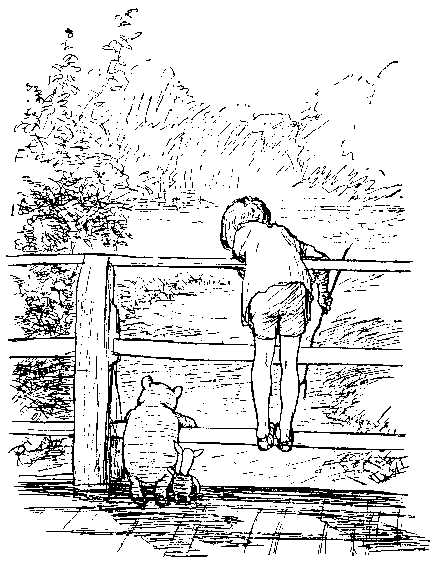
| �Tigger is all right really,� said Piglet.
�Of course he is,� said Christopher Robin. �Everybody is really,� said Pooh. �That�s what I think� |
| from The House on Pooh Corner by A.A. Milne |
 |
|
|
|
|
 |
|
|
|