 |
|
|
|
|
|
|
|
|
|
|
|
|
|
|
|
|
back |
|
|
|
HOW DID THEY DIG SO DEEP?
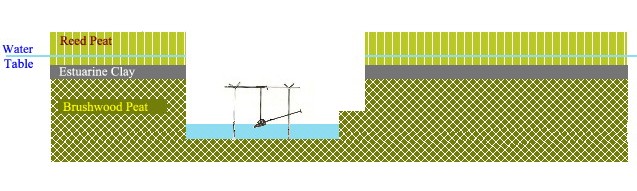
Peat is highly impermeable. If you dig a hole into wet peat to well below the water table, water will only ooze out from the sides of the hole very slowly. The deeper you go, the more compressed is the peat by the weight of the ground above, and the slower the water seeps out of it. |
|
|
|
"The possibility of digging peat to a depth of several feet even today is often underestimated . . . . . practical experience has shown that a depth of several feet can be attained in places where the general water table is only a foot or two below the surface. For instance an ornamental swimming pool was excavated in the Hickling marshes to a depth of nearly three metres entirely by intermittent hand labour without the use of elaborate pumps with the men working well below the level of the water in nearby dykes: indeed the landowner concerned suggests that a depth of twelve feet could easily have been attained."
Lambert et al., 1960 |
|
|
|
There is plenty more evidence, both anecdotal and scientific, which confirms the peculiar, impermeable properties of wet peat. All of which means that even today you can dig up peat from the same sort of depth as the broads, without using pumps and without even getting your feet very wet, always provided that you do it reasonably quickly.
In medieval times, that is exactly what they did. |
|
|
|
"Turf digging then, as now, was probably a seasonal operation for the summer . . . ."
Smith with Lambert et al.,1960. |
|
|
|
All the evidence strongly suggests that they spent no more than two or three weeks each year digging up enough peat to last them for the next twelve months. Clifford Smith reckoned that if twenty men from each village near to a broad worked for three weeks each year, the broads could all have been created in three hundred years or so. He also reckoned that one man could have dug up 1000 turves a day, that a medieval turf contained one quarter of a cubic foot of peat, and that the domestic requirements of a single household would have been 10,000 turves per year - five days' work for two men.
Dug out to a typical depth of ten feet, a pit with a volume of 2500 cubic feet would measure ten feet wide by twenty five feet long - not a bad size, you might well think, for an ornamental swimming pool. I won't trouble you with any more sums but there is every reason to suppose that, digging down to the same depth as the broads, they could have extracted all the turves that they needed to last them for a year even if water levels were no lower than they are today. What is more they wouldn't have needed any sort of pump or baling device.
Which is probably just as well. Apart from a bucket on the end of a rope, I can find no reference to any manually operated baling device which has ever been capable of raising significant quantities of water from the sort of depths to which most of the broads were dug - |
|
|
|
 |
|
|
- not the 'shadoof', not Archimedes' Screw, and certainly not the ladle-and-gantry, which in the 19th century was used to good effect in the shallow peat diggings of the Somerset Levels.
If they had invented a pump, then surely it would have been widely used at sea, yet the earliest known forms of marine bilge pump date from the 16th century. Not without reason did Joyce Lambert and her colleagues initially dismiss this sort of solution as "unlikely engineering". |
|
|
|
next page |
|