| Over a period of two or three weeks each year, they dug down as deep as they could, and in so doing created small, separate pits. The more people digging in the same pit at the same time, the faster the peat was extracted and the bigger the pit became - until they had filled their annual quota, or until there was too much water in the bottom of the pit to continue. When that happened, after a few days because of summer storms, after a few weeks because of lateral seepage, and certainly by the time of the next peat 'season' in the following year, the flooded pits were abandoned behind walls of peat, and they dug new ones. |
| HOW DID THEY REALLY DO IT? They dug the turves from separate, small, deep pits and fairly small compartments and they did it quickly. These diggings extended well below the water table, so they soon became flooded. The walls separating the flooded pits were removed by dredging. The bulk peat thus recovered was processed into more turves. In this way the great flooded basins of the broads were created. The method used would have worked even if conditions had been no more favourable than today. The techniques of any 'engineering' involved, far from being unlikely, are those which we know from the evidence were actually employed. It is a method entirely consistent with the residual physical evidence and with all the meagre documentary evidence. Just like Martin George's similar proposals, it is a method which would have left in its wake diggings which were permanently flooded. |
| Why did they stop? Contrary to earlier impressions, the level of the sea relative to the east coast of Norfolk was not rising at a rate of about three feet every hundred years throughout the 14th and 15th centuries. Although inland water levels in the late 14th century must have been higher than they had been in the 13th, they were still lower than they are today. So it makes little sense to argue that a method of deep digging would have become impossible in the 15th century due to rising water levels, when it would still work today with the water table only a foot or two below the surface. At a few locations, the residual physical evidence strongly suggests why they stopped. They ran out of peat. This appears to be the case with the Ormesby, Rollesby and Filby group of broads, and at South Walsham, but elsewhere the fens still contain huge reserves. |
| The appalling weather conditions in the early 14th century contributed to the economic problems of this period. Harvests failed; diseases afflicted cattle and sheep; there were great shortages and periods of famine. Between 1305 and 1310, the prices of grain and livestock doubled and went on to reach new heights between 1315 and 1317. Landowners enjoyed these inflated revenues until 1337, when prices started to spiral downwards. Uniquely to Broadland, peat fuel was also a commodity, sold in markets and imported into Norwich and Yarmouth in large quantities. The records reflect exactly this same inflation and deflation in the price of turves and in production costs. In 1349 the Black Death reached East Anglia, striking down over a third of the population within the space of a few months. The remainder of the century was a time of economic uncertainty and social unrest. Recurring outbreaks of plague and a low birth rate meant that numbers did not recover. Landowners had lost their market for surplus commodities and with it a major source of income, so they sought new markets to restore their revenues. |
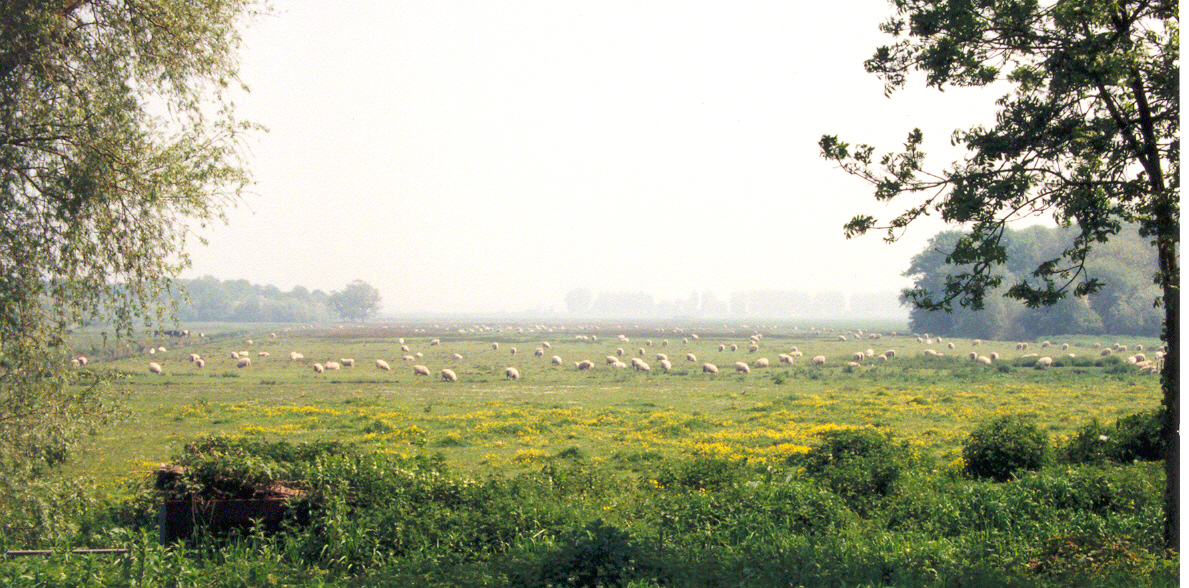 |
| Many converted to sheep in order to export the wool, but on the great grazing marshes in Broadland the trend seems to have been away from sheep and towards the fattening of cattle. |
| Marshes in the Yare valley. |