The temple of Artemis at Ephesus
The Mausoleum at Halicarnassus
The Hanging Gardens of Babylon
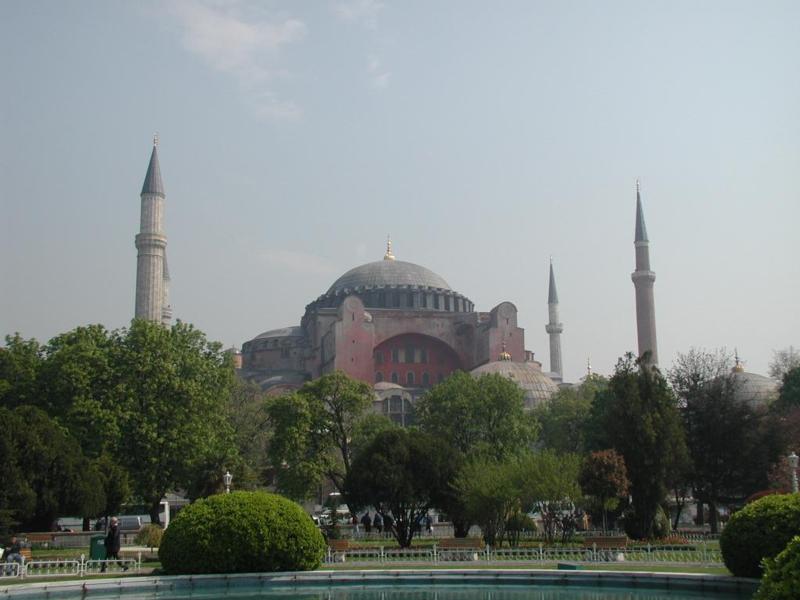
Location: Istanbul, Turkey
Completion Date: 537
Diameter: 102 feet
Type: Ribbed
Purpose: Religious
Materials: Concrete
Engineer(s): Anthemius of Tralles, Isidorus the Elder
Considered the finest example of Byzantine architecture in the world, the church of Hagia Sophia was constructed on a scale unprecedented in human history. Under the rule of Justinian the Emperor, and with a force of 10,000 workers, the dome atop the church of Hagia Sophia was built in record time: it took just five years, ten months, and four days to complete.But when construction began, Anthemius found himself in a geometric fix. How would he build a circular dome atop a square base? Anthemius arrived at a revolutionary solution. He built four massive columns at the corner of each square. On top of the columns, he built four arches. He then filled the spaces between the arches with masonry to create curved triangular shapes called pendentives. The pendentives and the tops of the arches combine to form a strong base for the dome.
But it was the dome that made Hagia Sophia the most complex building of antiquity. The shallow dome was made from 40 equally spaced ribs. Forty windows were then set at the dome's base, creating the sensation that the dome actually floated over the church.
In 559 A.D., an earthquake tumbled the dome. It was rebuilt to a smaller scale, and the whole church was reinforced from the outside. After the Turkish conquest of Constantinople (1453), Hagia Sophia became a mosque, and the ornate interior mosaics were obscured by layers of plaster and painted ornament. Today, all plaster removed, Hagia Sophia is a museum of Byzantine Art.