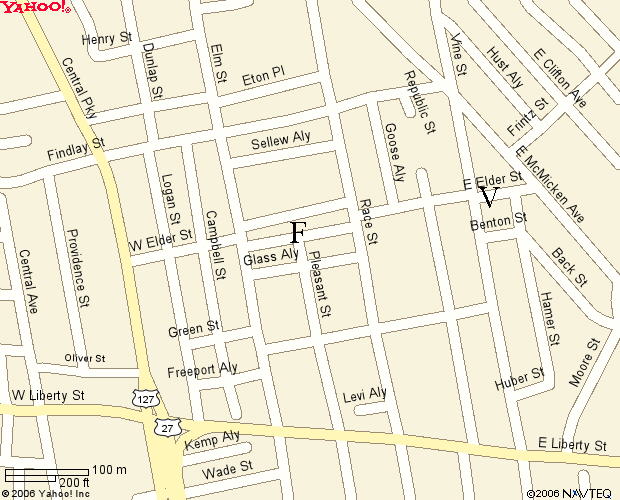
This next map is a larger map taken from another source that shows a view of this area even further zoomed out. Notice the proximity of this property to Findlay Market. Findlay Marketis marked on the map with an "F". 1732 Vine Street is marked with a "V" on this map. Findlay Market is the oldest open air market in the U.S. and it is one of the foci of the City of Cincinnati's decades long, stalled and re-started again redevelopment efforts.
While the city's on and off again efforts are to be commended, this alone is not going to be enough to make of this neighborhood all it can become. Such an effort requires not only real estate developers, and an infusion of capital, it also requires community activism and the work of visionaries who aren't simply looking to make a fast buck through the conversion of rental housing into condominiums.
I don't want to mislead anyone here. This area is rife with the problems of urban decay. The city's redevelopment efforts are the result of a dramatically perceived need. The city's efforts are insufficently funded, wrought with corruption common to all city bureaucracies, and woefully unsustained by meaningful progress. And unfortunately, gold-digging condominium conversions make justified enemies through the total gentrification of neighborhoods. All condominium conversions are generally destructive of urban areas over time.
Condo conversions generate a rapid influx of moneyed interests, which also generally depart just as fast once the money has been made and all the problems of condominium real estate, the parcels and subparcels of it, start to escalate into yet another real estate decline. This has been the American urban experience over the last twenty years in many urban areas hit hard by the condo gold rush.
There are certain incongruities of economy that develop when rental properties are turned into condominium projects. These economic incongruities invariably precipitate the demise of condo conversion driven redevelopment initiatives.
First of all, condominium-ization is not a means by which to provide more affordable housing. It only makes for even more expensive housing. Every condo owner gets their own property tax bill. Every condominium owner pays their own separate utility bills. Every condominium owner pays their own mortgage. And every condominium owner gets a condo-organization bill every month too. All of these less-is-actually-more the-sum-is-greater-than-the-whole cost factors demonstrate exactly why housing is made considerable less affordable with every condo project that goes forward.
The irony of urban redevelopment efforts focused upon the condo-ization of vast urban swaths through neighborhoods of rental housing is that the ensuing decline that results from these efforts will be deeper than the decline that politically called for redevelopement in the first place.
--------------------------------------------------------
