Copyright 2/2006. All rights reserved. Please correspond for permission to reproduce. [email protected]
Dedication
Here's a funny but nonetheless somewhat true conjecture to ponder, self-humoring yourself as you do.
As you read this book, it will give impetus to thoughts wholly unwritten, even unhinted by the words on the page, certainly thoughts that are beyond my experience, and likely all others as well.
I have this same experience every time I read. My mind strays. It's as if a fireworks display of original thought is set off by the words of authors. It's so haphazard, and sometimes so overwhelming I must put down the book I am reading for a while, just to let my mind play catch-up, and work out what is important.
Such is the joy of reading, and reading philosophy, however tedious some misled philosopher-authors might be. There still is value in what comes about from the time and effort.
If you don't write down what you think as you read philosophy, you surely will leave your own philosophic satisfaction unsated, and, you might deny the world, and all its people something of greater value than anything else your life might be able to bequeath.
As you grow older you will surely feel the urgency intrinsic to this observation. Remember, advice, good advice is the most wide spread expression of free will.
Coincidental to the writing of this book, my friend, Roy Moody of Perham, Maine (1917-2006) died. It was Old Roy who told me when he was well into his eighties, he still felt in his mind the same as he did when he was twenty. The permanence of a youthful mind and spirit is a wonderful thing, one no less wonderful to behold than to experience.
It was Roy who told me more than once, "When the first snow comes, it's wise to remember that it is not so much slipping on the ice, or falling that hurts as it is when you hit the ground."
That's the sort of good advice friends give, more than once, if you're so lucky as to have good friends like Roy Moody in your life.
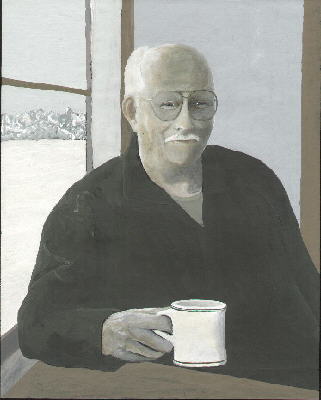
Old Roy Moody (1917-2006)
Preface
As I write this book, An Illustrated Philosophy Primer for Young Readers, I do so with an anticipation learned scholars of philosophy will also read it, and knowing that among my audience of young readers I will find critical students of philosophy interested to see how it is I have treated this subject, and delivered that treatment into the hands of young readers. Welcome. I hope you approve.
While some might phrase the first lesson of philosophy as We may all be mistaken, I prefer to start with a lesson that begins, None of us are even entirely sure of the meaning of the words that make these many uncertain questions, questions for which there are so many quick, esteemed and surely solicitous answers, it just simply isn't possible anything can be truth, but there it is seemingly before us all, the world... So let us proceed ever so cautiously.
My approach here requires me to exclude all that I deem not to be philosophy, which is a lot, even most of it. Yes, philosophy has been called upon for opinions about a wide variety of otherwise quite extraneous topics, but this is so merely because philosophic minds have something extraordinary. My approach here concludes that while philosophy has strayed, much of what has been written is not philosophy at all. Shedding this dead skin grown over both ancient and modern philosophy, I have found some interesting, even enlightening considerations for our young readers. My hope is that as an introduction this text will arm them well for philosophy's future.
I am currently living in Camden, Maine, where my wife and I relocated after sixteen years in Perham, Maine in Aroostook County on a small, fifty-acre farm where we raised our two sons. Camden has delivered to us a whole new living experience as a resort destination by the ocean abandoned in the winter by the majority of its summer residents.
Every day, or at least most days here in Camden this winter, I have risen and after breakfasting I�ve walked the third of a mile to the Camden Public Library to use the computers and the resource material available there. There isn�t a single day that I have arisen knowing where the day would end up either in my writings or my other encounters. Each day is different, and just as unpredictable as the previous day, as it should be as you read this book page by page. I have not written this book to present any grand philosophic scheme, but rather, to establish a foothold and a base camp upon a mountain as yet unconquered for youthful readers interested in philosophy.
There is fantastic enjoyment in philosophy for those who take the time to embrace it. Its methods of doubt and re-doubt lead to the path toward truth, and, it is my hope that as my young readers go through this book they too might find the enjoyments I have found in reading and thinking about philosophy.
Because of the complexity of some of my topics, some of what I have written here will be beyond every reader in one part or another. It is permissible therefore to simply run your eyes over the words in sections that make you stumble, and continue on as if you understood what it was I was trying to say.
The fault here is not in your ability to understand what you�ve read, but more likely the fault is in my failure to express my thoughts with sufficient clarity. Success is at hand though, should you merely finish the book.
American philosophy is paltry unless we look beneath the realm of academia where it flourishes unknown. Were any American today to write the great book on philosophy, they would become known as the American Philosopher.
So, then, I have written this book specifically with the intent to deliver the reader to a certain place, and by my chosen literary method, I have done so in a manner, I hope, that will cause the reader who gets to the end of this book and to that place to realize what they�ve been reading isn�t at all like what they thought they were reading.
The path toward truth is just like that.
Adam
1
What is philosophy?
Owen
In the introduction of young minds to philosophy great care must be given by any teaching philosopher attempting to define the wonder and excitement felt for the avocation, surely a leisurely pursuit of a path to real knowledge. The first impression given a young mind on such an important life-long pursuit as philosophy can be, should neither hinder nor bias the student.
It is safe to say therefore that philosophy is the pursuit of a path towards meaning and knowledge, if we then go on to impress the student that this "meaning and knowledge", the interest of the philosopher, is very special and apart from what the young student may already think meaning and knowledge may be.
Philosophic "meaning and knowledge" is a bargain apart from that bought by any other approach to what can be said is truth.
The meaning and knowledge sought by philosophers is held to be unattainable because philosophers seek a path towards absolute truth, which is the intrinsic definition of meaning and knowledge for the philosopher, that it is a path and not the end of that path. It isn�t good enough for a philosopher to be partly right, right in some instances, half right, or, even right about anything for that matter. Philosophers know they are never right. This is what sets them apart from all science.
The philosopher�s goal is to demonstrate when something is wrong, and then to give a fresh hint as to a direction where truth, absolute truth, might be found. Absolute philosophical truth in meaning and knowledge is unattainable, but for the philosopher, that does not mean, we cannot try.
This is certainly not to say nothing can be learned in the study of philosophy, the pursuit of a path towards meaning and knowledge, or by the dedication of one�s own time surrendered in philosophical pursuit. It is the role of the philosopher in society to come closest to correctly interpreting what all others think of as meaning and knowledge, or what others say they believe is true.
The philosopher is full of doubt always, doubt about what others believe is true and especially about what other philosophers believe is truth. This is the philosophic process, this process being better than any other yet invented for determining a path that can lead towards truth. The philosophic process is the only method to finding a path towards absolute truth in all meaning and knowledge.
I can give to young readers, all the young philosophers reading here, no better definition of the study of philosophy. The philosopher stands atop all human knowledge surveying all he sees, his job being to discover a path towards truth by thinking about what he and others might be observing and doing. From atop the mountain of knowledge he continually looks upward to see how much higher is real truth in the meaning and knowledge of every human.
Throughout history philosophers have provided hints at the path toward truth, truth, which has always conquered the world, for truth is irresistible and irrepressible. The momentary success of a philosopher is often accompanied by their sure remorse for speaking what they thought is the truth, even as elusive as truth is, as the less than truthful words of philosophers have set armies against armies and men against men, and by the slightest of flaws in their philosophical statements and analysis, they have ruined life for many millions, where they sought to make life immeasurably better by what they perceived as their clear understanding.
By the use of their brains alone early in recorded history philosophers became very important for their knowledge. Their knowledge was dangerous for societies as well as it was often dangerous for the philosopher.
2
The very first documented philosophers lived in Greece more than two thousand years ago. Before there were documented philosophers in Greece, the only wise men belonged to a very different kind of religion, called polytheism. Generally defined, polytheism means, worshipping many gods.
Philosophy is not a religion, though the wise men that were polytheists envied the philosophers� knowledge and growing esteem. The wise men that practiced polytheism adopted some of the knowledge beliefs of philosophers in order to advance their own esteem and the following of their religion.
It is no longer philosophy when a religion adopts some of the wisdom discovered by philosophers. This is instead theology, and theology is not the same as philosophy because a philosopher is always keen to find out if he is wrong, and, theologians are anxious to prove their religion right. The emphasis is in the wrong place for theology to be philosophy.
Duns Scotus (1265-1308) posited true philosophy is true religion. This is the wishful thinking of a pious man, and not the strong thinking of a philosopher. Duns Scotus wrestled with his religion like many philosophers trying to make religion fit philosophy. A man can be sure about his religious beliefs. A philosopher cannot be sure about anything.

Perhaps as philosophers we should as much as is possible let all the various Gods in their respective universal hereafters sort out the pious and the impious, the saints and the sinners, as well as the heralded and the heretics. As philosophers we should seek not to judge, but to find the best path toward truth. Let their Gods be the judge of it all.
Those men who believe good science is good philosophy make a very similar philosophic mistake. Again, the emphasis is wholly in the wrong place.
A scientist does not work by the higher standard of truth required of philosophy.
This is no small distinction when we weigh it against the historic import of mistakes made by scientists who thought they had a good philosophical footing.
3
The idea expressed by some philosophers that one day everything will be explicable in mechanistic terms, this idea of ultimate determinism, that science is supreme; this is utterly ridiculous.
No thorough scientist holds this view.
Let me give an example of what scientists know: In physics there is a problem called the three body gravitational problem. The three body problem is a conjectural problem. Given three gravitational bodies in otherwise empty space, the conjecture asks for a solution to the problem that will resolve where these bodies will end up in relation to themselves off into the future.
What is remarkable about the three body problem, is that there is no solution. The wrong answer is virtually assured. It is not a question of more powerful computers, or, just a little more tinkering. Science can only go so far before it loses the struggle with the three body problem, and, this is for the hypothetical three body problem. The Universe is infinite and has an infinite number of gravitational bodies.
If there is anything science has proven out conclusively, it is that there are plenty of problems for which there are, and can be, no solution. This however, is not a philosophical problem. In philosophy there is no problem for which there is no answer, even if we may be left with an answer that is not to our specific liking.
So, when philosophers attempt to defer to science by postulating that one day everything will be mechanistically determined, these philosophers are fishing in a bucket, in this case, the bucket of the scientists' assured failure.
It is astounding the credulity, the too easy acceptance of something as truth, science has mustered. Scientists lament the credulity of today's Creationists who hold that the Bible is literal truth. But thousands of years ago it was proved once and for all by the Greek philosopher Zeno of Elea (490BC-425BC), credulity in reason itself is unwarranted, even ridiculous.
4
Some philosophers, as well as physicists who have wandered into philosophy, have questioned whether there are infinite worlds. To this the philosopher might recognize there are at least as many different worlds as there are sentient, or thinking, beings on the planet, or, that ever have been on the planet. The philosopher should hold though, that none of these many worlds is the real world, the real world being that which our senses sense but that each of our minds receiving those sense impressions can only imagine.
5
Philosophers believe they can discover the path to real truth by thought alone, but that is not to say philosophers do not consider what has been empirically observed. One of the tests philosophers put truth to, is to discuss it with other philosophers as well as with others who have made observations. This is what philosophers call the dialectic method, a system of revealing a thesis, or proposition, proposing an antithesis, yet another related proposition, and, from these two facts given develop a formal synthesis, usually through discussion. Philosophers often talk to themselves, sometimes annoyingly so. It�s simply a way philosophers consider truth.
The dialectic method gave rise to the admiration for the speaking and reasoning ability of philosophers. This "speaking and reasoning" ability that others admire, is generally called rhetoric. But, rhetoric is not philosophy. Rhetoric is just rhetoric, just as surely as what is found deposited by a bull in a pasture is manure.
It was said of Socrates (469-399 BC), a Greek philosopher, that his rhetoric was so skilled that to those who asked him a philosophical question, he would in return ask questions until their own answers would answer the question they originally asked of Socrates.
Socrates� method of dialectic analysis, his rhetoric, was very clever and philosophically quite astute, because it allowed Socrates to never utter a word that could be doubted, and, yet, his dialectic method satisfactorily answered many puzzling problems.
Other philosophers could have benefited from Socrates� dialectic method and his rhetorical skills, because throughout history philosophers in many ages have said and written some pretty bad philosophy.
One very bad philosopher once wrote, "When a man is right, he knows it!" Well, I guess we all know some people like that.
It is very important for philosophers to write down their ideas and their discoveries so other philosophers can learn and improve upon them.
Here�s an example of some very influential and important philosophy: An ancient Greek philosopher once stated, "Nothing can come from nothing."
This philosophical statement stood uncorrected for thousands of years. It has been the foundational source of knowledge in many other endeavors, from cosmology and physics, to medicine and law.
This philosophical statement has recently been found to be false.
Here�s why: "Nothing can come from nothing." seems easily enough understood, and entirely self-evident, "self-evident" being a phrase coined by philosophers when they�re lazy about a proof. But, if we rephrase the statement, "Nothing can come from nothing," to be, "Something cannot come from nothing," we immediately see a problem, even though we have not changed the original meaning of what was stated.
The problem arises, we know what "something" is, but we do not know, and cannot know, what "nothing" is. We cannot know what "nothing" is because even in the absence of everything else, there is always time, which is something all by itself.
6
This new notion that the idea that something cannot come from nothing is false, might lead physicists to discover that the base unit of the entire Universe is time, or Time with a capital T, or, perhaps even something called a time quantum. This is not philosophy, but it is nonetheless quite interesting.
Perhaps given enough time scientists might eventually look upon our belief in matter as being as quaint as the once widely held belief in animism, the belief that everything is alive. None of these ideas, animism, matter-ism or time-quantism can be definitively disproven because each is based upon our mental josteling of mere universal forms and ideas, none of which have a definitive reality we can directly experience or know.
The ancient Greek philosophers once thought the base unit of the Universe was the atom, which was a fantastic leap in scientific knowledge for the philosophers of a people that didn�t even have a microscope.
The real truth is not that something can come from nothing, but that "nothing" is an erroneous concept made not in relation to absolute truth, and this philosophic error has caused millennia of trouble for philosophers and scientists all over the world.
That is philosophy, always seeking a path towards unalterable truth, and never half the truth.
So what is philosophy that it is so powerful amongst human beings? Philosophy is the pursuit of a path to knowledge that cannot be improved upon.
Philosophy is not a religion, though religious teachers have always been anxious to reinforce their religious arguments by the use of philosophical analysis. This is not philosophy however. It is theology.
Like the nature of relationships one might have in sex, the nature of one sex as compared to the other, and religion, all ought to be considered philosophically taboo for it surely has been our experience that nothing good has come of these musings by philosophers. They are impertinent to the purpose of philosophy for the most part.
Philosophy is not the laws of society, though lawyers and statesmen who enact and enforce laws have always used philosophy to justify their jurisprudence, to encourage adherence to laws, for enforcement of them, and for the escape from successful prosecution under them. This is not philosophy however. It is law and government, the political science.
Politically, ours is a moral-socialist empire, meaning we allow our leaders to set moral goals for the people. Due to so many half-truths acted upon by politicians however, our country�s good reputation is often held in such disrepute it may only be redeemable by future events. If that is ever to happen, it will likely occur due to the will and invectives, the angry words, of philosophers as they dismantle all of the purported "political philosophy", which has been a long banter of half-truths that debases the nation�s reputation.
7
Philosophy is not mathematics, though mathematicians have heavily relied upon the criticisms of philosophers to understand the very basis of all mathematics, as well as to look for new mathematical venues and concepts. Mathematics is not philosophy, however. It is mathematics.
Think about it. In mathematics there are more numbers than there are things in the entire Universe, and, there are in fact more numbers between any two integers, zero and one for instance, than there are things and all the combinations of those things in the entire Universe! Mathematics is based entirely upon universal forms and ideas. Mathematics is constructed as if those universal forms and ideas, numbers and their functions, were real things. Numbers and their functions are not real things in the Universe.
The philosopher Gottfried Leibniz (1646-1716) sought as his path to the truth a method of philosophy that would allow mathematical-like philosophical calculations.
We can all be thankful Leibniz�s scheme cannot fit reality. Life would be pretty dull, and it would probably resemble your father�s old 1970 Pac Man video game. Mathematics is entirely based in false forms and false ideas, universals, numbers and functions that approximate the real world, but do not reflect the undeniable individuality of every thing in the real world.
8
Reality is not an approximation, and philosophers are sure of that.
Jared Diamond in his "Guns, Germs and Steel, The Fate of Human Societies" 1997 W.W. Norton & Co. gives a tremendous description of how written languages came into being:
"THE THREE BASIC strategies underlying writing systems differ in the size of the speech unit denoted by one written sign: either a single basic sound, a whole syllable, or a whole word. Of these, the one employed today by most peoples is the alphabet, which ideally would provide a unique sign (termed a letter) for each basic sound of the language (a phoneme). Actually, most alphabets consist of only about 20 or 30 letters, and most languages have more phonemes than their alphabets have letters. For example, English transcribes about 40 phonemes with a mere 26 letters. Hence most alphabetically written languages, including English, are forced to assign several different phonemes to the same letter and to represent some phonemes by combinations of letters, such as the English two-letter combinations sh and th (each represented by a single letter in the Russian and Greek alphabets, respectively).
"The second strategy uses so-called logograms, meaning that one written sign stands for a whole word. That�s the function of many signs of Chinese writing and of the predominant Japanese writing system (termed Kanji). Before the spread of alphabetic writing, systems making much use of logograms were more common and included Egyptian hieroglyphs, Maya glyphs, and Sumerian cuneiform.
"The third strategy, least familiar to most readers of this book, uses a sign for each syllable. In practice, most such writing systems (termed syllabaries) provide distinct signs just for syllables of one consonant followed by one vowel (like the syllables of the word "fa-mi-ly"), and resort to various tricks in order to write other types of syllables by means of those signs. Syllabaries were common in ancient times, as exemplified by the Linear B writing of Mycenaean Greece. Some syllabaries persist today, the most important being the Kana syllabary that the Japanese use for telegrams, banks statements, and texts for blind readers.
"I�ve intentionally termed these three approaches strategies rather than writing systems. No actual writing system employs one strategy exclusively. Chinese writing is not purely logographic, nor is English writing purely alphabetic. Like all alphabetic writing systems, English uses many logograms, such as the numerals, $, %, and + : that is, arbitrary signs, not made up of phonetic elements, representing whole words. "Syllabic" Linear B had many logograms, and "logographic" Egyptian hieroglyphs included many syllabic signs as well as a virtual alphabet of individual letters for each consonant."
9
From this description of the basis and development of writing we can see the written word has some similarities to mathematics. It should be clear the written word in every language, just as in numbers, can describe more things than exist in the Universe many times over, and, as in mathematics, words can describe more things than exist in the Universe an infinite number of times over.
When we examine the nature and elements of the spoken word in every language, it seems that while an infinite variety of sounds coupled with an infinite number of ways to combine those sounds, while easily exceeding in number every possible variety of things in the Universe that can be, as well as all their relationships, those sounds that make language, when we think about them, on the one hand it�s clear they can create meanings for our minds that do not truly express real absolute truth about the Universe, on the same hand it�s also true, those sounds in their infinite combinations also cannot express some real and absolute truth that does exist in the Universe. Language then, seems a double impediment to finding a path toward truth.
In fact, we do not have the words to express all the real truth we know exists in the Universe. We can never, for example, express adequately how or what we feel when we win at a sporting event, or, when we lose, when we fall in love, or when we lose a loved one.
Language it seems is both too large to fit the truth of the Universe, and, too small to express it all as well.
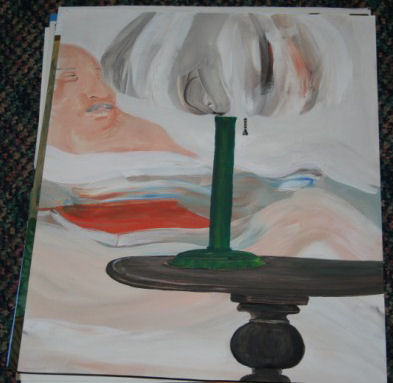
Anyone who has even a remote appreciation for art knows in every painting there is something of truth that cannot be expressed in words, or for that matter, by science or mathematics, both of which are also capable of holding in a numeric sense concepts infinitely in excess of everything possible in the Universe. These sets of knowledge, art, science and mathematics, overlap, but they do not entirely encompass each other, nor do any or all of them combined encompass all the absolute truth of the Universe, nor, can they, it seems.
10
The path to absolute truth, the absolute truth sought by philosophers through doubt of all other knowledge sets, is the only way humans have yet devised to encompass and begin to understand the absolute truth of the Universe.
I can explain this by example, an example of just how fallible our logic and perception is, and why doubt alone holds the key to the path toward truth.
Both from a lifetime of observation and through logical decipherment anyone can know what time it is when the full moon rises. It rises at the same time every month. And yet it is almost invariably left unobserved, and is at the same time out of the reach of the logic of most humans to answer the question, what time does the full moon rise?
I will not answer this question for you here, for it is within everyone�s ability to answer this question for themselves, if it may take a long time for some, and a longer time for others to understand why and what the answer is.
Human logic and human perception are flawed. We might think there are in a group of a thousand people a few who can readily answer the question concerning when the full moon rises, but! Without doubt about their answer, how can either they or we know their answer is correct?
Little of what passes for sense or sensible is either. We must be carefully particular about what we mean by sense.
We have a great many words to describe what we see. We have a lesser number of words to describe what we smell, hear, taste and sense by touch. Taken together, if our individual worlds were made simply of words, we could see how limited are our sensually founded worlds might be. We know intuitively there is more truth.
Our individual worlds are not made simply of words. Our worlds are made of relationships of words, with a smattering of functions applied to these words and their relationships, as well what we surmise as feelings and instinct.
Thereby, language gives us a clue to the infinitely complex knowledge set with which we can experience, cope and describe the Universe. This knowledge set, unique to every human being, is clearly larger than all the Universe and all possible relations and functions possible within the Universe. This knowledge set by its excessive capacity is faulty and must be pared to find the path toward truth.
It is also clear despite the size of all our immense knowledge sets, they also are insufficient to describe everything, every relationship and every function in the Universe. So, in order to find the path toward truth, this knowledge set must also be expanded.
From these two observations we can know the path toward truth changes by our perception of it.
It is also clear, different languages provide different knowledge sets, just as do different cultures that use these knowledge sets. Apart from our current discussion, here we have a very definitive defense for the need of human diversity, and, in fact all diversity.
Doubt, vigilant doubt is the method to finding the path toward truth, and we cannot avoid doubt or we have no path toward truth that can possibly be found.
11
Our minds have the innate inclination to let coalesce universal forms and ideas, forms that sensory data and our languages convey. Universal forms and ideas are not real, but rather, they are merely mental aids.
Our minds tell us that universal forms such as rock, human, cold, red, two and tiger are real things. They are not, as these are all expressions of a form our minds create and accept, just as it then classifies each of them into categories that are also mere universal forms.
It is a good thing our mind recognizes such things as tigers, but the idea of a tiger that our mind grasps is not real, only the animal we sense before us is real. To recognize it as a tiger is useful for our survival, but it is an animal like every other animal, unique and distinct from every other animal.
It is easy once you get your mind into shape to think like a philosopher and to see why universal forms aren�t real. Here�s an example:
Your father is a man, right? And, if you are a young man, then when you grow up, you too will be a man, right? If you are a young woman, you will grow up to be a woman. The same reasoning applies to either sex.
So, your grandfather, he too was a man, right? Now, what about your male ancestors from 10,000 years ago, were they men too? And, what about your male ancestors from 50,000 years ago, were they men too? And, what about your male ancestors from 1,000,000 years ago, were they men too?
As you begin to think about what we mean by the word man, it becomes obvious the universal form in our minds we use to refer to a man cannot be applied to our long ancestral lineage that stretches backward in time for millions of years. But, where do we draw a distinct line between that which we refer to as men and the so-called missing link from which men arose in evolution? So, then, what do we mean when we say the word, man?
We know what we mean by the word, man, but we know better what we mean if we accept our knowledge as faulty, and prone to the creation of universal forms that are really non-existent in the real world.
Try examining philosophically what we mean by the other examples I referenced earlier, rock, human, cold, red, two and tiger. How can you show they too are not absolutely truth?
12
We know there are an infinite number of untruths intrinsic to our knowledge as it is expressed through our languages, and, as our minds perceive it. The correlation to the real world is very close, but as philosophers we demand absolute truth, not approximations.
Our common solution to the dilemma that arises due to universal forms and their non-existence is to continually invent new universal forms, universal forms that express even greater truth, and, less at the same time.
There is a song that contains the line, "The words of the prophets are written on the subway walls." This is a statement about where, how, when and by whom truth might be written. None of us expects to find truth written on a subway wall, but we read on anyway in the faint hope of finding the truth all humans by their human nature seek in false universal forms and ideas expressed through language.
We know humans also have a need to express truth as well, and, what better, more public place to write it than on a subway wall for every passer-by to read?
While I�d never encourage anyone to deface a subway wall with graffiti, if I read there, "While being claimed to be about too many things that don�t exist, philosophy is about seeking a path to absolute truth." I�d know, or at least I'd hope, I�d read the truth.
In fact however, philosophy is not science. All sciences and even languages are simply rules about approximations made of nonexistent universal forms and ideas, and, each science is built upon a concept manifold of infinite forms, infinite ideas and their infinite combinations.
Philosophy is not cosmology, the study of the Universe. Nor is philosophy physics, the study of the physical universe. Philosophy is not chemistry, which is the study of the different kinds of matter and how it interacts at an atomic and molecular level. Philosophy is not medicine, which is the study of deformity and disease, and, how biological bodies can maintain and be rejuvenated to health. Philosophy is not psychology, the study of the workings of the mind.
But the practitioners of all these sciences and every other science rely every day upon what has been found by philosophers, to advance their scientific pursuits.
The philosophers� oversight of all science does not imply approval of any science through some philosophic moral ground.
The philosophic moral imperative in life is to leave the world in at least as good shape, and hopefully better than when we found it. In many instances it is easy to see the amoral, morally neutral, application of science can represent a supreme danger, one that might be better left alone and out of the reach of humanity.
Perhaps, as we inspect the history of explosions, their historically exponential increase in size as they are given to us by the history of science, perhaps we should send all the scientists to Mars, or further, so that the world can be safe from their dangerous craft?
Diogenes of Sinope (412-323 BC), about whose contribution to philosophy others attributed cynicism, was a philosopher who saw no need of any human invention geared toward comfort, science or technology. For Diogenes life is simply good enough. His philosophy holds great appeal even today in our comfort driven world simply because nothing bothered him, there being no greater comfort.
We all wish not to be bothered, and, we all make every effort towards presenting that outward appearance.
13
A story about Alexander the Great (356-323 BC) finding Diogenes after searching his kingdom describes the philosophy of Diogenes well.
Alexander the Great, a Greek Macedonian king, the destroyer of Greek Thebes, Alexander who was on his way to conquering the whole of the known world fancied himself something of a philosopher, for in his youth he had been tutored by Aristotle (384-322 BC). It was Alexander who sought out Diogenes.
After a long search Alexander found Diogenes in a small town lying upon a rock sunning his body in the morning sun. Alexander, the great stallion of a man that he was stood before and towering over Diogenes lying on the ground and, stated, "I am Alexander the great king. I seek Diogenes the philosopher. Are you such a man?"
To which Diogenes replied, "Yes. I am Diogenes the philosopher who lies on the ground as a dog before you."
Alexander, excited and quite honored at having at last found the great philosopher, and, anxious to pay him tribute, reasserted his manliness stating, "Diogenes, I am glad to meet you. I am Alexander the great king, the son of Philip of Macedonia. I have come to find you, Diogenes, to ask if there is anything I can do for you, anything at all, for as King of the Greeks there is little beyond my command."
Diogenes then replied, "Yes. There is something you can do for me Alexander, son of Philip. Step out of the sunlight that warms my body, Alexander."
14
The Phaistos Disk with its estimated date of 1700 BC, a disk with 45 distinctly stamped glyphs, or symbols, stamped dozens of times in different orders in a spiral appears to be writing, and even printed writing by humans.
No one today can read the Phaistos Disk. Its early date set by archaeologists too is a mystery, since printing would not to be invented otherwise for thousands of years.
Archaeologists discovered the Phaistos Disk. The great importance of the Phaistos Disk to philosophers is wrapped up in our inability to either decipher it, or know anything about what the creator meant to express by its creation.
The Phaistos Disk as an ancient artifact is of course priceless. As an object of philosophic curiosity it serves as a stark lesson in how transient truth might be. The utter obliqueness of our understanding of it asks us to consider and contrast from this extreme of not knowing what was intended, or, what its creator meant by the Phaistos Disk�s obvious yet unknowable statement; to what might have been written yesterday in a daily newspaper. Do we really know the truth expressed and intended by the creators of the artifacts of our knowledge?
Or, do we merely add all the knowledge we get from birth to an entirely renewed grouping and conglomeration of universal forms and ideas, which we know are false, and rattle about in our own heads unattached to no other significance than what we somewhat arbitrarily place them against?
In other words, if there is truth scattered everywhere, including scattered throughout history, is some truth once known, now escaping our comprehension today?
The answer here is obviously, or perhaps to be more specific, horrifyingly, yes. Truth can get away from humans. History is full of examples of lost truth being found, so we must assume lost truths have also not been found. Truth may be lost forever due to our inability to recreate the circumstances of their discovery in the past.
15
With seemingly ever more people on the planet with an ever changing diversity, all being continually impinged upon by the homogenizing effect of civilization, we are doubtlessly in some respects limiting our ability to know truths that have already been discovered, forgotten and lost, and, which are continually being discovered and lost to us almost as fast.
The lesson here for young philosophers is, write it down! Write it down as plainly and simply as possible. Share your ideas!
The ancient Greeks may have been slave holding and murderous barbarians (as were most peoples of that time), but still relatively speaking, their philosophers were getting at the truth. In contrast I might ask, are our own philosophers getting at the truth?
This is why I have written this book for our youth among us. I may be entirely wrong, and, even as I doubt it, I then doubly again doubt myself, it seems to me, young philosophers must be called to the fore.
16
Of the mistaken identity of universal forms and ideas as it transpires between two individuals, I have two stories. First, when I was a young man of fourteen, my own mother sat beside me on public bench and spoke to me for a quarter of an hour before she realized it was not me at all, but another, one wearing a bathing suit of an out-of-place color that made her realize her mistake.
The second case of mistaken identity of universal forms and ideas I relate here occurred very early one Sunday morning as my brother and I drove a somewhat limited-access highway. As we drove along we spotted a Massachusetts State Trooper in his cruiser racing up the highway ahead of us nearly a mile. We were the only two vehicles on the road early that morning, and, I foolishly encouraged my brother to try and catch the trooper-buck who was clearly traveling at a very high rate of speed in his own youthful enthusiasm.
So off we went, and, we were making significant progress as the exit we intended to take approached when the trooper-buck-cruiser's red brake lights went on, followed by his white back-up lights as he stopped on the side of the road ahead of us, and, as we peeled off the exit ramp considering the trooper's sure hot pursuit.
As we traveled in our direction in my brother's white Volvo that had a blue fiberglass replacement fender on the front-right, all the while anticipating the screeching tires, siren and blue lights of the trooper's chase, approaching from the opposite direction that early Sunday morning was another Volvo exactly like the one in which we road, including the blue fiberglass replacement fender, all so inopportunely headed directly into the white hot pursuit of the oncoming young trooper-buck who was surely looking for him with some utterly sure intensity.
If such mistakes are made with such obvious universal forms as a mother's own son in a bathing suit, and, a white Volvo with a blue fiberglass fender, then, it follows the occurrence of mistaken identity of universal forms and ideas is quite common when we approach both more complexity and more dumbfounding simplicity. It is a wonder anything in this world is what it seems, but, it may be too.
17
Immanuel Kant (1724-1804) sought a synthesis out of a priori knowledge, or first knowledge, which is, he supposed, able to provide philosophers with what he termed transcendental knowledge. Philosophy is difficult and slow work. Kant�s short cut is a wrong turn on the path to absolute truth. Kant by his transcendental knowledge intends to arrive at absolute truth, which by his very intent, is anti-philosophic.
The very idea that a priori knowledge is infallible truth just isn't credible. What? Evolution has been deciphered as the empirical model of truth manifest in DNA? Perhaps we philosophers should then ask single cell organisms, What is morality? What is the meaning of life? What should we do?
Philosophers know we cannot attain absolute truth, which is why the manner of philosophy is to stay on a path towards absolute truth, but never to assume we can arrive there.
The there-ness of absolute truth Kant sought was an aberration, a false and universal form and idea of his own deception. Kant�s apparent envy of science and its empirical method are wholly misplaced. In seeking to make a science of philosophy he misses the mark. He and his followers can only be classified as successful in creating more science, and, science is all built on half-truths.
18
I think I can explain why empirical knowledge is a very real problem by an analogy describing a game of Charades played by three very capable physicists, each of whom are up for a Noble Prize.
The first physicist in this game of Charades shall be the respondent. It is his task in this game of Charades to convey by gesture and mimicry the answer required to win.
The second physicist shall be the inquisitor. It is his task to ask questions of the respondent physicist, who by gesture can only answer, "Yes", or, "No". The respondent physicist can mime things he thinks will prompt the inquisitor physicist to ask better questions, as well as guess a better answer in this game of empirical knowledge Charades.
It is the third physicist's role to decide what the answer is that he would like to see the respondent physicist elicit from out of the mouth of the inquisitor physicist. This third physicist, who has never played Charades before, thinks he sees an empirical opportunity. So, he quietly asks the respondent physicist to get the inquisitor physicist to state a formula that will solve the three body gravitational problem, which of course is not known to any physicist.
The judge of this game of Charades is the Noble Prize Committee. They are impressed with the genius of the third physicist who posed the problem. On the committee are numerous friends and acquaintances of all three player physicists, and, each of them are also very competent physicists. A number of the committee members are Noble Prize winners from previous years. In other words, the judges have all been in the same position as the three player physicists.
The three candidate-player physicists are locked in this seemingly impossible game of Charades for many years. They play day and night in the hope of providing the breakthrough solution to the three body gravitational problem. The committee is very sympathetic to their predicament, and would very much like for them to make some headway. The committee encourages them year after year, noting how much closer the candidate-players seem to be getting.
Finally, after many years the inquisitor physicist dies. And then, shortly thereafter the respondent physicist, he too passes away. The third physicist is all that remains of this threesome of great physicists who toiled at this game of Charades day and night their whole careers without making much headway on the three body gravitational problem. And then, suddenly the third physicist dies too.
19
The Noble Prize Committee is indeed remorseful seeing the waste, and noting the failure of these three great physicists.
A few years later a group of three younger physicists takes up the challenge. They are no more successful at the game of Charades meant to solve the three body gravitational problem, but, one of them notices that if he breaks the three body problem down into a two body gravitational problem, much of the discrepancy that has blocked access to a solution to the three body gravitational problem melts away.
They discover by analysis the incidence of error in the two body problem does not predict the observed greater incidence of error in the three body problem. This disproportionality of error leads them to believe there is an effect they call the Whizzle Effect, which seems to arise from the interaction of gravitational bodies when there are three bodies involved but not two.
A great statistical search is embarked upon to determine the nature of the Whizzle Effect, and at long last they find the Whizzle Effect seems to be very small, trailing in the direction opposite the motion of each body, dissipating by the inverse square, and, receding away from the mean of the mass of each of the three bodies at the speed of light.
For their success, and despite not being able to determine why there is a Whizzle Effect the three young physicists are nominated and awarded Noble Prize for their work on the three body gravitational problem, while noting the tremendous contributions of their predecessors. After all, the Noble Prize for physics has to be awarded to someone!
Students of physics are thereafter taught that the answer to the three body gravitational problem has been best resolved by the work of the three young physicists who were awarded the Noble Prize. These students stand in awe at the discovery of an effect for which there is no clear understanding, but which is clearly observed.
Now, this story relating the discovery of the Whizzle Effect is not a true story, though something similar is doubtless there menacing the three body gravitational problem, something that someday will be discovered, and heralded, something that will provide a solution that is only slightly better, and something that will still not provide an absolute solution. There simply are no absolute solutions to any physics problem, though physicists have certainly been led to believe, as they are trained to believe there are, absolute solutions that can be derived from their empirical method. After all, that is how you win the Noble Prize for Physics. Isn't it? No. You win the Noble Prize exactly as I relate in the above Whizzle Charades story.
20
Yogi Berra came closer than Kant ever did to defining the path of philosophy when he stated, "You can observe a lot just by watching." Philosophers must resolve themselves to remain observers of science, lest they make of philosophy a science, which it is not, and, should not be.
It is needless to say, Yogi Berra did not receive the Noble Prize.
21
Nevertheless Kant goes to great and tedious length to explain how he came to believe philosophers can know certain things a priori. As a result most philosophers today accept readily that some things can be known. These things Kant thought were a priori, are not original knowledge. These things, space and time, are known only as and in relation to universal forms and ideas that are quite fallible.
That is not to say such fallibility need be fatal to our ability to know something, but that we should be constantly vigilant by continuing to doubt the validity of every universal form and idea, lest our ability to know should succumb to an eventual inability to know for our failure to conceive of doubt about such things.
The scientification of philosophy is a common fault of philosophers throughout the ages. The Greek Atomists after Plato did not in all their scientific insight give us philosophy. The goal of philosophy is not to presage, or predict, science. The scientific successes of the Atomists were a scientifically intuitional accident that was thereafter wrongly thought of as philosophy.
Reading Kant it seems clear Albert Einstein (1879-1955) who philosophically stated, "The most incomprehensible thing about the world is that it is at all comprehensible." read Kant too. Both Kant and Einstein had similar delusions concerning the nature of time that roughly parallel. Neither however was able to deliver their respective sciences for Time what Euclid (325-265 BC) and others gave us for space in geometry. What Kant or Einstein, a theoretical physicist, failed to deliver was a geometric-like formula for deciphering mathematic problems concerning the dimension of Time in the Universe, though Einstein went further than Kant in this respect.
22
Here�s a Time problem: If a train is traveling at 30 mph from Salt Lake City, Utah to Chicago, Illinois, how long does it take the train to get half way in its journey? We can solve that problem, if we know the distance on the railroad tracks, but Einstein went further by telling us such a train traveling to Chicago would be younger than one remaining behind in Salt Lake City. Still he failed to piece together a cogent whole as did Euclid, one with a focal point and a scale of some dimension that can tie in the whole Universe (however faulty the description of Euclid might have been).
The geometry of Time seems incomplete in comparison to geometry of space, especially to mathematicians steeped in higher math whom are also theoretical physicists delving into the mysteries of Relativity Theory and its nemesis Quantum Mechanics. Both Time and geometry are interdependent Einstein realized, but he tossed his hands into the air concerning his attempt to give science several necessary footholds.
After Einstein gave physicists Relativity Theory, Niels Bohr (1885-1962) and Werner Heisenberg (1901-1976) gave physicists Quantum Mechanics. Each science approached the problem of arriving at these necessary footholds for understanding differently and thus arose a great schism, a split, in physics. This schism is yet to be brought to heel.
Philosophy can suffer no such schism. It is impossible for philosophy to suffer a schism as has repeatedly occurred in every science. The manner and principles of philosophy are doubt and re-doubt, to which nothing need be added except an open mind full of questions. If there is a single statement of fact in philosophy, it is accepted as an error, and, if not, it is an understood fault and failure of philosophers to adequately doubt it so that it may be removed from philosophy.
23
The need to doubt all facts has been proved time and again. When a proof arises that removes the truth of a stated fact that has existed for a long time, it is heralded by philosophers as great philosophical achievement. Philosophers cannot rest an argument upon accepted truth. They instead use doubt, and re-doubt to discover ways to unmask the failure to reveal absolute truth, which is never achievable as a statement of fact.
All science theorists on the other hand are necessary liars, each successive generation necessarily better liars than the previous. It is the goal of science theorists to be the most ably necessary liar, and thus the most convincing.
Philosophy makes no such defamation upon truth. Philosophers are skeptics who look to decipher lies, some of which are lies of omission, when some of the tougher bolts in a theory are left un-tightened.
It is the role of philosophers to try and keep science theorists honest, but they know full well they will never succeed. Science theorists do not have the same ethic or credo as do philosophers.
So. Why can�t human beings know absolute truth?
This is a question philosophers have wrestled and reckoned for a very long time. There have been philosophers that believed they had found absolute truth, but time and the persistent doubt of other philosophers have always proved these schemes fallible.
24
Here are some of the problems with defining absolute truth:
A. Everything we can sense comes to us though our fallible senses. Our fallible brains must then process fallible sensory information into universal forms and ideas, a form of brain-data compatible with our minds.
B. It has been known for a very long time, to know anything absolutely, we must know everything absolutely because every thing is ultimately interconnected.
C. Our minds have developed to take shortcuts that have helped facilitate our ability to get along in the world.
D. Humans, while sentient, thinking beings, think and express themselves in words, words that are fallible and misleading.
E. Our conscious selves each live in our own separate worlds entirely made in our minds, the result of which is, none of these separate worlds is real.
F. Language, as important as it is to humans, is imperfect in so many subtle ways. In every language the form is a whole, each word interdependent with all other words, yet the whole is finite within its relationship to the whole. The Universe is similar but disparate in its own construction. It too, the Universe is a whole, but, it is a whole so completely distinct from language, the possibility that language could describe it, or any part of it well is rather remote. And logic, while its mental cadence is pleasing to the mind, logic too is made of words, each of which are part of the whole of their respective languages, and, each logic statement is equally remote from the whole of the Universe.
For all of these reasons we cannot know absolute truth, and, as philosophers we take advantage of these reasons in order to dispel untruth. So, the reasons we cannot know absolute truth, actually turn out to be beneficial. They are tools used by the fallible brains of philosophers in efforts to point the way toward absolute truth.
And as for the reasons we cannot know absolute truth being beneficial, to bolster against this deficit in capability, human minds build and maintain reservoirs of many classes, and infinite warehouses full of data from which our minds draw upon to be creative. Creativity, in one form or another and sometimes in many forms combined, is an essential survival tool for every species.
25
There are other tools used by philosophers that are ultimately more and less effective in pointing the path to absolute truth.
Of syllogisms and logic, two modestly helpful tools of philosophers, even Immanuel Kant, as dry and mistaken as he was, refers to logicians by the same words as the ancient Greeks described them when they attempt to answer foolish questions, as "one person milking a he-goat, and another person holding a sieve."
This sounds more like Mark Twain (1835-1910) than Aristotle or Kant, but you can rest assured Zeno would be laughing hysterically at the subtle truth of the statement!
Kant does do well when referring to the dissection of universal forms and ideas as a philosophers� tool. Culturing a growth of a universal form or idea is another such tool. Learning to think in these terms when analyzing universal forms and ideas can explain how foolish they are. Another philosophers� tool is the use of analogy, or the creation of a parallel argument, which can often point towards an obvious fault.
Kant also says in passing, "We may say, for instance, the world exists either by blind chance, or by internal necessity, or by external cause." He sees the statement as creating an exclusion of one truth from another. He does not recognize that all three are likely true.
The world for me, which is all I can truly know, is created by the blind chance that the egg that became me was fertilized inside my mother.
The world for me also exists out of my personal necessity of it exactly as Rene Descartes (1596-1650) discovered when he wrote, I think, therefore I am.
And again, for me the world arose from an external cause when my mother and father fell in love.
Kant makes a great leap into philosophy as a pseudo science as he searches for "pure reason" with which he then decides to infer "transcendental deduction" ultimately edifying the gobbledygook of his imagination. Kant is a man, though successful in valuably spurring the imagination of many, he stands alone milking his he-goat and holding his own sieve, for, as philosophers, as we view him as this spectacle, we must all acknowledge he is the mirror of us all when we fall into the trap into which we are all born, being human, when we are right, we know it!
The role of philosophy is to guide ourselves and others out of that trap of deceit.
26
If there is truth a priori, it is to be found in our minds� irresistible affinity for universal forms and ideals. Even the words, meaning, knowledge and truth, what we mean by those words are universal ideas. We must live with this condition.
But as philosophers we seek to point the way out of this trap, and though there is no way out, we can better our condition by marching about this green pasture of life cleaning up the rubbish and preferring not to make any more of it than seems necessary.
Pardon the wrong appearance of my conceit, for nothing I can know could be more beautiful, more knowledgeable or more truthful than the life I have lived and the thoughts I have held, even though I know full well the same must be the truth of yours.
I certainly succumb to my own well-founded incredulity, and just like the King of Siam, for kings can do no wrong, I too in my own mind am right, as well, I know it, and still, it does nothing to reduce my experience of knowing truth where others may think it might not be, as well as they know it.
Such green pastures, for therein we all reside in fantasy with a priori truth blooming all around us like shining copper pennies! For the most part, willful free will causes us all to wheedle our most worrisome wants and our winning, worrying wishes into singing warblers and working seamstresses sewing and singing the melodious fabric of our lives, our selves and the truths of it all. It is indeed wonderful.
Political philosophers are the proud but nasty ravens who cackle and squawk their dominion into subservient fear that the eggs of our young might be stolen. The robin gacks loudly at us, forever proclaiming what wonderful things worms are to eat. The songbirds are our fellow human beings who sing and praise truth. The geese that honk at us from high up warn us all not to be too sure about what all that noise means, "Wait for me! Wait for me!" is their song as they fly north and south following the seasons and meanings of words and life alike.
During the Guilded Age, the infamous Philosophy Club in the U.S. Senate ran the country between drink and poker as if the country was a club, their very exclusive club. The example is what passes for political philosophy.
What strikes the logician so smartly in the face about all the many and rabid justifications for the necessity of government in one form or another, that men are brutes who would run wild with murder and mayhem... The question must be asked, how then, if this is true, can humans be trusted with the enhanced powers of the state?
Of all the Benthamonious utilitarian justifications for duty and the right of the state to so inhumanely incarcerate our fellow humans in foul cages under circumstances not fit for dogs, none should be less taken to heed than the need to correct bad behavior and create a deterrent to criminal activity, especially as this sure predisposition forever in the accompaniment of the authority of the state applies to those in positions of authority. It might be doubly wise to incarcerate and punish successful candidates for public office for a long term before they are sworn into office.
Occasionally a candidate will seek a position as the titular head of government by promising, upon election to arrive in the capital with enough troops and guillotines to make the always needed cleansing sweep of all the many bastions of authority, power, privilege and, universal governmental corruption, while predicting he'll fund the very few actually needed operations of government through sale of tickets to the show on the great day of cleansing. Such a candidate has the hearts and minds of the people well within the grasp of his comprehension.
All such candidates deserve our every vote just as surely as they deserve to be thrown out of office once they have chased all the vermin out of the capital city and dissolved all their salaries, medical benefits, their life insurances and their obscene pensions. Especially then, such a candidate should be quickly removed upon completion of the necessarily perennial task so they do not then advantage themselves and their gang, their cadre, by such a consolodation of power in government.
There are but two types of corrupting influences upon all governments' initiatives to pass laws, 1) Whenever a law is passed, there arises an equal malefactory tempting the sure sale of the escape from prosection under such law, and, 2) Laws too are sold in order that they may be enacted and enforced to the purchasers' advantage.
None of this is philosophy however. It is but common sense, base and foul, a trap, and like Voltaire, Francois Marie Aroute, (1692-1778), and most political philosophy ever written, enchanting entertainment that is made of and given to the greatest utility to political operatives. Above all, government should be entertaining, and, it usually is, if like a freak show at a carnival.
27
The most commonly quoted political philosopher, as they are refered, seems to be John Stuart Mills, (1806-1873). Here's a sampling of his sooty, ill-tempered waft:
It is, perhaps, hardly necessary to say that the doctrine is meant to apply only to humans beings in the maturity of their faculties. We are not speaking of children, or of young persons below the age which the law may fix as that of manhood or womanhood. Those who are still in a state to require being taken care of by others, must be protected against their own actions as well as again external injury. For the same reason, we may leave out of consideration those backward states of society in which the race itself may be considered as a nonage. The early difficulties in the way of spontaneous progress are so great, that there is seldom any choice of means for overcoming them; and a rule full of the spirit of improvement, and the means justified by actual improvement is warranted in the use of any expedients that will attain an end, perhaps otherwise unattainable. Despotism is a legitimate mode of government in dealing with barbarians, provided the end be their improvement, and the means justified by actually affecting that end. Liberty, as a principle, has no applicaion to any state of things anterior to the time when mankind have become capable of being improved by free and equal discussion. Until then, there is nothing for them but implicit obedience to an Akbar or a Charlemagne, if they are so fortunate as to find one. But as soon as mankind have attained the capacity of being guided to their own improvement by convictions or persuasion (a period long since reached in all nations with whom we need here concern ourselves), compulsion, either in the direct form or in that of pains and penalties for non-compliance, is no longer admissible as a means to their own good, and justifiable only for the security of others.
This man, Mills, is no philosopher. He wouldn't even make a good friend or neighbor. "Barbarians"? "Nonage"? This guy had to be plied well with the booze of his age to be able to rationalize and think the way he thought.
This man, Mills, his ignorance is so great, he is like something the cat dragged in, though I may be slandering a cat's better taste here. A philosopher? I think not. If knowledge is a path, and Mills represents one step on that path. But, please wipe your feet. Better yet, remove your shoes and throw them away. Socrates needed none.
Archaeologists lend a helping hand here to philosophers who must deal with such miscreant and so-called political philosophers as plague this earth. It is the method of archaeologists now to leave some of their sites and some of each of their sites entirely undisturbed for future scholars of archaeology, knowing their methods will improve, and knowing their understanding will be greater concerning what it is they're looking at in their sites. Destruction of diversity of any kind is immoral.
28
Many have stated and restated how important it is to vote. And, it might be.
Though, in our creased and folded manifold ethic intrinsic to the essense of the universal vote, as if universal suffrage were once the newly coined words of some political deity, some who vote vote now with a ballot, some twice and many more times or, throw away the votes of others, some vote not at all, while some vote with an assassin's bullet or a truck bomb, some by muckraking journalism or, journalism practiced to the highest ethical standards, and others by doing as little as possible or, refusing to do anything at all, as a modern Diogenes.
We as philosophers must consider and recognize, after all, the vote is but a complaint, and nothing bothered Diogenes. A vote is wholly representative of human discontent. The idea of a vote breeds this discontent, and, the demand for greater universal suffrage and reapportionment! The concept behind the idea of a vote is divisive. After all none would vote if we were sure everyone else would vote as we might.
How should all think? As philosophers with a good moral grounding, but then, until now, no politician and indeed no voter had a good moral grounding within their grasp. Yes, the path toward truth is irresistible.
For more than three centuries irascible political philosophers have divisively argued the rights of man, stirring up the discontent of every political voter just as if they spoke with the authority of some divine truth, while none of them knew any moral imperative.
Any vote and all votes regardless of how they might be cast should be votes for a sustainable future at least as good, and, hopefully better than the present for all and, all diversity, which is the strength of us all, our future, and theirs, all those who will follow us into the world.
The path toward truth, it is irresistible, is it not?
And apparently we shall know we are upon the path toward truth when we feel no need to vote. The path toward truth, it is ever so non-intuitive when you are not upon it. This, this is why the great philosopher Zeno was run out of the Greek City of Athens.
But, this is not philosophy. It is merely a swipe at the divisive nature of what passes as political philosophy.
29
Our human logic is haphazard, and only by philosophic pursuit can we begin to shed light on the path to real truth and the whole truth. Still, we can only see truth in the distance, indistinguishable. It may come to us in a strange form, and, sometimes even in a humorous sequence of events, but, it seems necessary to apply philosophy to everything in the world, along with a certain skepticism and doubt about events that unfold before our sensing eyes for our far less than logical minds.
Long ago in ancient Greece it was found that it could be logically proved that free will does not and cannot exist. Diogenes was sitting in on a lecture to this effect admiring the inane rhetoric, but ended the discussion by simply getting up and walking out. There is always an infinity of choice, so there is always free will.
30
Everyone seems to think they know so much, and everyone is worth listening to for the uncertain truths they might reveal. But the untruth seems utterly ubiquitous. It is everywhere, and truth? Truth is as rare as hen�s teeth. As Mark Twain stated, "The reason we hold truth in such respect is because we have so little opportunity to get familiar with it."
Non-Americans absorb and admire American popular culture, but there is no doubt, what they admire is the philosophy they find there, the much surer expression of free will.
I read something recently on an Internet blog that struck me as a simple application of the philosophic method. Here is an untruth that is everywhere, and a truth that humors us back to our senses.
The blogger linked to a Mid-western news site and a human-interest story concerning a young cat that was stuck in a tree. The cat�s owner, it was related in the story, had called the fire department to ask if they couldn�t come and get her cat out of the tree. A dispatcher at the fire department informed the young lady, they could not, because insurance regulations forbid them from such duty with their ladders. The story ended with a plea to the public for some kind person with a ladder who lived nearby to come to the rescue of the young lady�s cat.
The blogger�s comment, cruel, humorous, and ever so to the point of the dilemma, was, "Come on people, how many times have you ever seen a dead cat in a tree?" Socrates would have been proud of the blogger for cutting through to the path to the absolute truth of the matter. Cats may look stuck in a tree, especially to humans who feel so much concern for their poor kitty, but cats are natural born tree-climbers, and they�ll come down all by themselves when they�re ready. No one I know ever saw a dead cat in a tree, but I�ve seen quite a few humans who were overly concerned about their cat who appeared stuck in a tree.
The aforementioned story is a lesson in epistemology, the study of human knowledge, the likes of which few could possibly ever improve. That is human knowledge unfolding right before your eyes, the apparently true untruth of it, and then the better truth of it. Always there is a better truth, but never absolute truth.
All scientific venues of study ultimately arise from either philosophers or the philosophical thoughts of their founders. Philosophy continually demands the creation of new sciences, while destroying some of the old ones, like phrenology. Look "phrenology" up in a dictionary. It�s funny now.
Apart from philosophy, all other venues of study grow increasingly tenuous of their hold on truth because they of necessity must stray ever further from the philosophical method of extreme doubt, and hence further from the path toward truth.
31
Some of the sciences of humans are still today quite spurious, and mysteriously mystical to the philosopher, who might liken some venues of study made by some humans to seeing a firefly and believing it to be a star that came down from the night sky. This might be fanciful and even poetically beautiful idea, but it is not in its first instance encompassed by the rigorous search for the path to meaning and knowledge that is philosophy. In its second instant of analysis, the philosopher might correctly say, Humans are prone to fanciful ideas of beauty and truth that have no relation to the real world.

Janie

Janie
The philosopher knows beauty. Those who do not see ugliness in anything see the greatest beauty. That is the beauty we see in pictures of our blue planet from space.
32
Only two, perhaps three generations of humans have seen pictures of our planet earth from space. I was alive when the first pictures from space were taken, and, they were as unsettling as they were beautiful. You might be used to seeing pictures of our planet from space having grown up seeing them from the time when you were very young. The next time you look at a picture of our planet from space, imagine you are seeing it for the first time at the age you are now. Such a perspective would give you a glimpse into what truth was for me when I first saw pictures of earth from space, when I was in my teens.
There is still a higher standard of truth required of philosophers.
33
This philosophical demand for a higher standard is no small distinction when we weigh it against the historic import of mistakes made by science, politicians and even theologians, when it was wrongly thought there was a good philosophic footing in truth.
Here is an example of the difference between physics and philosophy: Robert Boyle (1627-1691) is most famous for having given physics Bolye�s Law, which states, For a given quantity of gas at a given temperature, pressure is inversely proportional to the volume.
For a physicist and those who use this law of physics in their work this law makes sense. The dogma of the science of physics requires that Bolye�s Law be taught more or less as it was written in the Seventeenth Century.
For a philosopher however, Boyle�s Law could quickly come under attack. The philosopher demands absolute truth, which would require numerous warnings about when Bolye�s Law might hold true. Of course, Boyle�s Law requires a stable gaseous substance, as Bolye�s Law is not true for gases subject to chemical re-composition, or even atomic decay. It also falls short of truth when very large volumes of gas are observed, volumes that can be influenced by gravity. Neither does Boyle�s Law hold true when we observe the atmospheres� of planets that are bounded by no absolute volume.
Anyone who has ever taken an elementary physical sciences course has heard that bodies of unequal mass fall under the influence of gravity at the same speed. This is a gross over simplication, and also, entirely untrue. Nonetheless, when this scientific tidbit is heard for the first time, it shocks the common sense of its hearer, and that is the way it is taught.
Newton's law of gravitation states that every body attracts every other body with a force proportional to the product of their masses, and inversely proportional to the distance between them. From Newton's law it seems clear, the mass of a body does indeed affect the speed at which two distinct bodies will fall under the force of gravity. Physical science teachers are permitted to revel in teaching what they do simply because the small mass of the bodies they are describing relative to the mass of the earth is so insignificant, the mass difference does not noticably affect the outcome of two falling bodies on earth.
But, there's more to Newton's law of gravitation. Newton's law states ... every body attracts every other body..., so, it seems under extremely close inspection, falling bodies fall at different rates dependent upon their mass, as well as dependent upon the effect of all other bodies in the Universe upon the compared bodies falling.
Here we were discussing Bolye's Law just previous to this interjection of Newton's law of gravitation. They seem not to work well with each other, and indeed they do not, for gas is made of molecules which do not fall, but are compressed, under the force of gravity. Furthermore, recent observational discoveries have led astronomers to note for us that the Universe itself seems to be expanding at an ever-increasing speed. Galaxies seem not to fall, but rather they seem to be getting further away from each other at an increasing speed. So. It seems the mishmash of physical laws are both self-contradictory between themselves as well as with observations.
This is not to say these scientific laws are wrong, but it is to note they are not absolute truth, and, certainly not the absolute truth for which philosophers seek a path towards.
Philosophy's goal is a path toward absolute truth. Here among scientists philosophy can best comment about the very distinct failings of the scientific, and empirical sciences generally.
34
There is another problem with the above, expanded restatement of Bolye�s Law still remaining. The expanded description involves the use of the term "gravity". While scientists have a good and relatively mechanical description of how gravity acts upon the physical universe, there is no clear understanding what gravity is. Gravity is a remote force, exerting its influence from afar without having to touch that which it influences.
Gravity as physicists think of it, is a mystical force. This is far from the scientific edicts of their method however.
As such, in a scientific sense an absolute truth about what gravity is, has eluded physicists, and this is possibly because of its doubly complex nature.
There is an important philosophic tenet put forth by William of Occam (1284-1347) called Occam�s Razor. Occam�s Razor can be summarized; usually the simplest explanation is the best explanation.
While Occam�s Razor is a worthy philosophical guidepost, it does not follow logically that the simplest explanation is always the best explanation.
Instead Occam�s Razor inspires a philosopher to question, Do we have knowledge of all things that can complicate this problem? Oh course, philosophers know we cannot know everything that complicates any problem. But, we try, and when we pause in our trying for a while, we continue to doubt.
35
The problem involved in the use of a term like "gravity" is related to the successful, but over-reaching use of Occam�s Razor having simplified explanations in meaning and definitions too far, thus leaving for the philosopher to address any number of unforeseen possibilities and complications involving physicists� inability to get a firm handle on gravity and how it does what it does.
Gravity is the definition invention of the eminent physicist Sir Isaac Newton (1643-1727). It could be that gravity is really two or more phenomena that have been observed in their combined form as one force. Newton gave physicists the universal form he defined and described, called "gravity". While we can observe the force of gravity many ways, because we do not know what it is, it is impossible to be sure it really exists.
The best possible explanation aside from and apart from the relative-pseudo-mechanical explanation of gravity currently used, might entail breaking down gravity into its components, space, matter and time. Physicists will be elated when this happens, for philosophically they know there is a problem in their understanding encompassed by their concept, the universal form, known as "gravity".
36
Philosophical truth is absolute truth. Truths in physics, though often nagging, are often held to be good enough despite their obvious shortcomings. Truth in physics is often found in leaps over ignorance. In physics it is possible to get past some ignorance to discover some things that would be otherwise unattainable. But too often, when ignorance is ignored, it crops up again elsewhere looming as an intellectual obstacle many times as large as it was originally.
It seems just as important to philosophy to question, Why humans tolerate, endure and suffer ignorance seemingly so willingly. Why do humans persist in believing they can know absolute truth? It is so utterly obvious they cannot. There clearly is a connection between these two questions. For a real philosopher, this is the nexus of our inquiry. The answer cannot include absolute truth, which is unattainable. We may prevent some stupidly irrational events from occurring, but never all of them. We might however, limit the succession of stupid and irrational events from proceeding one after the other as they do.
The incompatibility of the dual sets of meaning and knowledge represented by Quantum Mechanics and Relativity Theory is one such example. These two theories do not speak to each other, and neither knows what the other is talking about most of the time, or perhaps I meant here, Time with a capital "T".
It would be very clever to come up with an answer to the problem and unify Relativity Theory and Quantum Mechanics, though as philosophers we still must ask, knowing of the dangers inherent to all sciences, if it would be wise. Both answers will only arise from doubt, and even then philosophers will not be satisfied with the answer.
37
Mathematicians too have been lulled into a sense of self-assurance based upon false philosophic statements, and or, their own false philosophic understanding.
Mathematics is an ideal form method only. It is flawed by the acceptance of universals as being real things. Universal forms have been definitively determined by philosophers not to be real at all. The determination that universal forms are not real provides insight into what is absolute truth, and similarly, where all scientists should be looking for flaws that have arisen as a result of their unconditional surrender to universal forms.
In mathematics the universals are numbers and their functions. The philosopher now knows, and it took a very long time to find it out, that no two things are alike enough, that by adding them, as 2+2=4, can this mathematical statement then lead to a complete understanding of four very distinct and separate things. Mathematical calculations are true for universal forms only. Our minds have affinity for forms, but universal forms are not real. They are creations of the mind, which can only give us close but often misleading correlations to the real world.
38
There are other problems with numbers. Say, we wish to add by counting, a hundred acres of ice cubes sitting in the hot sun, or a lake full of pregnant guppies, or many thousands of blackbirds in forest full of trees, or, all of these things together so we can say how many of these things there are. The universal forms and ideas of numbers are simply not up to the task.
39
An apple in a basket of apples, if we take that one apple out of the basket and place it on a table before us, and, then look at it long enough, it seems intuitively, infinitely an apple. We know from experience however, the infinity of an apple sitting before us on a table is a small infinity in comparison to the infinity represented to us by an apple tree, which in turn, the infinity of even an apple tree, seems a small infinity compared to the infinity represented by all apple trees that will ever grow on earth, and there too, that infinity represented by the infinity of all apple trees seems a small infinity compared to the infinity represented by the infinity of all trees that will ever grow on earth, which again, in turn seems a small infinity when compared to the infinity represented by the infinity we can imagine when we think of the infinity represented by the earth itself� And, remember the apple sitting on the table in front of us? It came from a basket of apples. So, infinity is indeed an idea with which mathematicians can tussle, as did Mathematician P. Martin-Lof, whose recent and apparently as yet unpublished work on the mathematics of infinity enchanted other mathematicians for some recent years.
40
Having just experienced some of the revelations of Martin-Lof, a very small sampling of the mental mathematical machinations he toyed with his pencil and paper before him as mathematicians are prone, as philosophers, we too must reflect.
We philosophers know all numbers and numeric functions are mere universal forms and ideas, all made only in our minds, even if they are hen-scratched before us on paper. Even if they work very long at what mathematicians do, all their work has only a passing correlation to the real world and real truth. The concept of infinity too, is but a universal form and idea. Martin-Lof found there are likely an infinite variety of mathematical and logical functions that can be imagined and employed using the concept of infinity.
In some ways, it seems important as philosophers to recognize the mathematics of infinities might come closer to the path to absolute truth, than does the mathematics of Euclid or Newton, the latter who defined large portions of Calculus Mathematics.
41
It is interesting that despite too many philosophic posits to reference them all, within the framework of the mathematics of infinities two lines, especially if they are parallel, can indeed enclose a space, which is entirely contrary to the posits of too many errant philosophers who dabbled in the science of mathematics.
42
Similarly, it should be noted the thoughts of the human mind are to a greater proportion made and thrive on infinities. Unlike computers, for which programmers go to great length to avoid infinities, which generally will crash a computer, the human mind seems to thrive on infinities. While there are computers that can beat the world chess champion, they have been programmed for this specific task. There is no computer that could beat a competent twelve year old at chess, if it were only to receive the same instructions on how to play the game that the twelve year old was given.
Of Lady Lovelace's, (1815-1852) and similar objections to the question of whether computers can think, it is doubt the computer lacks, doubt and then when finding itself wrong, it must then be able to recognize an incorrect answer as the predicate of the right question. Therein is human creativity. Without it as described, computers are as likely to show human creativity as a million monkeys working at a million typewriters are to produce the great American novel, even perhaps, less likely.
43
And finally, all this is not to say this newer math, the mathematics of infinities, is absolute truth, any more than it is to say the mathematics of geometry or calculus are absolute truth. However, it is necessary to note for mathematicians that their so-called pure science is ultimately flawed, and though mathematics can have real analytical value, we should also note all the mathematical systems of mathematicians merely take a generally noble if missing swing at absolute truth.
44
One problem with all knowledge, a problem well served by an analysis of mathematical schemes, is understood by our propensity to view problems solved, when we can follow a trail, a mere thread of thought, and sequence of logic and reason to some apparently satisfactory end. Having accomplished such a mental feat of reason we are satiated.
It therefore has been immanently pleasing for philosophers to speak of the interior angles of a triangle, how they always add up to 180 degrees. Ah! It is so pleasing to the fallible mind, yes?
I have yet to read any philosopher who then expressed the obvious other side of this mathematical scheme. The sum of the exterior angles of every triangle is also always equal to 900 degrees.
If mathematicians were philosophers, all their proofs would be required to exhaust all possible faults by accomplishing their proofs from both and every direction, it would be an endless task. Instead mathematicians hold a single-minded thread is enough of a proof. The result is less understanding in their equanimity here, and thus, mathematicians lose sight of the fact that they are not about their proofs, but, about the sure understanding of them and their implications. The difference is what makes for the genius of incredibly gifted mathematicians versus mere number-technicians.
Mathematicians would find it meaningless for us as philosophers to point out, in their proofs, in order to be absolutely sure, they should exhaust all possible wrong answers as part of the process. There are of course an infinite-infinite number of possible wrong answers to every mathematical problem. Clearly however, as philosophers we should note the statistical likelihood that the equation best suited to describing the Universe is at least one order of infinitely more likely within that much greater realm of possibility (wrong answers) than it is within the realm of mathematical solutions that are correct mathematically. This of course is empirical heresy the likes of which could get all philosophers burned at the stake, but, it is nonetheless excellent philosophy.
Perhaps, if we can take any lesson from history, especially the history of all ideas about the nature of the Universe, we can make a reasonable assumption that the Universe is built around the wrong answer to a mathematical puzzle, and perhaps even several wrong answers to several mathematical puzzles. History seems to confirm this notion, at least this has been the experience of every attempt made thus far to pin the Universe down mathematically. No right answer has even come close.
45
Mathematics is ideally about piecing together a mere infinite whole, if not about anything infinitely real. Philosophy is more about recognizing, piecing together the whole is impossible, because the whole for philosophy is set in a much higher order of infinite-infinite, and, unlike mathematicians, philosophers take an exhaustive approach to their work at comprehension.
Mathematics is a wonderfully complex toy, a toy that in theory never breaks. Philosophy cannot be a toy, and, it is ever so prone to the common breakage we see in the real world.
In truth, such breakage is often the goal of philosophers who revel in it. Kant made a beautiful philosophic system, a system other philosophers for millennia have made sport of breaking in every way conceivable.
And though irrelevant, such breakage was beneficial.
46
In contrast, when Einstein forever broke Euclid's geometry and Newton's gravitation, mathematicians and physicists at first abhorred the prospect of progress, and then heralded it as only a minor adjustment to the (false) hope of the truth for which they still held onto concerning the surely wrong-headedness of Euclid and Newton. No insignificant notice was given thereby though, for Relativity Theory attaches a sure death by infinite qualifications of all previous physical theories.
The truth is, Relativity Theory wholly wrecked all physics, and all mathematics, both of which were used to prove Relativity Theory. Simply put, if you cannot measure either time or space, and you simply cannot measure either in a relative universe because everything is constantly changing in infinite ways, then, you surely cannot count either, for what left is there to count?
If Einstein had said this plainly in his original empirically-earth-shaking thesis, it would have been tossed into a trash can. But still, Einstein knew this was at the bottom of his work because he employed doubt to achieve his success. And, now he has left us to await all those in the future who will again employ doubt to again undo the whole world of physics at every seam. Such irony is wonderfully indicative of where truth and the achievable path to it exists.
47
Moreso, in the grand scheme of philosophy, philology, the art of correct reading, has nothing whatsoever to do with writing correctly, for which there can be no truly remedial remedy made by fixing language upon a constantly changing path towards truth. Philology does however, provide for the wholesale debunking of science, about which philology is said to be of great, if dubious, benefit. Critically assailed, our words most often do not mean what we take them to mean upon first reading.
48
Philosophy juggles such contradiction daily. And, if Einstein disproved Euclid and Newton, he wholly substantiates Berra. I'll introduce Berra later.
The irony here is that science cannot even make of itself a science in any ideal sense, so how could philosophy ever follow? No. Philosophy does not follow. Philosophy leads.
49
Of course, philosophy is not mathematics. Mathematics is entirely built upon a scheme made of false and misleading universal forms and ideas, numbers and their functions.
Alas though, our meaning and knowledge, here mathematics, falters worse yet. We have forgotten so much that was once known, and, not even the greatest mathematicians alive today can discern all the myriad reasons why 360 degrees was so handily chosen by early mathematicians to represent the number of degrees possible to orbit around the center of a circle.
That 360 degree decision, a choice made thousands of years ago, was made by mathematicians of the past who knew well some things mathematical that will never enter the minds of modern mathematicians.
As such, mathematicians today cannot re-invent the number of degrees in a circle better than has already been done for them because they no longer know exactly how or why 360 was determined to be the best number for the mathematical task then at hand when it was decided.
And far worse yet, unlike absolute truth, mathematics is a doll house built in a menagerie of prompted illusion. Because those early mathematicians did not and could not write down their thoughts about such things adequately enough to portray their thoughts, there is no way today to determine what they were thinking when they determined 360 to be the best number for the task.
The resonance of the harmonics of the universal forms and ideas in the minds of ancient mathematicians is not what mathematicians hear today. Their ancient universal forms and ideas correlate somewhat but do not exactly parallel the universal forms and ideas of mathematicians today. We hear their ancient songs, or, at least we read some of the sheet music, but we cannot know what it really sounded like to the ancients.
50
To a skilled philosopher, whether then or now, however we analyse it, the beautiful melodies mathematicians sing is all just noise when viewed against the backdrop of the philosophers' path to absolute truth.
It seems needless to say, but I will say it anyway in an effort to draw the curtain on our discussion of mathematics, and, so philosophers can get a good laugh at the expense of our mathematician friends, there are an infinite number, a number greater than the sum of the count of every thing in the Universe and all possible combinations of every thing in the Universe added to that number, such an infinite number as exceeds all possibilities in the Universe can be given to the number of different kinds of mathematics available for mathematicians to discover, and, not one of them would be or could be truth in the absolute sense philosophers deal with every day as they by doubt pursue the path toward truth.
51
Of course philosophers have been caught up in the very same trap as mathematicians. A philosopher might choose to analyze another's posit. Then someone will analyze the analysis of the posit, followed by an analysis of the analysis of the analysis of the original posit, though at this point restating the original posit seems pointless to most philosophers who have either forgotten it, or all the philosophic effort has so changed the meaning of it all, it's pointless to revisit it in any event. I would hope as philosophers we can come out of this malaise soon. There is important work to be accomplished, philosophic work.
For those who might be so inclined as to actually work at philosophy, I can advise you, one of the sure symptoms of the immediately aforementioned problem can be recognized by the weight or length, which indicates the thickness of a book on philosophy. That's not to say you shouldn't read it anyway, though.
52
Regardles of the length of the book, philosophers know absolute truth cannot be attained. Neither philosophers nor mathematicians can arrive at absolute truth. And, while philosophers are content to admire and doubt the noble and majestic missing swings of mathematicians, mathematicians are content to just keep swinging away. Philosophers can only point the way to the direction where we might think mathematicians might connect with the path to absolute truth.
Making our finger pointing more troublesome, truth is everywhere and in everything. There is even truth that can be known about every thought of every human, but by in large it is not the path to absolute truth philosophers seek, except as it relates to the thoughts of human beings and what human beings can and will think.
All sciences are sufficiently complex and uncoordinated between each other as to require the continual scrutiny of their knowledge subsets by philosophers. And still, no matter how philosophers might try, no matter how much philosophers might contribute to science, and, even if they are successful in uniting several or all of the sciences into one single coherent discipline, however unlikely that may seem, this will still not be the absolute truth philosophers seek. It is impossible to ever make any science into philosophy because of the scientific reliance upon universal forms and ideas.
There can be a very close correlation between science and reality, but such correlations will always remain approximations.

Philosophical truth is absolute truth. Sciences are just approximations of rules and forms.
53
Politicians pass laws and even wage wars based on their less-than philosophic understanding of good and evil. Their definitions for these words are not the definitions philosophers could ever subscribe to as truth. "Good" for the philosopher is truth. "Evil" for the philosopher is the ignorance that arises from the absence of truth. In a philosophic sense neither is intimately knowable.
The definitions accepted by philosophers for these two words, good and evil, are quite different from the definitions given to them by political scientists. Still, as long as politicians cannot simply be ignored like animals who feed in a pasture, philosophical analysis of the errors made by politicians is sometimes of some value for those who worry over such things.
One of the most vexing social and political problems today is that of terrorism. Here, the philosopher has an answer apart from a global war on terrorism, a war that only seems to give rise to more terrorism.
It should seem self-evident terrorists that detonate bombs attached to their bodies, do so because of some moral belief in the benefit of their life's sacrifice.
If we are to sufficiently address the growing problem of terrorism, it seems as philosophers we will be required to embrace and comprehend for analysis the moral ideas of the terrorists.
First of all, suicide is a problem of staggering proportions apart from terrorism. Suicide is an easy way out of any problem. The suicide bomber feels no pain when he blows himself up. Suicide is not however, a solution that doesn�t come but at a terrible cost to those we love that are left behind to pick up the pieces and, thereafter attempt to start anew. In this sense, anyone who commits suicide imposes upon the surviving a devastating burden. We could say suicide was immoral, but, only if we could say the burden imposed upon society by the suicide, or even suicidal attack, of one person could have no beneficial result.
It's easy to say, except that that's apart from the analyis we're considering, as it were, from the point of view of the suicide bomber himself. He certainly thinks his act is morally beneficial. That is what we are considering.
54
The terrorists who commit suicide, and even those who plant bombs that kill others, are called evil. Fanatical, patriotic and religious beliefs lead to essentially suicidal and murderous attacks on both sides of every war.

The combatants from each side are however, generally attempting to create change to that which they see as unjust or immoral. These things they would argue, being beyond redemption otherwise. Such reasoning may on the surface seem plausible, until the philosopher points out, evil is but ignorance.
In order to perceive where these arguments lead, a philosopher might conjecture about these problems, that just possibly the combatants in war are right about the need for violent and what are ultimately the suicidal acts of the participants. If conditions are so bad, then it seems those who are the target of such justifiably violent aggression should yield.
If conditions are however, not as bad as all that, that these impossible conditions might not necessitate violence or suicidal acts of violence by combatants, it still seems the responsibility to yield is still on the shoulders of the targets of the combatants.
Here, if the target of these acts sees another rational way out, they might act upon it by sharing that information with the combatants in war in the hope that the problem might be addressed satisfactorily, thus removing the perceived as necessary incentive for violence.
The rational way out of war, or ending one, leaves us some what appeased. But, the difficulty arises that humans seem not to remember thereafter, there is no difference in the tragedy of the first life lost in a war and the last life given to it, which most often occurs after the war has ended and the rational way out that has brought about the end of such a war, simply hasn't reached all the suicidally murderous participants.
55
To be a competent lover, one must begin by imagining oneself transposed, if you will, into the body of your mate. Then imagine what it would be like to be that human being. Once there (in your imagination) it is then a matter of discovering what would be reassuring. All life's experiences in human relations are like this.
56
The philosophers� view of morality might eventually come to be that, life is ever so wonderful, that we who have been lucky enough to land on this planet should feel an obligation to live a life that would do nothing to detract from those who in the future will inherit this earth. That obligation to the future, the feeling of it guides morality.
57
Sociologists, historians, ecologists and anthropologists all equally agree today that at the rise of civilization the Semites in the Fertile Crescent committed ecological suicide by their agricultural practices. They did not know what they were doing at the time, but they destroyed the futures of so many that might have been able to live in their lands. They did so due to a failure to understand what their methods of food production were doing to their region�s life nurturing potential.
Both the United States and the former Union of Soviet Socialist Republics created very similar agricultural disasters, America, in its Dust Bowl, and, the USSR by its Virgin Lands agricultural program that plowed up many millions of acres of land that simply blew away in drought. Similar catastrophes afflict every continent in every age.
58
There are three levels of authority in this world. The first level is brute force, as when armies clash one against the other, or when a suicide bomber strikes. The second level of authority is the smart force, which is a force exerted by those who have used their time to gather together the certifications of authority available to them through education generally offered by the state. The third level of authority is the wise force, which comes only from philosophic learning. This last level of authority can trump all other authority, for it can be exerted upon any man whose authority can be called into question by reason.
59
Thomas Hobbes (1588-1679) held that, "force and fraud, in war, are the two cardinal virtues."
In war the smart force may be illustrated by the certifications of military rank, those certifications and rank that permit some military men to send others off into harm�s way and presumably to their death.
The wise force is also illustrated in war, by the avoidance of it, and by the ending of it.
60
The world has for time immemorial required the wise philosopher to guide it.
Through Bertrand Russell�s (1872-1970) book, "A History of Western Philosophy" published originally in 1945, I learned John Locke (1632-1704) relates the King of Siam, "Siam" now being Thailand, and a wholly tropical land; the King of Siam, it is related, ceased to believe whatever Europeans told him when they told him about ice.
Such is how we should hold all our own prejudice against philosophers who attempt to point the path towards truth, even if we find it impossible to believe them. We still could be wrong.
It is interesting that Russell should expound this small bit of philosophical commentary concerning Locke�s note about the King of Siam�s incredulity of all Europeans after hearing them speak of ice.
Within Russell�s book I found him often coming close to the brink of a discovery about the nature of meaning and knowledge. Perhaps, like Socrates whose rhetoric was entirely made of questions, he meant to leave the reader within reach of his own discovery. Some consider Russell as the American philosopher. Though he was British through and through, he was also better received by the American socialist-leaning public.
61
All humans are susceptible to incredulity of the same nature as the King of Siam. The King�s incredulity didn�t stop at ice. As Locke relates it, his hearing of ice, which he deemed impossible as described by Europeans, tainted everything he heard from out of the mouths of Europeans thereafter.
Such incredulity built upon bias is a nearly universal failing of the human mind, and it relates directly to our tendency to mentally construct forms in a universal form. For the King of Siam, apparently Europeans thereafter fit completely into the form he considered liars, one such classification made in and entirely by the King�s mind.
62
From Socrates, and his method of rhetoric, asking questions to answer questions, we found all humans can have answers to difficult questions. There we should consider the philosophic short-sightedness of closing ourselves to the views and observational statements made by others regardless of our opinion of them.
I personally never met a man, woman or child who could not do something I could not do. This is a philosophic statement about the value of every life.
This observation also gives rise to an adequate philosophical defense of liberty, for anyone who is afraid to speak might hold the information that might keep us all from impending disaster. It is a common courtesy of moral humans to warn others of the danger behind any given door through which others might pass.
63
Advice is one of the few good things given freely in this world. Giving good advice is the greatest of actions made by the free will of humans. There is some debate about whether or not humans have free will, or whether each individual is irrevocably strapped to their fate. By advising others with good advice, we have answered this philosophical question once and for all. I advise all of you here of that quite succinctly.
The question of free will versus Determinism, or fate, is not a question of moral responsibility, for we have already seen how stupid humans can be. The question then resolves to the free will of the collective of humans. Will they find the moral imperative amenable, or prefer their own extinction? This is where empirical science has led us, to this choice. The choice itself was brought about by the choice of philosophers to endorse empiricism, as Determinism is but a variant of the empirical idea.
64
Environmentalists might assert the monetary value of North America, if it existed today as it did at the arrival of Christopher Columbus (1451-1506) in 1492, would exceed the sum total of the gross continental product of all of North America from 1492 to the present, plus the current value of the continent today.
Environmentalists are trying by this statement, to give us their good advice about what some perceive as the nature of human progress.
What civilization does to the virgin landscapes of nature is a travesty. And while Thomas Aquinas (1225-1274), John Locke and Karl Marx (1818-1883) all argued to varying degrees, value comes from labor, the environmentalist could just as cogently argue, all the labor applied to all of North America since 1492 could be likened to taking the Hope Diamond and crushing it into industrial diamonds suitable for use as an abrasive in industry.
65
Our pursuit of a path towards absolute truth requires us to examine all answers to a question once it has arisen, and, while remaining doubtful of every answer, we should from there, seek the path to absolute truth concerning both the question and all the prospective answers.
Somewhere in between these arguments, moral humans will eventually find a balance that will ensure the future world inherited by those who follow us will be at least as good as that into which we all entered, and hopefully better.
66
The poet-philosopher Percy Bysshe Shelly (1792-1822) stated, "When a proposition is offered to the mind, it [the mind] perceives the agreement or disagreement of the ideas of which it [the mind again] is composed." Ice, in the mind of the King of Siam, is like ecology in the mind of eighteenth century philosophers and the Semites who allowed the land of the Fertile Crescent, the birthplace of so much civilization to run barren.
Tolerance of ignorance too, needs to be imparted by philosophers, for we are all ignorant of future knowledge, just as we are of much past knowledge. Today in some ways we are no doubt just as ignorant as the Semites whose agricultural practices destroyed the fertility of their lands.
67
Here are two examples, one a self-deprecating acknowledgement of ignorance, and another condemning of the lack of liberty and the over-reliance upon the smart force:
When I was twelve years old, I was employed in one of my very first jobs. It was at a beach, and, the beach association provided the employment to me. I was anxious to prove myself a worthy employee. I was given the task of painting berth numbers on the boat docks using stencils and a large can of blue spray paint. The task required me to get into the water and paint the numbers at eye level.
At that time I didn�t know how to clear the nozzle of a spray can before the paint hardened by turning it upside down and giving it a quick squirt. I painted just two numbers when the brand new can of spray paint clogged, making it impossible for me to continue with my work. I was flabbergasted.
As I had been left alone to work, I went into the tool shed and looked for a solution. I found in there a sewing kit that contained a needle, which I attempted to use to prick out the dried paint from the hole in the nozzle, but to no avail. As I grew ever more covered in blue paint from my lack of real progress with the needle, my frustration grew.
With no other solution, and after repeated attempts to clear the nozzle with the needle, all the while getting more paint on me in the process, I finally succumbed to my twelve year old ignorance and stupidity.
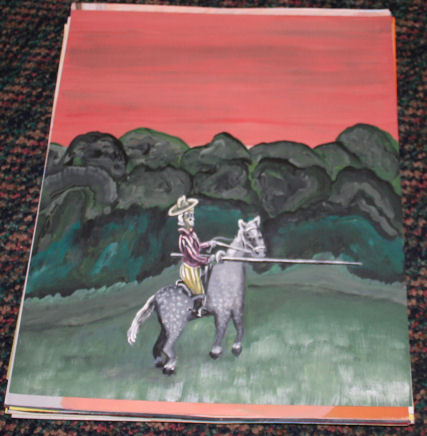
I went back into the tool shed, found a sledge hammer, took the can of blue spray paint outside, threw it onto the sand on the beach, and in my bathing suit hit it with the sledge hammer. It exploded with a somewhat satisfying boom! Leaving me covered head to foot, teeth and hair, feet, legs, bathing suit, chest, face with blue paint.
It�s an hilarious, if alarming story, one I�ve told many times throughout my life. I probably had told the story a thousand times, when twenty five years later, at the age of thirty seven, a friend upon hearing my story asked me, "How did you ever get all that paint off?"
And then I remembered, and realized, what I did after that utterly stupid act was even more stupid. I remembered then as if it was just the day before.
Two of my friends, Steve and Chris Chudik had heard the boom! They came running down the beach laughing in some real sympathy for my sorry predicament. Realizing I needed to get cleaned off some how, we then went together back into the tool shed and found a chair and five gallon can of gasoline, which we proceeded to take outside, and while Chris and Steve stood on the chair, they poured five gallons of gasoline, it was heavy, over me in a shower so I could clean off the paint.
68
My second story I read in a newspaper account some twenty-five years ago. Somewhere in Texas two junior high schools came together for a field day where they had made arrangements for a massive tug-o-war, one school against the other. Each school had some fifteen hundred students. The school organizers of this event found some ten-ton strength, Navy-issued, finely woven, nylon rope for the purpose.
Now, of all the well-certified smart people that were there on the day of the event, junior high school teachers, principles, guidance counselors, and, coaches, apparently not one of them foresaw that there might be a problem with this scheme. And, if anyone, or any of the no doubt very smart junior high school students did think there might be a problem, they were apparently too shy to speak a word against the tug-o-war idea. Who knows? Perhaps some did speak against it, but failed to sound a convincing alarm bell.
With fifteen hundred students pulling as hard as they could on each end of the rope it immediately exceeded by a factor of ten or twenty the strength for which it was designed. Nylon rope stretches. When it let go, several dozen of the students closest to the center of the rope, the ones immediately facing each other, were severely maimed, one even loosing a leg, others arms and many lost hands when the ten-ton rope snapped and whipped violently upon the unsuspecting students.
The world is full of dangers, most often human-made dangers unexpected by most. All that was needed that day in Texas was for one person using their brain to say, wait a minute, think what we�re doing here, and, the calamity could have been avoided. Perhaps someone instead said, "No one asked you for your opinion."
Aristotle makes assertion as to the intelligence of humans because they do not walk over a precipice or into a well on their way to Megara. The same intelligence can be better attributed to a goat, as goats are less likely to fall from a precipice or into a well. And, while goats may not spout logic and do butt their heads, they do not logically go to war and kill their own kind by the tens of thousands, even millions, nor, do they develop technologies that can wipe their species entirely from the planet.
Aristotle, and, all the subsequent empiricists from the Enlightement forward, have found great comfort in creating virtually endless and overlapping categories and formulas for every aspect of human knowledge. While this methodology is the source of the raw scientific power that threatens all human existence, it also upon close inspection is a mishmash of gobbledygook, immoral and destructive.
Yes, the human mind has seemingly infinite power to entertain all such machinations of human intellect, but, while our minds have an infinite ability to play with these toys, there is but a limited amount of time given every individual, and, the earth, the planet we call home has a limited ability to withstand the onslaught of the empirical scientists' residual and now utterly ubiquitous trash.
Knowledge and the life experience is far greater than any mere scientists' inventions can improve upon, for with every so-called scientific advance, we eventually and always find the associative costs too dear to pay.
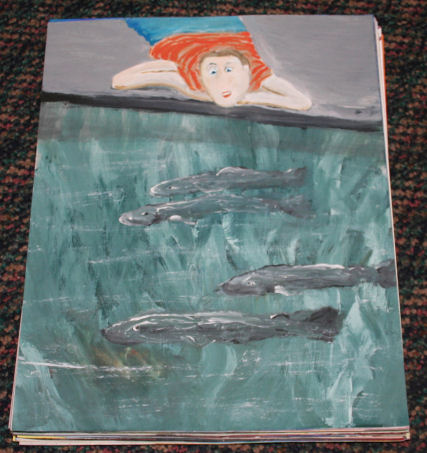
69
We should be reminded here of the Manhatten Project, a time when the world's most able scientists hit their own can of spray paint with a fission sledge hammer, this despite some doubt as to whether their swing might catch the atmosphere of the earth on fire and destroy it. A lucky guess to the satisfaction of the scientists there, somehow, luckily ruled out the possibility. Scientists all over the world continue to pull on their ropes. Our governments, our moral socialist governments fund the purchase of all these many ropes.
Step out of the sunlight that warms my body, Alexander.
In our search for the path toward truth philosophers must always be aware that the most dangerous thing every human being will face during their short lives is human-made danger in this world.
Our sympathy is unbounded, but it would always be better not to have to feel sympathy by avoidance of what causes it, if possible.
One of my sons when young awoke from a nightmare one night in a frightful state, tears streaming down his red cheeks, and crying. Upon consoling him awake, his mother, Janie, found that the nightmare that brought my son to such a crumpled state was the sympathy he felt for the fact that, in his words, "Birds have no hands!"
Philosophers bear no truth, just a path towards it, and they fly too.
70
We have all seen how pleased a child is upon learning to count to ten, or, to recite the alphabet, and still, the path toward truth can meander unexpectedly about even within the learning events of a small child.
The human mind cherishes form and order, but the real world is formless and order-less on closer inspection. Should you ever happen upon a child having just mastered their ABCs, ask the child to recite them. And after they have sung them through, tell them: Oh! That is wonderful! And then further ask: Do you want to learn the silly alphabet now? They will roar with laughter and approval as you disorder the alphabet to the same melody, Q_X_P_Y_R_L_J, N_Z_F_M_C_W_A!
From this experience, you too might recognize some truth in the formless and order-less world. A child learns through their precocious senses that feed directly into their pure minds almost devoid of order, minds very capable of learning order where none really exists except as we create it.
71
The philosopher who is also a teacher knows that learning by rote, or a routine or mechanical course meant to reinforce ideas about universal forms as truth, is not as productive as otherwise because it does not reflect the real world every student intuitively knows exists outside the classroom, and sometimes, inside the classroom too. Students taught by rote examination are often either dullards or rebellious clowns.
We can readily discover many failures and their common patterns related to organized learning and even education, if we merely take a look at older textbooks. These aged textbooks when read in a fresh light are quite often re-seen as amazing chronicles of ignorance, bigotry and bias. Tracing the systemic failures inherent in older and ancient texts as well as their educational effect upon history as it unfolded is a more noble philosophic course than reading anything written today by which we are all too likely to be led into a similar trap.
Knowledge is a patchwork of ideas cast upon a temporal society and written or spoken by mortal humans during their ever so brief lives. That patchwork of knowledge and meaning is like a jigsaw puzzle, but not all the pieces are there, and most of them don�t fit together as we would expect them to in any event.
It is left to you as a philosopher to weave a fabric of truth out of this imperfect knowledge. Philosophers use doubt as their loom shuttle. Doubt alone can point towards a path toward truth.
Baruch Spinoza (1634-1677) philosophically held that humans are ineffectual in changing their circumstances or the circumstances of the world. He held that human beings are prisoners held in bondage to their surroundings. Whether or not this meager life Spinoza offers us is truth, the very least we can do in our lives is to clean up the trash strewn in Spinoza's prison.
Philosophers today know life is a series of mostly, unintelligibly marked, multiple-choice doors through which we choose to pass. Upon passing through any one of our independently chosen doors, it is usually more difficult to leave and return back through the same door, if the door into which we just entered has not disappeared altogether. So it is that we go through life.
72
It is a common courtesy of all moral humans to warn others about the dangers that exist on the other side of doors that present themselves to us.
Addiction is one of the dangers behind some of the doors that stand before us.
Contrary to the precepts and practice of law, dying is neither important or half as serious as addiction. It is how we live our lives that is important. This is why leading another into drug addiction is worse than murdering him.
Riding in a car without a seatbelt is another danger lurking behind that door. A thirty-mile per hour collision will result in the same force against your face when it hits the windshield as you would feel if you dove face first off a thirty-foot high building.
Financial security comes not from how much money someone makes, but instead from how much money one spends. This is a difficult lesson for some to learn, but it is the only cure.
There are always choices to be made. Those choices are presented to individuals and to society as a whole. An example of a choice presented to society is the use of land mines, biological warfare, and, the atomic bomb. These are generally not difficult choices.
Another example of a more difficult choice for society to face is the use of antibiotics. Self-preservation and love of our selves infers approval of the use of antibiotics.
Super-bugs, or antibiotic-resistant bacteria, that arise from the use of antibiotics however, seems also to infer a secondary choice relating to self-preservation, but here, it is preservation of the whole of humanity from harm that must be considered.
The science of medicine has invented and endorsed blood transfusions. Blood transfusions have transformed all human beings' blood into a community pond where disease is now passed via blood transfusions in addition to the way it normally is transmitted. Humans existed without blood transfusion technology, and here, due to increased transmittance of disease, we might imperil that existence. The science of medicine is both appealing and very dangerous.
When I was in grade school I classed with a child affected in her mother's womb by the drug Thalidomide. I loved her deeply as a compassionate child would, and that love has always remained with me. She had a wonderful mind and disposition despite her deformed body. I have hated drug companies ever since, for what they did to my Wendy, and, for what they have continued ever since to do to others.
I also view all doctors as akin to barbers with very quick and dangerous shears for the same reason. I have collected throughout my lifetime too many stories of medical malpractice. If there is a medical philosophy, such as, do no harm, the medical industry has lost its way. I must apologize to every barber here, for the horrid slander I have just made in comparing their vocation to that of doctors. Hair grows back.
Am I like the King of Siam? Or, do I fear our real "tiger"?
There are many such choices in life, choices for ourselves, and, choices for ourselves living in a society upon a small planet. Only philosophical reason applied by free will, can fully address these choices.
73
Long ago, thousands of years ago, philosophers discovered that everything human beings can know comes to us through our senses.
Our senses are touch, smell, taste, hearing and sight, and, what some seem to think is a sixth sense some have when they claim they are able to tell something is rotten in Denmark when they are no where near enough to Denmark to possibly be able to smell anything there.
When philosophers originally thought about how everything we can know is passed to us, and thus filtered through our senses, they were astonished because they suddenly realized how easy it is to be fooled into believing the world is something it isn�t.
When philosophers thought more about this, they realized just how important the human brain is in making something useful of all the unprocessed sensory data it receives.
There is an important philosophic tenet put forth by William of Occam called Occam�s Razor. Occam�s Razor can be summarized; usually the simplest explanation is the best explanation. Our brains have hardwired into them a sense of Occam's Razor, especially as it relates by processing sensory data.
While Occam�s Razor is a worthy philosophical guidepost, it does not follow logically that the simplest explanation is always the best explanation. Instead Occam�s Razor inspires a philosopher to question, Do we have knowledge of all things that can complicate this problem?
Occam's Razor is useful, but it can lead to a wrong conclusion.
74
The human propensity to find duality in the world and all things in it is also a good general tool, but just as with Occam's Razor demanding or over-emphasizing duality can lead to deception. There are singularities, triads and more too. And we must remember, to a philosopher nothing is exactly the opposite of anything else, any more than anything can be exactly the same as something else. The real world is too complex for such uniform symmetry.
Our minds trick us into seeing symmetry in a tree, where, upon close inspection there is none. All symmetry is an illusion, an illusion that shows us how thoroughly the sensory data our minds receive, changed from reality by entering the mind, how it is transformed into universal forms and ideas that are false, even if it may generally correlate the real world to our perception.
Philosophers were for some time struck by the reality of our inability to enter, sense and know the real world, and, they went through some denial about it as well. We should accept it. Our worrying about it is like worrying about birds not having hands. It is of little consequence for birds.
The philosopher Roger Bacon (1214-1294) found it is a philosophical mistake to argue from the wisdom of our ancestors, from custom, or from common belief. For philosophers arguing without the knowledge of why the wisdom of our ancestors, custom, or common belief hold truth is evil and ignorance. But, for Roger Bacon the greatest evil to be the concealment of ignorance. This statement however, is refutable. I will refute it later.
75
Science is a small, shallow sea on a world made of oceans of great nescience, or lack of knowledge. Science by its design is not absolute truth and, by its practice, it is corrupted beyond any fault of its design. Philosophers see science as a fountain, but they are doubtful and cautious about what flows from science.
Philosophers are given the task in every age of making something like truth flow from the many rivers that repeatedly fill the many much larger oceans of nescience. This is not an easy task when science is in a hurry, which it usually is.
Every philosopher today knows we are all guilty of the concealment-of-truth malady of thought, and that, no scientist sleeps well when he has concealed the truth. And worse yet, Abraham Lincoln, something of a minor presidential philosopher, noted that it is possible to fool most of the people some of the time. These are the times when philosophers try men�s souls most beneficially, and when freedom is most desirable, to question false authority when some know, and, so many who think they know are only yet to be proven wrong.
I am reminded here of the short humorous story by O. Henry, the pen name of William Sydney Porter, (1862-1910), "The Ransom of Red Chief" to which I will refer all the so-called political philosophers who often debase philosophy into lying matches concerning the best form of government. O. Henry's short fictional story relates the kidnapping of a young man. The kidnappers upon holding him hostage while seeking a ransom for the red-headed child found that Red Chief, as the young man referred to himself, was much more trouble than he was worth.
Such are the strongest beliefs held about truth most of the time, and especially about the long and too often heralded history of so-called political philosophy.
Charles Maurice de Talleyrand (1754-1838) once said a diplomat is given a tongue in order to conceal his thoughts. President Lyndon B. Johnson (1908-1973) once said of political men, "The most important thing a man is saying when he's talking is what he's trying hardest not to say." That is what is political philosophy, naked and hideous, as most know it to be. Real philosophy is as beautiful as a child�s face or the newly risen sun. Real philosophy is not wheedling. Real philosophy does not waste its time with graft, deceit, treachery or war, all of which are the mainstays of so-called political philosophy.
LBJ also is quoted as having once said as he berated a man, "You couldn't pour piss out of a boot, if the instructions were printed on the heel." I don't know what this quote has to do with philosophy, other than it hints none too subtly at a path towards truth about the ignorance of some, and, even most of us.
Concurrently in our Age of Fear (9.11.01 - ?), Rumsfeldian anti-terrorist political science has cultivated such deceit as posited in such anti-philosophy as, "There are known unknowns, and, there are unknown unknowns." It was also later revealed by others, there are also known knowns, and, unknown knowns. The concealment of truth is all too often one of the greatest of evils.
76
Whether a "political philosopher" prefers democracy, monarchy, plutocracy, oligarchy, a dictatorship or a republic, a dictatorship of the proletariat or an all men (and later on even the slaves and the women) are created equal democracy, or, any other form of government for that matter, none of it will change human nature. It is doubtful anyone throughout history has ever changed the world by political means such as revolution, winning an election, or a war because what is at the base of social structure is human nature, which is almost completely, if not completely, impossible to change. Even freedom is meaningless, if we destroy the world enjoying or protecting our so-called freedoms.
Neither the Magna Carta, the Declaration of Independence nor the Emancipation Proclamation have been worth more than the paper they were written upon as they have affected the very human nature these documents have since been alleged to have been intended to address. The documents are not guilty as such. They simply were never intended to address what civicians attribute as their cause and meaning.
History as written is less a fraud than it is unwarranted hindsightful pride, for civilization simply has not advanced one iota. Slavery is now more prevalent and in many more and more oppressive forms, and, the state has now the capacity and the apparent willingness to end all our lives by any number of blindsighting means.
All these different forms of government all have in common the same malady, which has entirely to do with human nature. Changing human nature is much more difficult than changing the form of government. Wars of conquest or liberation? I fail to see with all the trouble in the world, trouble far worse than Red Chief, why anyone would want to or attempt to conquer or bring what is too often referred to as, freedom, to another land. It�s an all too common hoax.
Political philosophy is all but a mean hoax. And that which is termed, "judicial philosophy", the enforcement end of so-called political philosophy, should be likened to the philosophy of an executioner, a gravedigger or perhaps the philosophy of someone working behind the desk at the department of motor vehicles. "Next, please."
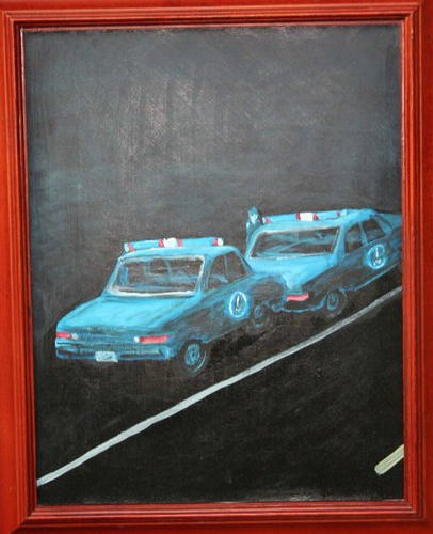
The very idea of a "judicial philosophy" should conjure up images of dungeons, black-hooded executioners, Hugo's Les Miserables, the Dred Scott affair, and similar atrocities. Humankind's interaction with what is termed jurisprudence, which is defined in the vernacular as the philosophy or science of law, perfectly exemplifies my point here. This thing called the "law" as it is referred, however, is purported to be an empirical application and extrapolation of codified statutes enacted by government.
Anyone who has any historical sense of the law and government, knows there is something amiss in this definition, especially as "philosophy" might be maligned by a far more than false claim to legitimacy and truth.
The Greek historian Herodotus, (484-432 b.c.), reports the Babylonian King, Cambyses, (530-522 b.c.) discouraged corrupt judges by having one such jurist flayed alive, his hide tanned, made into the seat cover for the official's vacant bench, and then appointmed his son as his successor, where upon he was made to sit upon it.
This man Cambyses lacked sufficient imagination. Judges ever since, even to the present still condemn innocent humans to far worse punishment. Those innocent humans are you and me, and everyone else that walks under the blue sky.
It's an impossible job, being a judge, the practicioners of which, due to the inhuman stresses intrinsic to the task, are ever so prone to the insanity of megalomania. The command, Judge not. should be taken entirely literally.
77
Some noble philosophers seek to change the world through conquests of the mind, but then only by their efforts to shine a light on some part of human nature that has been fast asleep in the simian tree nest of our intellectual selves. Come on people! We know better than to listen seriously to hucksters and hooligans, and, political philosophy!
Now, who else should we discredit today?
The so-called political philosopher has among their many wares a wide variety of imminent threats that wrongly lead to conclusions about the likelihood of finding a dead cat in not one, but every tree. They are even known to kill a few kitties so they may be used to fulfill their mad prophesies of doom.
Within their deceitful ethic is the justification for every and any war. Every political philosopher succumbs to this seduction, and they would have us all march off to be gased in the trench warfare of their self-deception. Dead cats in trees! It is absurd when we know the reality of war, so many dead war heroes, as they are called by politicians and journalists who are seeking favors from politicians.
These wounded war veterans we see paraded before the TV screen by the media and our government, all whom seem to say they'd go back and fight with their comrades, footless, legless, armless, their very skulls blown in half, half their guts removed, torn out by munitions and the field hospitals of war, they say they'd fight again, if given that chance, in a war, a uniformily noble cause, that ravaged their being, and, caused their personal sacrifice, but what would you expect? They're patriotic. Is this the answer though, when there are as many similarly wounded war veterans from the opposing side in these wars already re-enlisting and continuing the fighting? All the while the conflict provides ever more willingly wounded souls.
By the daft reasoning intrinsic to political philosophy, we should all end up dead war heroes.
Step out of the sun light that warms my cold body, Alexander.
You're scaring that cat by standing under his tree wherein he finds safety from all threats.
If this is treason, these words, then bring me Socrates' hemlock. I'll do my moral duty, a falcon for my head , crimson flames tied through my ears and a snake in each fist as well. I walk slower in winter every year I age. I fear slipping on the ice and falling, but, nothing, nothing hurts as much as when you hit the ground, but death, death, death is not like that at all, so I lay siege to their towers of pure, pure, pure hideous deceit.
Change the locks. There's nothing else left to do.
78
There is a marvelous story, a Chinese fable concerning Wang Fo, a great painter of his age, imprisoned by the emperor. Wang Fo is able to paint such a fantastic painting, he is able to step into it and walk through the scenery until he finally disappears with his freedom.
Here, in this fable, we have found a description of each of our worlds, into which at death we shall step into and disappear.
If our lives are beautiful, and something by which others will remember us by, the paintings their worlds represent will contain a part of your painted world, the one into which you will eventually disappear. There, if you wish, is meaning in life, its purpose, and its wonder.
The truth is elusive, even if humorous at many levels. Truth is just as complex as it is elusive. Because knowledge has been accumulated in a uniformily haphazard manner, whether empirically as scientists do it now, philosophically, as it is best done, or, otherwise, it still must be acknowledged that there are many layers of truth, none of which anyone has been universally successful in piecing together into anything resembling a comprehensive and cohesive whole, a system, or, an all-encompassing science, though this seems what some philosophers are trying to say they�re all about in their surely doomed efforts wrought with mistake after mistaken method.
And this is all really something of a good thing, both that philosophers try and that they fail, because should such philosophical wizards ever convince us that they have succeeded in giving us the whole truth, the rest of our disparate knowledge would be too quickly forgotten. We forget enough good knowledge in every succeeding generation already without the belief that we�ve finally knocked down the whole shebang.
79
Too many books on philosophy neglect Mark Twain. I will not, and this looks as good a place as any to insert some of his more famous philosophical statements.
"Barring that natural expression of villainy, which we all have, the man looked honest enough."
"Clothes make the man. Naked people have little or no influence on society."
"Don't part with your illusions. When they are gone you may still exist, but you have ceased to live."
"Education: that which reveals to the wise, and conceals from the stupid, the vast limits of their knowledge."
"Facts are stubborn things, but statistics are more pliable."
"I am opposed to millionaires, but it would be dangerous to offer me the position."
"I have never let my schooling interfere with my education."
"I was gratified to be able to answer promptly. I said I don't know."
All the above was given to us by Mark Twain whose real name was Samuel Langhorn Clemens (1835-1910).
And I cannot resist adding a few quotes from the baseball manager and player, Yogi Berra. (1925- )
"It ain't over till it's over."
"No one goes there nowadays, it's too crowded."
"The future ain't what it used to be."
"When you come to a fork in the road, take it."
"You can observe a lot just by watching."
There is so much truth in Yogi Berra, it�s unbearable he hasn�t received the acclaim of more academic philosophers.
80
One of the problems facing philosophy today is that it has claimed the crown of truth, but it is both too narrow by its academic sense and too broad of its acceptance embracing other fields of academic and even mystical study. The jargon of academic philosophy is more than untenably cryptic. It is likely catastrophic for both philosophy and mankind.
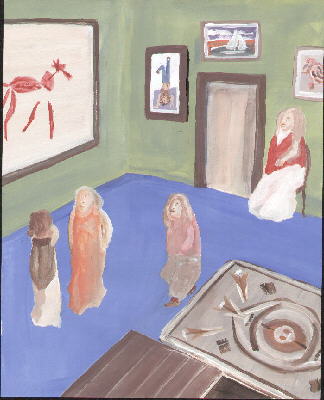
Academic philosophy generally holds a synthetic proposition is significant only if it is empirically verifiable. Aside from the horrid mystification of and intrinsic to the jargon, this statement is utter nonsense. It is twofold meaningless because all empirical statements are synthetic propositions. And, yes, empirical statements are verifiable, but, despite the thread-like correlative utility they all have in common, they are also verifiably wrong, each being easily cut through to their heart by the application and requirement of infinite adjustments.
Such academics have retreated deep into their sterile caves where no sunlight shines at all. Come out fools. There is sunlight and warmth out here, life. I write here for you, for all. Let all those Alexanders, these, the most able liars of scientific theory, let them find us, here, in the sun that warms every body and gives life to all. We conquer by giving life, not by taking it. We take no prisoners, and yet, all surrender to the path that leads toward absolute truth.
Philosophy needn�t be academic at all. And, in fact it is best when it isn�t academic.
In our empirical culture, the very idea we mean when we say, "That doesn't make sense," is that something expressed does not add up empirically. Hold on to your hats kids, because, nothing, absolutely nothing adds up empirically. This was the point of my long discussion earlier about mathematics and physics. Empiricism though useful, is also a sure fraud. And, worse yet, like black magic empiricism delivers enough harm so that it should be considered more dangerous than truthful.
Human beings simply do not and cannot live empirically, or, exist empirically. And, niether can human beings depend upon empiricism to maintain life upon this planet for all those who will follow us in the future. Without philosophy, empiricism will likely destroy the future for human beings, creating a misplaced future where no human beings can possibly exist. This will be the end result of empirical thought, the empirical knowledge set, a vision that is increasingly more clear with every passing decade.
On the other hand, every form of artistic expression today now attempts to portray philosophic truth, and, some of it does a pretty good job if it. None of it however, is empirical, and we should be thankful for the departure.
In terms of popular culture's attempts to portray truth, I think of "Catch 22", a tale of the insanity of the Second World War, "Ice Nine" Kurt Vonnegut�s tale of an ultimate manmade ecological disaster, "The Shining" a movie tale about the insanity of isolation and "The Blue Brothers", a movie tale of two musicians� Quixotic battle to re-live a past that never really was.
81
Ancient astronomers gave hypothesis to the question, what holds the stars up? Wrapped up in this historical phenomenon is the answer to the question, what is the meaning of life?
My hypothesis about the meaning of life may be no more successful than the ancients� query concerning what holds the stars up. They then posited that the stars were fixed upon a celestial sphere. The ancients were very close to answering their question.
I should perhaps interrupt myself, and interject here that cosmology, the study of the Universe, has several tenets that have deep philosophical importance. This is an unfortunate reality, unfortunate because in a comparative analysis the discussions given the origin of the cosmos between religion and science is like hearing one man describe a dog as just a very large eight-legged rat, and hearing another man describe the same dog as being much more like a small two-legged horse. Academic philosophy seems more intent upon insisting meanwhile, that a race horse is just a very large rat.
The first realistic view concerning the cosmos I will mention is the idea that if some potential theory important to our understanding of the Universe seems to indicate, if it were true, the Universe would not appear to us today as it does, because the implications of this idea dictate that over time the Universe would be necessarily changed in a way that does not accord with what we see, then a supposition is due, such theory is a wrong-headed idea. This is the major assertion of the steady-state universe.
Acceptance of steady-state universe implies, as human beings our lives, and even our recorded human histories, are far too short, and our ability to both see and understand are far too limited to detect any appreciable wholesale change in the Universe. Albert Einstein was a steady-state theorist.
82
Einstein is also famous for saying, "God does not play dice with the Universe." Here, his philosophical assertion is not that we can or do understand, but that it must be possible to understand. His assertions here are in direct contradiction to the nature of the Universe as it is asserted to exist by Quantum Mechanics, which generally asserts the universe is a place where some things happen for no logical reason.
The history of the discovery of the Universe, the expanse of it, indicates, if this history is to provide a lesson, twenty years hence the known universe will be a trillion-trillion times larger than it is today. Furthermore, if we examine the history of justification for a universe smaller than it has later been found to be, those arguments made today seem similarly spurious.
Furthermore, while it is quite conclusive that humans can learn from history, they usually learn from history in a retrospective analysis concerning what could have been thus learned, if we had just bothered to consider the obvious lessons at hand.
Furthermore, in terms of predictions, I have yet to see conclusive evidence humans can predict better either what will or will not happen in the future, though there seems to be some very small correlation relating to how far off into the future we humans attempt to reach. Humans are best at predicting what has just happened, even to the extent these predictive capabilities about what has just happened decline the further in the past the event moves from our perception.
The long history of empirical science is clearly on the side of Einstein here, his steady state universe, even though the current roster of observational data is clearly on the side of Quantum Mechanics. We must remember the tenet given us by Twain though, "Facts are stubborn things, but statistics [and obserational data] are more pliable."
How presumptuous it seems that cosmologists posit that they can now see the both the beginning and foretell the end of the Universe. It is amazing arrogance, such is science and humans. Such as history has shown us, it has always been.
What is interesting about the conundrum relating to the schism between Relativity Theory and Quantum Mechanics is noted by Newton who stated he stood on the shoulders of great men, when in fact he stood on the shoulders of all men who doubted the existent scientific explanations of the universe. Yes, our understanding of the cosmos advances, but not without repeated retreats from battle lines that often turn out to be absurdly drawn on once thought fertile ground that cannot exist.
This doubt is not science. It is philosophy. Philosophy redraws battle lines. Science defends them, sometimes absurdly.
The empiricists ultimate con of pre-eminence, that by eminent domain our destiny is in the stars, will seem ever more distant, more remote, and ultimately even much more impossibly futuristic than it seems today as the scale of the Universe is better discovered and settles deeper into human consciousnesses. The squirrel-caged jogging astronaut they portend our species to be is a fraud. Our own planet is far more in danger of being destroyed by science, than any planet in our solar system is likely to be inhabited by human beings.
Empiricism has exposed the sea bed of scientific knowledge for miles and miles away from the shore of our humanity, but the sure tsunami that is coming likely will drown all who have run down to examine the sea floor's bottom in their ignorant exuberance about the scientific oddities they currently experience. What is amazing, truly amazing, is there is so little sense of the danger.
These empiricists encourage us all to join them, these empiricists, their black magic and their bleedings, their mercurial cures, their psychotropic fixes for male children, their Thalidomide, their beta blockers, their genetically engineered time bombs, their wars, and their sure belief in the ultimate goodness of even democracy. All of it is empiricism at work, incorrigibly encouraging a eugenics of other ideas and ways of knowing, and ultimately of other ways of living. It is all but suicide, infanticide, homicide, etc.
The history of human folly and gullibility is immense, but philosophy, and philosophy alone doubts consistently enough to be ready to point a path toward truth. Philosophers are not tethered to empiricism, like the he-goat awaiting the humans' foolish sieve. These are the sieves of science, not philosophy. The processes of trial and error do indeed have an ultimate limitation. And, you can indeed observe a lot just by watching.
These words may appear to some less inspired readers as pessimistic, and cynic, even radical. No. I am ecstatic, for humans are about to have the great burden of empiricism lifted. Empiricisms are what oppresses humankind. Empiricism denies humankind its rightful place when it dominates humanity.
Many want to predict what humanity needs to cure its sure and dangerously mortal ailments intrinsic to the empirical ethic of progress. This is the wrong question. The right question is, not what is needed, but what is not needed.
Philosophy answers this question pointing to a path towards truth, just as philosophy will inspire future philosophers to posit more and more concerning what is not needed. In many ways, determining what is not needed is the essense behind the idea of the moral imperative.
There is much in this world empirical humans have created, and most of it, if not all of it, is simply not needed. If humankind is to survive for future generations, empiricism for the sake of empiricism alone will be a broken clay pot in some far off archeological dig.
83
Isaac Newton gave us a better answer to what holds the stars up in a round about way when he put forth the idea of gravity, and thus he indirectly inferred the universal form intrinsic to the notion of "up" was faulty. There is no such thing as "up" in space, and as "up" exists here on this planet, it too is but a false universal idea, like right and left.
As comparatively massive as stars are, it is truly notable humans once believed they regularly "fell" to earth as shooting stars. Our current understanding is surely, because of its much greater extent and complexity, to have mistakes that exceed in amazingness the shooting star hypothesis. The history of the study and discovery of cosmology is full of spectacular mistakes, and we have no reason to believe it will redeem mankinds' cognitive or predictive reputation any time too soon.
Human knowledge is ever so much like all those paintings of sailing ships with their flags waving in the wrong direction, entirely contrary to the direction from which the wind must blow them.
If you are enticed into considering the phenomenon of gravity, consider also inertia, for we observe both as the ancient Greeks observed matter. We have guessed once or twice, but mostly science inspired by philosophy has left both gravity and inertia alone and as utter mysteries.
Bafflement is the great equalizer is the quest for meaning and knowledge. And, there is well enough bafflement to go around. Philosophy, because it demands no truth be uttered withstands bafflement, whereas, all empirical knowledge sets must lie through the ubiquitousness of it.
The meaning of life is the same thing, and can be illuminated best by the understanding that there is no such thing as life except for us as it exists here on earth.
That�s not to say there isn�t life elsewhere in the Universe. It is to say however, that today, in our quest to fathom the meaning of life, life is a false form among many false forms our minds create to deal with such questions. Philosophers are not baffled here. They are immersed entirely in it, knowing that is the meaning of life, expressed without definitive words, univeral forms and ideas or any misunderstanding about it.
84
Life exists here on earth for us. It is the search itself, the search for the meaning of life that is the answer to the question we pose when we ask, what is the meaning of life?
Life for everyone is temporal. It lasts only so long. However, as long as there is any meaning to life here on earth, others will continue to ask the same question, What is the meaning of life? Thus the meaning of life is given to us all. It is this quest for the meaning of life, and it is glorious.
Life is about birth, childhood, love, children, old age and death. And with these small wonders comes great import and complexity. Life in this view is ever so precious and full. Why would anyone think empirical knowledge sets enchantingly deployed could clutter it, our lives, beyond the recognition of life's most moral imperative? No. We have a moral obligation to all those who would follow us into this world. It's not that they are the future, though they certainly are, it is that we are soon enough going to be the remembered as their past. In our fondest ambitions, how might we want to be remembered?
Why do we seek such an answer all our lives? It is entertainment, educational entertainment. The quest for the meaning of life enriches our lives and makes us better able to survive the real world's perils. The purest pursuit of knowledge is the pursuit of the joy of the experience of life, the continuance of it, and, better and more comprehensive humor derived from our understanding what little we can understand of life's experiences.
There is relevant philosophic comment coast to coast and pole to pole, and all of it is no less disparate, nor is it less relevant than what the academics cull from or keep of their own empirical spew of the stew of human meaning and knowledge. Academics in their rush to eugenically alter human meaning and knowledge along empirical lines are not only missing the bigger boat, they are missing the boat. No one can begin to seek to aquire a path toward absolute knowledge without considering, while the target may never move, those shooting at it are on a light-speed roller coaster ride with absolutely no chance to hit the center of the bull's eye. We're lucky enough to hit the target, even the broad side of the barn upon which the target is hung.
As always the meaning and knowledge we have available to us today is temporal, meaning it is specific to our own time. Philosophers should, like writers and painters, work with what they know, because they know it, and because, soon enough no one else will be able to remember it, or know it as they knew it. If today's philosophers don�t write it down now, it may be lost forever.
In the future the written words of philosophers will be just as important as it is today, to know when, how and why human meaning and knowledge changed. The history of meaning and knowledge reveals more about the path toward truth than does any temporal snapshot of it. All current knowledge not seen in this light is but a fantastic illusion. If you don't believe that, you haven't read nearly enough well-dated books. The information we write down today will only be available for historic readers if and only if we write down what we know today for later consideration and analysis.
85
Here�s an example of the sort of changing knowledge I mean:
If one takes a bottle, and screws on the cover tight, they will find that it floats in water. If you remove the cover to the bottle, and place it back into the water so that the water fills the inside, it will sink in water.
From this one might assume the air in the bottle is what makes the bottle float. This is partially true, but only partially. If you suck some of the air out of the bottle and place the cover back upon it, so that you have evacuated as much of the air as you can, leaving a partial vacuum behind, you will find that the bottle floats at an even higher level than it did with all the air inside it.
What this demonstrates is some conceptual validity to the idea of space. In fact the empty space inside the bottle makes it float, for the sum total of the weight of the bottle and the weight of the air, is more than the weight of the bottle without the air in it. Thus it floats higher in the water with some of the air evacuated.
Oh course, it�s almost impossible to suck all the air out of a bottle with your mouth, and if the bottle is filled entirely with water, it is impossible to suck any of the water out of the bottle. This is true because at room temperature air is elastic in space, and water is not elastic in space, which requires you to suck a nearly perfect vacuum to remove any water from the bottle.
With a device called a vacuum pump we can suck most of the air, or water, out of a bottle. It will float still higher, indicating there is still space inside the bottle after the air has been removed.
No one has yet devised a way to suck the space out of a bottle so that it might sink in water. This says something about the viscosity of air, water, and space, about which the latter, space, apparently is so solid we have yet to find a way to remove it from a bottle.
Now, while it may seem strange to refer to space as a "solid", I know you know, what I am saying here despite an in-ample lexicon, a compilation of words, to express myself.
However, when there are such words invented, no one will then know what I am talking about, since they will wonder, why did I not just use those words?
And with another "now", I propose for those here who read this, and scoff at the prospect of removing the space from inside a bottle, relativity theory says in theory, this is entirely possible, even if it is still questionable whether the bottle would sink with the space evacuated from inside of it.
86
In a round about way we thus dispense with half of Kant's a priori base for transcendentalism, space. The other half of his base, time, similarly under tough scrutiny melts away like the heart of a young man first smitten with love. Always doubt.
For a real philosopher it is but an academic exercise to dispell Kant's proposed philosophic science, and, to proclaim it all an errant transcendental syllogism, and nothing more than a mere philosophic phrenology.
87
Our previous exercise raises an interesting question for philosophers and scientists as well, one we as philosophers need not address, but merely pose.
If the space in a bottle is sucked out by some miraculous relativity pump, is there an inductive prediction possible concerning what will happen? Will the bottle sink in water? Or, will it due to the ultimate vacuum created within, this absence of space in the bottle, will it cause the bottle to fly up and away from earth because of the ultimate pressure of space around it? And, what would happen if we were to suddenly open the bottle and let the ultimate pressure of space rush back in to fill the space-void we created? Would the thunder-like clap destroy the world? Would the resulting implosion flatten every mountain and make our world as smooth and flat as a pingpong ball? Of these answers, we cannot know. We can only guess, but surely scientists, these empiricists reading here are already ready to try to fill the vacuous void of their knowledge, despite all the possible dangers of it.
These new concepts that lack evidence enough to permit induction of thought and reason, might give rise to a new science, if human beings can survive the initial experiments.
Both science and philosophy are dangerous, which is why philosophers at least must go to great lengths warning about dangers inherent to the pursuit of scientific knowledge.
88
The hint of a path towards absolute truth this exercise provides us is predictive. Every attempt to reduce philosophy to a science, will always yield a he-goat, a sieve and a fooled fool.
The first example just previously given, that of removing the air from the bottle allows us to infer the truth about space that is somewhat better than any truth in mathematics. Space, as a word hinting at something we are trying to describe in a word, is real, and a real description of space may be definitively observed by the aforementioned empirical observation, and then, tenuously inferred to be a real phenomenon. But mathematics... Remember? Numbers are mere universal forms that represent ideas. They are not real. Space is a real thing we are hinting at with the word. But do we really perceive it? Yes, and no. We certainly cannot describe it with mathemetics, nor for that matter, with any empirical science. We can only lie about it.
We can infer space in any number of ways, but it is removed from our direct experience by the filter of our senses and our minds� ability only to use universal forms and ideas to the decipher reality from sensory data.
The second instance of trying to suck water out of a full bottle, may not be as good as the first, because we are trying to infer something from what we cannot do, but it still lets us infer something about the nature of water and the strength it takes to create a perfect vacuum.
Now let�s get to my point. Each of the two previous instances is empirical science as it was practiced in the Seventeenth Century. The first two instances can hardly be considered empirical in the way science is practiced today. Science today relies so heavily upon the use of universal forms, many of them newly created, and mathematics, much of it newly invented, that science has changed from its original empirical form into a form that would be mostly unrecognizable to most Seventeenth Century empirical scientists.
There then, seems to be a different meaning to the common idea of empirical science today than there was when it was first conscientiously practiced. Most scientists today would say it is much better. But no one should doubt there hasn�t been just a single change to empirical science during that time span. There have been almost an infinite number of changes to what is thought of as empirical science since it was first practiced.
89
Now, for the individual empirical scientist, those men and women who are responsible for breakthroughs and scientific genius, the sort of revelations scientists know come from dreams or flashes of insight, these scientists lament they cannot converse with any number of scientific geniuses from days gone past.
Today�s empirical scientists intuitively know that yesterday�s empirical scientists had intuitive knowledge and understandings of science that were quite different and distinct from their own scientific understanding and consequent intuitive abilities.
These changes in intuitive abilities and variable scientific knowledge-sets happen because both meaning and knowledge change with every passing day. In some ways, our ideas are better. In other ways it is easy to see, our ideas, our thought processes, our intuition and our scientific knowledge is inferior to those of scientists who long ago had the benefits of the meaning and knowledge available to them, meaning and knowledge that they then gathered during their own lifetimes, and which for the most part is no longer available to us as such, and couldn�t be gathered and comprehended as they found it again anyway.
This is just one manifestation of how complex meaning and knowledge is. Here is another example, one that may shake your confidence:
Take a hand held mirror and go outside. Look into the mirror. Notice how your image in the mirror is so-to-speak a mirror image. Your left appears to be your right, and, your right appears to be your left. This is a mirror image, and we all have become accustomed to seeing it, and, adjusting our minds to deal with it. But the idea of a left and a right are really just two linked universal forms. Neither is real. It is just what your minds say about how you should perceive what you are looking at in a mirror. As you are looking into the mirror, notice the background behind you. It has no left and or right, despite the fact that its image too is reversed. The universal forms in your mind seem then to apply themselves to some objects in view, but not to others. Are you with me thus far?
Okay, now, as you are still looking in the mirror, tip your head down onto your shoulder, in other words, tip it 90 degrees. Keep it there. The left side of your face still looks like the right side of your face in the reflection, right? Your left hand by your side, if you wiggle it, it too still looks to be your right hand in the reflected image, right? And even the background behind you, while your mind doesn�t allow you to perceive it as left or right, it too has flipped in the image you are viewing in the mirror, right? But, though you have tipped your head 90 degrees and everything has pleasantly flipped as in a mirror image, why hasn�t the sky become the ground, and the ground, why hasn�t it become the sky?
Don�t worry about this exercise. All is well. What we are witnessing in this optical exercise is the frustration of knowledge. In fact the sky is now at the opposite hand in the reflection. We have stumbled upon the laxity of our minds to perceive the workings of a simple reflection, and we are forced to consider, all our sensory input is cast upon our minds as a reflection. So what can we know? All of our universal forms and ideas are reflections. Well, we shall see what we can know. But the exercise does exemplify exactly how our minds� creation of universal forms distorts our perceiving, if not seeing, the world around us. The bigger question here is, do we all perceive the same universal forms, and do we all have our ability to perceive equally affected? The answer is, no to both questions.
90
Years ago when I was in college I also worked in the construction industry. A huge compliment was often paid to older carpenters by younger carpenters when we used to say of them, If I only knew half what that man has forgotten. There is real truth in that statement, and it is applicable to every generation in every epoch. Experienced, older carpenters had an uncanny ability to see many things younger men would never notice.
The truth is more likely, our minds, as complicated as they may be, by comparison to just a small portion of the Universe, our minds again, are infinitely minute and simple. This is why philosophy, the pure philosophy of doubt, is so preeminent over other endeavors we might engage in to develop meaning and knowledge concerning the infinitely larger and more complex Universe. Occam's razor is a necessity and a naturally developed inclination of our minds despite our ability to imagine infinite forms and ideas. We can only surmise noumenon, the original cause of anything which we study. In so doing we mentally slice through the infinite mental chaff our minds create as universal forms and ideas. We can only hope our intuition pares the worst of it, leaving the best of it, as we find it easier for our minds to comprehend when it is simpler. There is little to give us any reassurance here.
As I�m coming to the end of this tome, or trying to, a book on philosophy for young readers, I want to again talk about forms, the forms our minds make of the world around us. Universal forms are not absolutely true knowledge. They are aids that help our minds cope with a very complex real world. Universal forms are also made up by our minds as universal ideas, good, bad, beginning, and end. All universal forms and ideas are false, even if they are helpful in guiding us towards our personal understanding of meaning and knowledge.
While universal forms and ideas make our understanding of the real world easier for our minds to get a hold of truth, they also make our understanding of it all that much more difficult. Every individual�s mental creation of universal forms and ideas by their minds gives to us as philosophers the task of discovering real truth, one somewhat like trying to understand the ocean by the feeling of waves rolling up deep around our thighs and waists as we stand in the water at the shore of real knowledge.
91
To understand the real world, we must stand deep in the water and let the waves roll up and over us. We must also step back high upon a dune and look out to the horizon of the ocean of knowledge before us as well. We must even imagine what the bottom of the ocean of knowledge might look like to gain a good grasp of what the real world of oceans and ideas might be all about in our complex real world.
To those who study the history of philosophy, it seems there is an historical trend that the further we get away from the beginnings of philosophy, the less it is philosophy, and hence we find ancient philosophers so appealing. But even the ancients as admirable as they are, they also had their philosophic shortcomings. Still, there is a different ability to perceive things that accompanies every age, and, we should respect their contribution, at least that about which we have been fortunate enough to learn. Much of early philosophy was lost. We only know of Socrates from what Plato and others wrote of him, and we do not have all of Plato�s writings.
If we work at attaining real truth in our knowledge though, we truly still have the golden age of philosophy ahead of us. That is not to say we cannot benefit from occasionally asking, What might have Socrates thought and asked of this or that?
I know I have written this little philosophy book for the right readers, for if I was the last philosopher on the face of the earth, youthful readers would understand philosophy and carry on with all the important work meant for philosophers based solely upon the idea of doubt, which is an ancient idea.
I�ve written this book to create and motivate to logical battle an army of young philosophers. As I know how brilliant all of you are, my young readers, I now challenge you also to be as wise as you can be. Be philosphers and speak with the authority of the path towards truth that is philosophy. This army likely long after my own death will conquer the world, whether at my insistence or otherwise, making the world better, more efficient, and ultimately sustainable. The hunt is on.
Remember morality. Morality is the desire to leave the world at least as well off, and hopefully much better than when you entered it. This moral task is difficult to achieve, but not impossible.
92
Some assert abortion to be a philosophic question. It cannot be. First, the number one cause of death for pregnant women in the U.S. is murder. Second, the very same people who argue abortion is a philosophic issue relating to morals in society by-in-large also support war. They cannot have it both ways.
The side that disfavors abortion says, the young mother can always put the child up for adoption, or, into a foster home run by the state, but they also say, they strongly support right of the mother under the laws of the state to extract child support from the father until the child reaches the age of majority. Furthermore, the cost of a medically complicated birth can exceed a half-million dollars in the U.S., and we should presume the father to be equally held liable for this impossible debt. Some would go so far as to imprison the father for his commonly shared misdeed, and, have him pay off his debt to society by slave labor wages in prison.
There is no consistency in either side of the arguments. This is not a philosophical question at all, not when summing the arguments we can assert the side that disfavors abortion has sadistic affectations upon the child, the mother, the father and society, and while at the same time the side that favors abortion is murderous and encouraging the common occurrence of the misanthrope of medical malpractice as a solution.
No. It is not philosophy. It is the nefarious meddling of the worst sort, that with interests aside from the tragedy of the issue. These are not good neighbors with the common moral courtesy in mind when they meddle so.
93
The ancient philosophers once toyed with the idea of philosopher kings. Now that most of the kings are gone, banished or beheaded by so many so-called political philosophers, we are now mostly left with the despots of democracy and the usurpers of socialism, all who, due to incorrigible human nature, have despoiled the habitable earth and enslaved men to the addictions intrinsic to temptation and fear. And of dictators? Temporally ubiquitous dictators, were they only beneficent, we could tolerate them too. Philosophy conquers them all.
He who believes and justifies his "rights" because government has bestowed them upon him, really has no rights. He who knows his rights through philosophy is secure in not having to utilize them, and so, merely to have, hold and speak of them as friends is enough.
94
There is great danger on the earth, danger for which moral humans advise others against tempting. Lao Tse (570-490 BC) a Chinese philosopher said of the dangers on the earth, "Though you may hear the cock crow on the other side of the hill, never go there." Even that long ago, the dangers Lao Tse warned against were made by humans.
"Jack and the Bean Stalk" a once popular children�s fable written just prior to 1807 by an unknown British author provides the same warning as Lao Tse, magic beans for a cow, the giant, fee, fi, fo, fum. There is danger in the world.
95
In philosophy there is a fairly well resolved problem that still persists, the mind-body problem. The mind-body problem is simple enough. Consciouness is a general feeling of deja vu, as in, I've always been in this body.
The continuity of consciousness might be better described, even better understood, as a non-deja-vu, in that, it's not that you feel that you've been there before, but, that you feel you've always been there, in this body. It's a mildly euphoric feeling, contentment, familiarity, even the steady and familiar reassuring hum of the awareness of biological existence. Important to our survival, consciousness and the continuity of it, the self-awareness of our being works well to correlate our existence to the real world. It gives us command of our selves and the less familiar surroundings it differentiates for us from us. Short term memory reinforces the sense we are who we are, but we are not awakened every morning with an afterimage of who we were the day before, only the illusion of that sensation, like deja vu.
Concerning this illusion of the conscious continuity of our selves, I should elucidate, we do not wake up the same person we were the day before. We can notice this truth in children, nieces and nephews, if we don't see them for some period of time. It is no different for anyone else.
96
Political philosophers, scholastics, transcendentalists, kids with cans of spray paint and five gallons of gasoline, junior high schools with ten-ton test rope, antibiotics, blood transfusions, abortions to appease social mores, war, and warriors, and the truth wrapped up in untruth that when a human is right, he knows it are all dangers intrinsic to the world. And, most all this philosophy of the unconsciouness and consciousness is difficult to consider real philosophy. It is more nepotism, the political employment of lazy relations, of the ego. Too many have been made to feel secure in their own deceit.
Friedrich Nietzsche (1844-1900) put it well, saying, "Men believe in the truth of that which is plainly and strongly believed." This predicament is so like Occam's Razor, and it too must be treated with similar skepticism. Nietzsche also notes for us, "A common false conclusion is that because someone gives the appearance of truth and honesty to us, he speaks the truth." This is the too well practiced fare served up by deluded psychological philosophers and politicians as well.
Great statesmen lie and feign they think they know you. Politicians, however, live their entire political lives hoping no one will ever come to know them and what they are. If they had real philosophy, a philosophy with a strong moral grounding, they would be known, and happier and better statesmen for it. Psychological philosophers are no different here.
97
That feeling one gets when something seems just right, well... That's just universal forms and ideas resonating in our minds like harmonics. It's the warm fuzzy feeling of parochial belief.
If we can show, and we surely can show, that some humans get the "sure" feeling at the wrong time, we can demonstrate our fallible reason beyond doubt. Just before that rope broke many were no doubt sure those junior high school kids were having the time of their lives. Remember this when you are so sure, for you are always on a more solid footing if you preface that feeling and the expression of it with doubt.
This doubt is infinitely more important to philosophers than any importance we can attribute to the cuddly feeling of self-satisfaction that arises from such sureness. When philosophers speak with their wholly misplaced "sureness", if they are not careful, very careful, they can send nations to war and cause populations to perish. This contravenes the moral imperative, to leave the world at least as good and hopefully better for all those who follow.
98
Philosophers have worried themselves as well as the whole world of humans that we cannot be sure of so much we take for granted, while frittering away the value of philosophy in a myriad of belief systems drawn up over the course of history, each disproved in turn and torn down as each belief led to a succession of catastrophes. It is better to always doubt than to plague humans with more false beliefs and the resultant catastrophes.
99
As I have spent half or more of my life casually pondering the cosmological Universe and applying the history of scientific discovery toward expanding and extending my intuition and imagination to these subtle and personally satisfying pursuits, I have a need to share what it is I have found by my enjoyable efforts. This is neither philosophy nor science, though it may be considered an application of my personal goal of simply trying to understand the Universe we sense through our senses.
Any reader of philosophy who also has caught the cosmological-bug will immediately realize as they read these few paragraphs I am inclined to a steady state universe by temperament. I find it a guiding light for, if cosmologists allow themselves to ignore the steady state precept in cosmology, they too soon end up with a universe of their imagination that cannot be substantiated by observation.
100
I do apply to my cosmological pursuit what I have learned from my other great cerebral joy, philosophy. If philosophy is a successful pursuit and a way to find the path toward truth, then the application of pure philosophy to such matters as cosmology seems natural.
The first thing I will say about cosmology and the history of it is cosmology, like every other intellectual endeavor made by humans, seems to historically suffer from the faults intrinsic to universal forms and ideas.
Some particularly daunting problems I have uncovered in the realm of these universal forms and ideas as they constrict our cosmological intuitive imaginations have to do with the idea of a "beginning" and an "end" as well as what we understand through language when we say we can "cross" a river, or, go "across" an ocean.
In the realm of cosmological theory enough has already been said about "beginning" and "end" so we can leave the topic un-addressed here, though perhaps I should reiterate again the underlying reason for Einstein�s cosmological constant, what he professed was his biggest mistake. It was intuited by Einstein specifically to avoid a beginning or an end to the universe, while far less nimble cosmological thinkers, who would make of Einstein a bigger and better liar of theory than he was, have repeated Einstein�s mistake by resurrecting his theory of a cosmological constant as if forgotten gospel in a manner wholly incongruous with Einstein�s original attempt to balance the universe of his theory and remove the implication of a beginning or an end to the Universe of our observation.
Such is the pedigree science, that scientists would claim as the predecessor of their ideas other men who sought to exclude the very ideas for which they seek to add credibility.
As for "crossing" or "across" the Universe, the universal form and ideas imparted by these words impairs our imagination concerning possible intuitions about the Universe.
When we think of "crossing" a field, we see the other side. We can predict the shortest path required to cross such a field to be a straight line. In our Universe however, the cosmological universe, there are no straight lines. Straight lines are also simply universal forms and ideas that have no bearing in a relativity-laced Universe.
So, we must ask, when we speak of "across" the Universe, have we shuttered out reality by the limit of our universal forms and ideas concerning crossing such a distance as the Universe represents?
Rephrased, we might ask is there an "edge" to the Universe? Our universal forms and ideas about space and time taken into account, by asking how to "cross" the Universe might lead us to false assumptions about the Universe, that it is possible to "cross" the Universe. It is not possible however, not possible in any sense we can comprehend given the tools, the universal forms and ideas of our earth bound understanding.
If we apply the hypothesis of a steady state universe to the idea of "crossing" the Universe, and coming to an "edge" of the Universe, we can immediately see a contradiction. There cannot be an "edge" to the Universe that fits our universal form and ideas concerning getting "across" to an "edge", like an edge of a tabletop. The Universe would simply lack any sense of steady state if there were "edges" to it, "edges" in the conventional sense.
Backtracking to remove the source of our problem we must redefine "edge" to mean something that can be here, there and everywhere in the Universe to retain some compatibility to the precept of the Universe being in wholesale steady state.
101
For cosmologists the steady state provided by ubiquitous edges to the Universe is a very satisfactory answer given what we know about relativity theory, even if to the uninitiated it might be perplexing how the edge of the Universe is everywhere in small pockets and large, at the tip of our fingers and within black holes as well.
And here, from here the question arises, is the Universe seeping in from these many edges, or, is the Universe seeping out through them? It seems by the observational data given to us recently by Saul Perlmutter and his group of astronomical observers, who attempted to determine the Hubble Constant, but instead were unambiguously startled to find a Universe expanding ever faster, the Universe appears to be the former, seeping into existence.
I did not intend here to write a book about cosmology, rather philosophy, so I will leave this discussion here only to say, philosophers know just how far away absolute truth might be. And, historians who study the history of scientific discovery support us, having repeatedly reaffirmed what philosophers have been saying all along. Most science is proven wholly wrong sooner or later. Our philosophic intuition guided by historical observation wants us to believe all science would be proven wrong, if we could actually touch absolute truth.
Philosophers have long been coaxing humans out of the superstitious cave of their past and along the path toward the Universe of absolute truth. And while it is nearly impossible for philosophers not to cross the threshold of philosophy and delve into speculative science, as philosophers we hold to our convictions about the path to absolute truth by stating when we cross this threshold that we might be entirely wrong, or else we become like scientific theorists, just lairs aspiring to be better liars than those who preceded us.
It is never the proper role of a philosopher to spread lies. There are too many lies already! So I will tell you the truth here, I not only could be entirely wrong about everything I have said here in this book, it is very likely I am. Such is the historically evidenced truth about human meaning and knowledge. As philosophers we seek the path toward truth, the path to absolute truth, but we must recognize our always-imperiled and utterly ridiculous sense of being right about anything. The chances of being right about anything are almost nil, for there is no history of any human being being absolutely right about anything, other than when they gave directions. I don't think I am over reaching here, but I must leave it to the reader to provide the proof of that statement by presenting, and then debunking, when they think of an exception to this rule.
Toward this perilous goal upon which we have embarked, it should be the goal of every philosopher who writes a book on philosophy to eclipse every other philosophy book ever written. It�s a lofty goal, and I likely have failed in this attempt. You shall have to read other philosophy books to see how well I have shot my philosophic arrow as high into the air as I could, only to see it fall back to the ground, and, leaving ample room for others to give it their own try.
It is my moral duty, desire and obligation to leave the world with every opportunity, and as I found it or better than when I entered the world. Here, surely I have left the opportunity for others to write a better book on philosophy.
Philosophy is the highest calling. In our doubt, our search for the path toward truth is met head on with no mere scientist or mathematician�s vain deception.
We as philosophers point the way warning as we do, we might be wrong, because we do know for certain therein lies the absolute truth, I may be wrong. It states nothing to say it. I may be wrong. And, yet it states so much too. We may all always be wrong, and as philosophers we are obliged by our common moral courtesy to warn others of exactly that. Our steady curiosity and the resultant required negation of our belief about what we have discovered is paramount.
Poor Nietzsche has left us with no such warning in his pertinent aphorist ramblings. Nietzsche is a magician of sorts, one with most every ability and trick of a great magician at his adept disposal. Nietzsche uses buckshot to aim at human nature, so of course he hits his target for us. It is Nietzsche who has done most to convince me, witticisms are in their least part philosophy, for witticisms are inherently oppressive, if thought provoking, a process that almost invariably results in error. Nietzsche's puns and his endless efforts to impress us with his odd culturedness, perhaps this was his preferred philosophical method to leave it to the unrequited reader to make our own philosophic discovery? Nietzsche is readible, if not for the most part cogent philosophy.
All the world�s grand castles of knowledge are built upon foundations of sand next to the flood prone river of time. Had Nietzsche given us that, I would herald him more.
As philosophers we know, all we can know absolutely is in our minds, and, that there we must be truthful. Books are receptacles of knowledge, but they must be written, and they must be read to bring that knowledge into our minds so the enchantment of other ideas can brush against all else we have come to know.
In this sense, it is likely true we can know nothing except that which we know by analogy. Yes, everything we think we can know is only like something else.
This does not denigrate what we might know, but it does question the basis of every analogy. Even mathematics is an analogy.
102
This analogy-conjecture, does it make it impossible for original knowledge to arise? No. Original knowledge comes elsewhere. We see original knowledge all the time by the luck and skill of artists, their "art" the "skill" of it being very akin and remarkably analogous to the feeling we get on days when we drop everything we touch. There, is the subconscious creative impulse exclaming, demanding to us, create! Human beings are creative beings with the bruised feet and broken objects strewn all over the ground to prove it.
Like philosophy, there is no science of creativity. It's a notable void in the history of the schemes of so-called philosophic systems. And, even more remarkable in this light, is how creative are the authors of these philosophic systems! I mean no humorous slight here. I write this with all the seriousness due the thoughts of Diogenes scribed upon the walls of a subway for our well proven consideration.
Many who study philosophy come away from it with the mistake that philosophy is about a debate as to the nature of meaning and knowledge. No. Philosophy is no debate. Philosophy is about the discovery of the path to self-evident truths that we can know, what is at least tentatively undebatable, about which, as I have repeatedly stated throughout this text, we know self-evident truths can only point to a path towards truth. Philosophy when it arises, as it did for the Greeks, is like a great flood over vast plains that sweeps away all before it. Here, is the distinction between philosophy, which is about absolute truth, and the rest of human knowledge. The surest sign of the abandonment of the great ship of philosophy are the rising waters of contentiousness. This is why philosophy is an irresistible force.
Philosophy is no debate.
The great pessimist Schopenhauer glimpsed truth when he ascribed to music a kinship with philosophy, though it is surely better to hear it in the sound of the ocean lapping the shore, or, childrens' noises when they are playing. All the sounds of this world are superior to the words that clutter, obscure and too often obstruct our experience of the path towards truth.
Schopenhauer is indeed a tragic figure in philosophy, that he in his great effort could not land upon a path towards truth he surely sensed was there in philosophy. We are indebted to him for his great sacrifice. Schopenhauer courageously bore his cross, when as close as he came was to debate himself, What is truth? He remained fixed there throughout facing in exactly the wrong direction, but so close. In this sense Schopenhauer, the atheist, is exactly like all those incorrigible apocalypse divining theists he despised. For Schopenhauer the apocalypse was already upon us, as it is with the mystics who run from their imagination of it by the obliteration of the mind as they choose it.
It is tragic Schopenhauer could not have recognized the thrill of the chase, and how much more we are like wild dogs than we are like the sweetness seeking bee he thought we were.
What fools there are. Reflect upon your life. Is it not wonderful?
The Second Part