 This GEOSCIENCE site is owned by
 JOHN GRAHAM BYRNES. Want to join the GEOSCIENCE Ring? |
|---|
| [Prev |Skip |Next 5 |Random |Next |List] |
|
This GEOSCIENCE site is owned by JOHN GRAHAM BYRNES. Want to join the GEOSCIENCE Ring? |
|---|
| [Prev |Skip |Next 5 |Random |Next |List] |
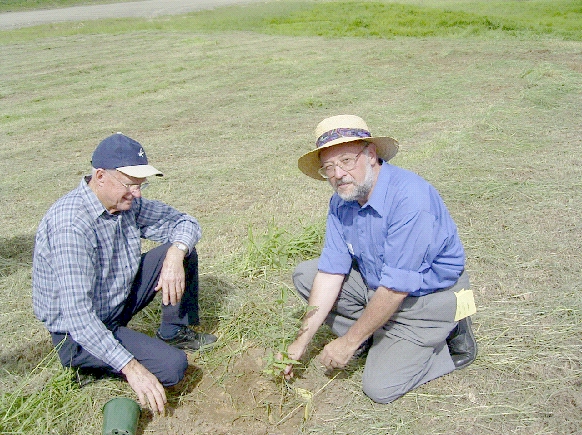
Planting a Byrnes family gum tree, in 2003 at the Castlereagh Chapel, at upper Castlereagh near Penrith,
in memory of family ancestors who came from Ireland and England two hundred years ago.
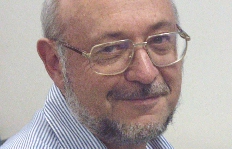 |
John G. Byrnes Ph.D. (Geology)Formerly Minerals Exploration Assessment Geologist(In NSW Mines Department 1972-2005) Now NSW Department of Primary Industries. Now working at worldwide coal interests with a coal consultancy in Sydney, Australia Master of Policy Studies Phone: +61 (0)2 9221 8440 |
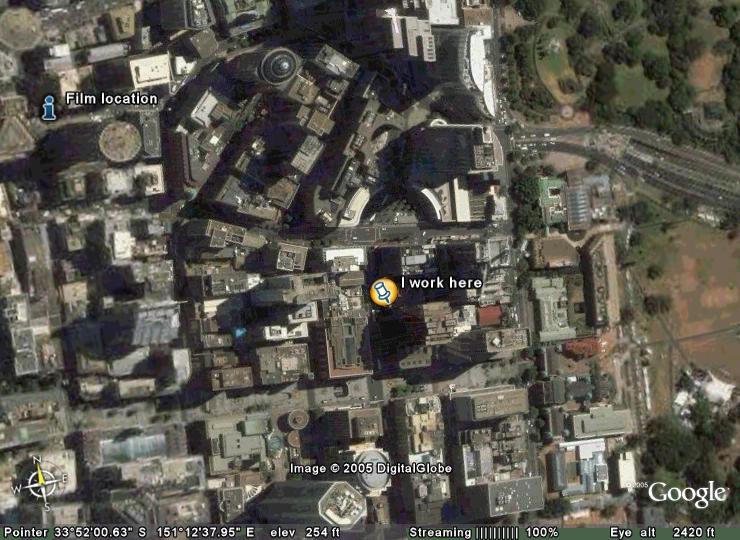
I work here, in the building just left of the pin top. The two arcuate buildings seen north of the pin top enclose Chifley Square. My father used to work there when it was owned by the Commonwealth Government (in which he was a clerk). Afterwards that area was redeveloped by the Bond Corp. into palatial buildings. To the right of the pin, and just before the open space (Sydney Domain) commences, are the buildings of the NSW Parliament and the State Library (includes the Mitchell Library).
Get in touch
To get in touch with me you can phone me on the above number most workdays, or else please either send email to [email protected], and/or click on the "Stay in Touch" link located near the bottom of this page (which will lead to a form where you can record your interests or comments).
What you fill in on that form will be forwarded to me at my Yahoo Guestbook (and at the same time Yahoo also sends me advisory email when you submit the form). The form has spaces for:
Name:
Email address:
Comments: [Please describe your interests in that dialogue box][Box] Yes/No - Send me any small items re my interests
[Box] Yes/No - Subscribe me to "LachlanHunter Newsletter"
[Box] The principal one of my interests is:
[Box] My URL is (if any)
[Box] Send me "Who we Are" (LachlanHunter Services)
Re the "newsletter" referred to, I belong to the LachlanHunter group of geologists.
That name is based on two major regions of New South Wales. One is called "Lachlan" (an administrative district of the State, and also a geological subdivision known as the Lachlan Fold Belt). The other is called "Hunter" (basically the valley of the Hunter River; which is geologically part of the Sydney or Sydney-Bowen Basin and is a region containing many coal mines).
To reach the Lachlan region from Sydney one first must travel west over the Blue Mountains which are composed of deeply dissected Triassic sandstones (and have some spectacular scenery). Along the western foothills of these 'mountains' (elevated plateau), the first belt of mineral occurrences or mining districts that one encounters is one of coal mining. This has the Ulan, Charbon, Kandos, Cullen Valley, Baal Bone, Ivanhoe, Springvale, Western Main, Brimstone and other mines. Along that same belt, wherever close to underlying Palaeozoic limestone, cement manufacture has also been very significant (Kandos, Portland). Heading further west there begin the goldfields. This region is where gold was first mined in Australia in the 1850s, leading to the Australian goldrushes that were similar in many ways to those earlier on in California. Also present are copper mines and lead-zinc mines. One of the oldest copper mining sites in Australia was that at Copper Hill, Molong.
The newsletter is not issued regularly, but several a year should arrive for you. Each issue carries notice of how to unsubscribe if desired.
Getting the LachlanHunter group's newsletter is probably the best or easiest way to stay in touch with whatever I am doing.
News is that I left government employ after the 5 November 2004 move of the head office of the old 'mines' department from Sydney (Saint Leonards) to Maitland. I will no doubt gradually slide further into 'retirement' but for the moment I remain working. Currently (2005) I am working mostly on coal-related interests (Australia, Canada, Colombia, Venezuela, Indonesia .. with South Africa and ex-USSR possibly to follow in future). In the meantime the old 'mines' or minerals department has merged into a current Department of Primary Industry; however the old URL of www.minerals.nsw.gov.au will still contact it okay. DIGS, their online information server, has recently been upgraded to now bundle all parts of a report, separately scanned and indexed originally, into a single PDF file. This is convenient but of course is leading to bigger PDF files now .. Mmm, I may have to get a bigger computer to keep up ;-)
What I do
Mostly geology, which has been pretty much my sole source of income over many years. I also do sociology but that is more of a private or 'hobby' pursuit/interest in that to date it has not resulted in any financial returns at all. I worked till recently for government, having been with the New South Wales government since 1972 and very briefly working for the Commonwealth before that (Bureau of Mineral Resources). I now work as an independent geologist but am also on the road to RETIREMENT, to the extent that I now rarely work at geology for more than four days out of every seven.
As for geology, if you are wondering "What is that?" then maybe for starters have a look at the Geology.com site. Also, for a list of links to geological institutions and societies click here. I have a doctorate in geology and I am also a Master of Policy Studies (UNSW). The latter was a "mature aged student" pursuit, and I graduated in 2003. The main focus of my Policy Studies has been upon regulatory reform, natural resources management, and quality standards-setting. In this I have concentrated on natural resources management, mine safety, and the role of government in the acquisition and management of information.I worked since 1972 (up till 2005) in the NSW Department of Mineral Resources, mostly within the Geological Survey branch which has a 126 year heritage of geological contribution to the understanding of how New South Wales came to be. The head office of the Department moved from St. Leonards on the Sydney "north shore" to Maitland in November 2004.
I commenced work in the department at the former Geological and Mining Museum located in The Rocks area of Sydney. I later returned to university (UNSW) to follow policy and social science interests, particularly in connection with sustainability and the new plan for natural resources management in NSW based on the recommendations of the Wentworth Group of Concerned Scientists, the role of geoscience in society, and optimisation of information for the common good. My work is in regard to the last-mentioned, ensuring that mineral exploration work in NSW is well recorded and will be of ongoing benefit to the community. Holders of all exploration titles in NSW are required to submit periodic digital reports on their activities and I have worked at improving and maintaining the standards required, which may be viewed or downloaded here (This is a large document and it may be best to do a right mouse button click and select 'Save Target As...' so as to then read it off your hard disk).
Interests
My interests lie in earth, social and computer-related subjects, including strong interest in most heritage aspects. I am a member of Australian Mining History Association Inc. and the Australian Computer Museum Society. Rocks, and the immense passage of time which they represent, have interested me since childhood ("The mind seemed to grow giddy by looking so far into the abyss of time" wrote John Playfair, Professor of Mathematics and Natural Philosophy at the University of Edinburgh in 1788 on the enormity of geological time). That concerns the past, which gave us the earth resources society extracts, and from which we can also draw valuable societal lessons I believe. Other major interests pertaining more to the future are sustainability and forms of cooperation.In historical and mining geology I have interests in earth history broadly and in carbonate depositional systems (reefs and carbonate shelves) and their palaeoecology (e.g. symmeytry patterns on the volcanic rises either side of the Hill End trough in New South Wales). The mining provinces I have been interested in include the Cobar-Bourke area, the goldfields around Bathurst-Hill End, the similarities of the NSW and Californian goldrush times, and the NSW Coalfields (especially the thick-seam underground collieries of the 1920s).
Currently, 2005, I am working with a large (international) coal consultancy and am located between Martin Place and Chifley Square in the City of Sydney. Additionally I am within LachlanHunter Services and Associates.
My early fossil interests included Receptaculites and it allies. The receptaculitoids appeared around 488 million years ago in the Lower Ordovician period and disappeared some 250 million years ago in the Lower Triassic period. They are fascinating in being one of the exceptionally few groups of fossils which have so bewildered palaeontologists that different investigators have differed to the extent of some regarding them as animals, and others regarding them as plants allied to the modern-day Dacycladacaen algae. I studied them over a period of about six years and ended up opting in favour of them being plants. However, even that amount of study did not give a really strong or convincing conclusion and I would not be at all surprised if someone turned up contrary evidence to take the interpretation of them back into the animal kingdom (they were earlier on interpreted as sponge-like animals)! Receptaculites are generally no bigger than the size of an outstretched hand, although it is also claimed that they may be gigantic and up to lm in diameter (viz. http://www.northrim.sk.ca/NorthRim/exad/editorials/03march_98/ed_dp980323.htm).
I am a "generalist" by nature, interested in all manner of mineral deposits (the fascinating peat-to-coal story, heavy mineral sands and marine placer deposits, epi- and mesothermal gold deposits, VMS-SedEx and Porphyry Cu-Au deposits, and so on). I best appreciate holistic approaches and like to see the 'big picture' in things, by way of well-integrated and comprehensive models.
And for one who is interested in digging up fossils and earth history not to be also involved with human history or geneology or the The First Byrnes in Australia would be atypical. So I have gathered at this site all the snippets on Byrnes and similar-named people from the early years of the colony (1788-1825) as compiled straight out of the Colonial Secretary records. In all of those there is only one "David", and that is the one who is my ancestor.
But, anyway, who were the Byrnes? Most would be derived from the Ui Faelan tribe of Ireland which gave rise to the clan name Bran (the Raven)(later anglicised to Byrne) and which was the clan that held out for longest against the conquering Norman/Anglo people. These O'Byrnes of the Ui Faelain were displaced by the anglo-norman invaders from their original fertile riverside lands in present-day Kildare and forced to retreat eastwards into the relative wilderness of the Wicklow Mountains. There they retained their "Irishness" (Celtic identity) and harassed the English of "the Pale" long after almost all other native Irish tribes had given up or had been suppressed and absorbed by the new dominant culture. As late as 1578, Dunlang was inaugurated as "the O'Byrne" in the age-old manner, and it was not until April 1601 when Phelim MacFeagh O'Byrne submitted to the new order that the end came to the clan system for all these Byrnes. This story has been well told by Paul J. Burns who believes that about 80% of Burns/Byrnes today would be derived of this Ui Faelain/Bran/O'Byrne lineage. The others may be from various other lesser clans of Bournes, Birns, O'Broins, etc. The main one of those lesser clans is the Clan O'Beirne of County Roscommon. The origins and history of Burns family names in Scotland is even more uncertain. Our "David" was quite likely from a line of these Scottish Celts transplanted to northern Ireland, or less likely may have been of the O'Beirnes around Carrick on Shannon. It is difficult even to speculate, as no record has been found of who his parents might have been. More is known, of the origins back in time, of the woman he married, the convict Ann Reffin from Leicestershire.
As we go back in history, the more people we discover who contributed to our genes or inheritance.
In my case I have so far traced or read most about two threads to the past, John Lees and Ann Reffin. I descend from John Lees of Castlereagh. Lees was laid off early from the New South Wales Corps (a.k.a. Rum Corps) and granted land at Castlereagh in 1803. He joined the Corps at Chatham on the Thames, thirty miles east of London, in 1796, during a recruiting drive by Lt. Col. Grose. He was a native of Stoke in Staffordshire. He arrived in Sydney on 2nd June, 1797.
John Lees paired up with Mary Stevens who sailed into Sydney Harbour (Port Jackson) on 12th June 1801, aged 23 (Mary had stolen 17 yards of cotton). Seven months later Mary knew she was expecting a child and thus began her long relationship with John Lees, whom several children later she married. As Mary was expecting her second child, their Castlereagh house took fire in February 1804 and was consumed. They lost all contents, including every article of wearing apparel, and were granted clothing from the government stores.
On 4th June 1804 Lees was granted ninety acres around where they were living (where the Upper Castlereagh Wesleyan chapel is). The Upper Castlereagh river flats were subject of massive flooding in 1806 which was disastrous to some of the settlers, but the Lees carried on.
The full story of John Lees is told in a book by one of his descendants:
Kavanagh, Merle, 1987. John Lees - The Chapel Builder. Published by the author, Sutherland. ISBN 0 7316 0188 2
As recorded by Merle Kavanagh, Lees is remembered for his untiring, unstinting generosity to Wesleyanism. He battled acoholism badly, presumably rum. Late one day in 1815 the first Wesleyan missionary to New South Wales, Reverend Samuel Leigh, was riding a horse he had purchased called “Old Traveller”. He was somewhere near Castlereagh, for he had been given a letter of introduction and told that at Castlereagh was a man who was from Staffordshire like himself, and who would be glad to see him. Finding the settlement, he sought to be allowed to sleep in a barn but the first man he approached turned him away even though he offered to pay whatever was demanded. He then rode another two miles through entangling undergrowth and reached the wooden hut of John Lees. He knocked on the door with his riding whip saying “Will you receive a Wesleyan missionary”. Not only was Lees delighted to see him but Lees was instantly converted. “We have been praying for three years” said Lees “that God would send us a missionary” and “If Providence has brought you across the seas to this country to convert me you may depend on it you will not be left to perish in the woods of New South Wales.” (Remarkable Incidents in the Life of Rev. Samuel Leigh, Missionary to the Settlers and Savages of Australia and New Zealand. published 1853 by Rev. A. Strachan - Uniting Church archives).
Lees donated an acre of his land and built a chapel on it, next to his house. This chapel, erected 1817, was the first Wesleyan chapel in the Southern Hemisphere. John and Mary Lees were buried in the Anglican cemetery at Castlereagh, as Methodists were not then licensed to conduct burials. But in 1921 there was reinterment of them both to the ‘sacred acre’ or ‘devoted acre’ at the Methodist chapel, as a graveyard was later permitted to be developed there.
I descend also from Ann Reffin. Ann is buried in the same cemetery as where John and Mary Lees were first buried. One of Ann’s children Samuel married one of John Lees descendants and I am on that line of descent.
Unlike John Lees, Ann Reffin did nothing famous and almost nothing is directly known of her. All that is known of her is pieced together from official annotations which survive. However, these are clear enough to take us back to Walton on the Wolds, where Ann was born. This small village has celebrated its 1000 anniversary as a place of settlement (there is a very ancient Christian cross in the grounds of the church where Ann was baptised).
Some seeds of destiny?
Ann Reffin, and many of the seeds of my destiny, and of those closely related to me, travelled to Australia on the ship “Experiment”.
The "Experiment", a ship of some 568 ton, was built at Stockton in 1798, which was the year that my ancestor David Burns was tried in Dublin. The “Experiment” was destined to soon carry to David, the young woman Ann Reffin, who would bear six children. One of Ann’s children had no offspring. Another had no surviving offspring, and the other four gave rise to four branches of our Byrnes family in Australia.
The Master of the Experiment was Fran J. Withers when the ship was contracted by the English government to carry convicts to the penal colony of New South Wales. The ship left Cowes for Port Jackson on 4 December 1803 but ran into such violent weather that it had to return to port to effect repairs. It set sail again on 2 January 1804. It travelled via Rio and took 173 days to reach Sydney, where adverse winds kept it for a further three days before it could sail up Sydney Harbour to the town of Sydney. There were 2 males and 136 females who sailed on that voyage. Six of the female convicts died on the voyage.
The Experiment set anchor at Sydney on 24 June 1804.
Two hundred years later my family remembered this arrival of Ann Reffin from whom we spring. Just before the 24th June our daughter Julie travelled to Ann’s birthplace, Walton on the Wolds and took photos and visited St Mary’s church where Ann had been baptised. In Sydney a meeting was held to remember Ann at Castlereagh, where Ann is buried. Between 20 and 30 people connected with Ann Reffin attended. The meeting was held in the old Wesleyan schoolhouse.
Another one from that voyage, Ann Smith from Wales, is also buried at Castlereagh. Ann Smith married Robert Bolton on the 3 November 1804. They had 11 children and births in 1814-1816 are recorded at Agnes Bank (named after a sand bank on the Nepean River downstream of Castlereagh).
Another female convict shipmate from that voyage, Molly Morgan, went on to become the 'mother' (founder) of Molly's Plains on the Hunter River, and her farm was where the CBD of Maitland is now situated.
To me the ‘seeds of destiny’ that travelled on the Experiment in 1804 were the seeds of our family and also the seeds of the later city of Maitland. Curiously, on Thursday 24 June 2004 (exactly 200 years to the day after the Experiment’s arrival) the Public Service Association of NSW delegates of the four component agencies of NSW Primary Industries department (agriculture, forests, minerals, fisheries) meet to plan work bans and rallies against asserted unfair or inequitous treatment of public servants by the current guv’nor Bob Carr. This includes Mr Carr’s pork-barrelling of city public servants’ jobs to the marginal electorate of Maitland. Although I will pass the old retirement age and could leave the service, and hence avoid going to Maitland, I instead will go. It somehow now feels to me that it somehow fulfils my destiny to be relocated to Maitland - as something planted in those ‘seeds of destiny’ that travelled on the Experiment with my ancestor and also the convict woman who founded the settlement location that became (West) Maitland. Hence I will be part of that relocation, which occurs in November 2004. I do not welcome this relocation at all. But how much less must our ancestors have welcomed being relocated to what in those days they called “the other side of the earth”? Sydney to Maitland is but chickenfeed compared with the British Isles to Australia relocation that the transportees endured. Most of them, and many of the Rum Corps that kept the early law, of course never returned to see their motherland again whereas I’ll be coming back to Sydney every weekend.
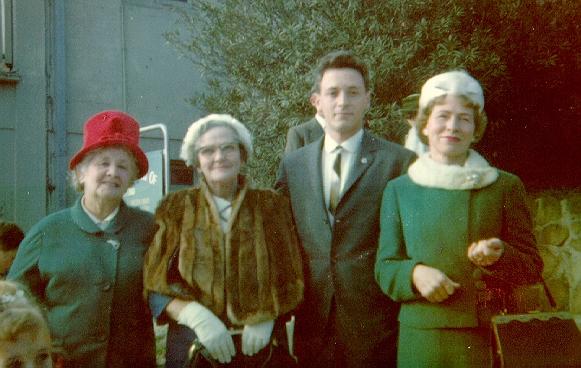
Graduating in Geology at University of New South Wales (Kensington) in the 60s. My mother (Doreen Phyllis) is on my left hand side and my grandmother (Janet Graham) is on my right.
My Resume
Go here for resume and referees are available upon application.
Some Miscellaneous Earth Science Sites
An interesting web site on a Paleontological research project based in St. Louis, Missouri. The primary focus is the study of formations in the St. Louis area and the site creator, Barry Sutton, has spent 8 years collecting the fossils at a road cut near the intersection of I-70 and I-170 in St. Louis. Barry has been experimenting with a style of posting "Viewer Comments" beneath pictures of his finds. He is promoting a "joint venture" approach to learning. He wants to bring together palaeontological professionals and amateurs to pool the research, so that findings and opinions are not of just one individual. Paleontology and Geology of Missouri
Phil Farquharson's Geology Pages. Phil is a graduate student at San Diego State University, after an extended hiatus of 18 years. A repository of geological stuff, including personal history and on-going studies, plus links.
Phil’s website is another one of those on the Geoscience webring and I've actally now had a link to it for years. But I note in 2005 that it's been expanding. And to update a little, the fuller material shows as follows:
PHIL FARQUHARSON
Earth Sciences and Computer Graphics Mentor
3547 Lowell Street
San Diego, CA 92106-1716
E-mail: geo-teaching AT cg-squared.com
Or geoguy AT geology-guy.com
Or geoguy AT cg-squared.comPhil began his geological education and career at U. of Wisconsin in 1965, and continued later at Grad schools at U. of Calgary ('75-'76) and Montana State U. ('76-'80). He worked in uranium at other exploration, had a “Life hiatus” in '80 - '98 and then returned to Geology grad school at San Diego State, '98-'04 to complete a Master of Science. Since then he’s been a consulting computer graphics person for a geotechnical firm, and a part-time geology teacher at Southwestern College, Chula Vista, CA. He is Vice-president of the San Diego Association of Geologists. Also, he is now teaching Earth Sciences in San Diego area colleges (Southwestern and Grossmont).
Some of Phil’s other interests include photography, family history (Clan Farquharson is Celtic of course; ggfather looks a bit like Abe Lincoln), autobiography, and so on. Phil’s working life has been very varied indeed. It ranges from working for Uncle Sam as a Nuclear Weapons Technician to working for less conventional identities like G. Gordon Liddy, Timothy Leary, Steve McQueen and Ali McGraw - all sorts of creatures of the night as Phil calls them; learning about computers, doing sales jobs and other things.
On Phil's rocks pages, I think his “Silicified Oolitic Limestone(?)" might be chalazoidite or accretionary lapilli tuff (albeit that it doesn’t look typical?) – What do you think? [REF: http://www.geology-guy.com/images/oolitic_sili_ls.jpg
The "Thylacoleo Remembrance" web site. This details the discovery and natural history of Thylacoleo, one of Australia's most famous marsupials of the Pleistocene Epoch.
Earth Science Australia. 100 Megs of free earth science resources and freeware, since 1996. By Geoscience Australia (formerly the Bureau of Mineral Resources).
Australian Atlas of Mineral Resources. This is another useful website by Geoscience Australia, in collaboration with the Australian Mineral Council. Here's what it shows for mineral (gold) occurrences around the town of Stuart Town near Wellington in New South Wales.
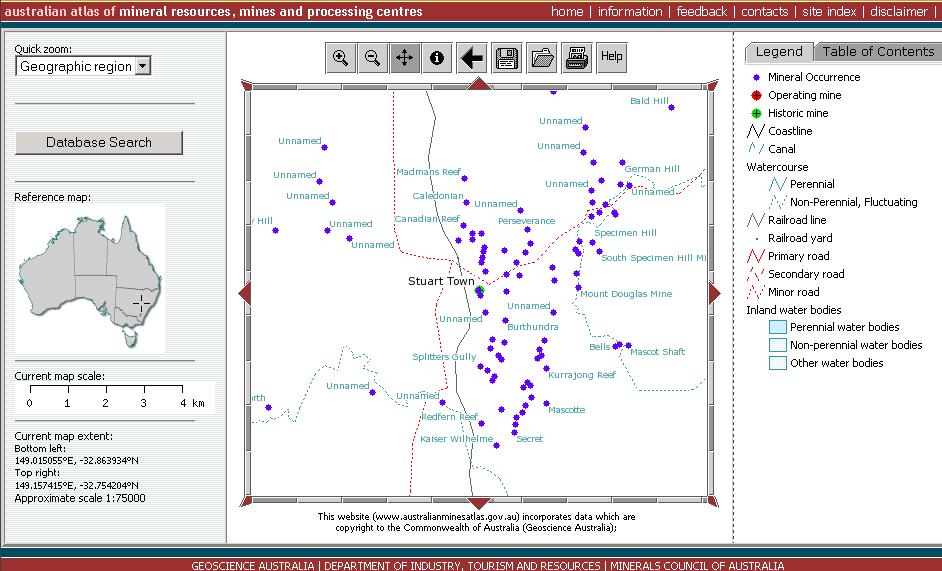
And for a series of zooming into that scale from a view of all mines immediately west of Sydney and the Blue Mountains Click here.My life, ma vie; me and moi. Who am I? Born in sweet France in 1946 and back here after dwelling 30 years in Sweden (brrr...). My name is Blaise Comet and I am nowadays working as a webmaster. I am also a professional in environmental matters with acid drainage at old mines and lead pollution at shooting-ranges as a speciality. Another of my professional interests is the use of GIS (Geographical Information Systems) to analyze and present these issues among other ones. So please feel free to get in touch with me if you want to discuss these matters or for whatever purpose... French, English and Swedish are the languages I speak and understand!
Geology Jobs. Searches and helpful information such as job requirements, qualifications, and salary for careers and jobs in the field of geology.
Fossil Sites. Fossil and Paleontological resources on the WWW. Join the Fossil Sites Web Club.
To be continued ... and to be separated off as LINKS pages So please send me any interesting links This page was last modified in August 2005

View Page Stats
See who's visiting this page.
Stay in Touch <-- Click here to open a form to input into my private Yahoo Guestbook, record your interests, and subscribe to "LachlanHunter Newsletter" if you wish. Or you can send a more free-form message in the box below.
Visitors (and please also drop me a line at [email protected])
