MAITLAND AND THE HUNTER VALLEY
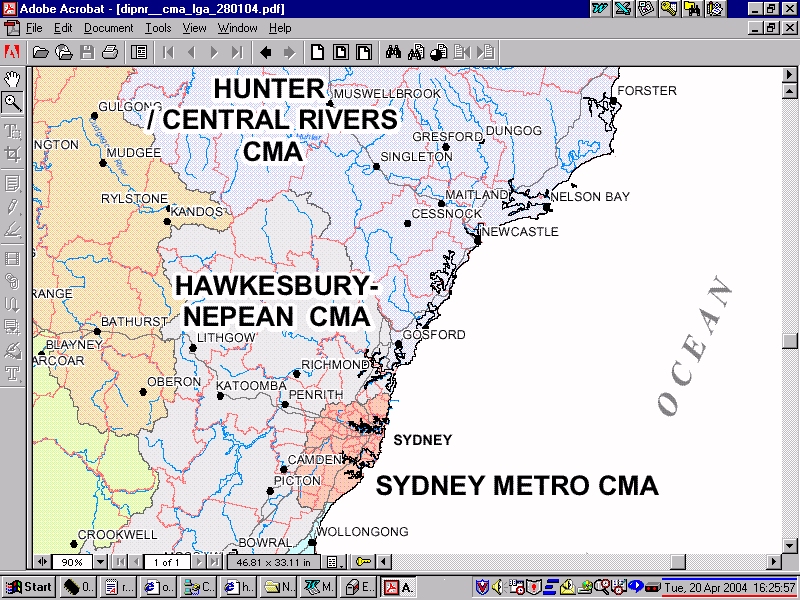
The above map is part of a map showing new CMA (Catchment Management
Authority) boundaries and the whole map can be downloaded from
http://www.dipnr.nsw.gov.au/nvrig/pdf/dipnr__cma_lga_280104.pdf
As the map shows, there is a relatively small catchment around
the greater Sydney urban area. Surrounding that is the large Hawkesbury-Nepean
catchment. The boundary of that with the Hunter River catchment to
the north runs northwesterly.
Viewed from the Hunter Valley side this is a very marked range (Wattagan Ranges) which is the escarpment of cliff-forming Triassic sandstones rising above the softer and more eroded Permian strata that floor the Hunter Valley, as seen below:

This photo is from the general store at Paxton looking south, across the road to the old Stanford Main No 2 colliery in the middle ground, and with the Wattagan range seen in the far distance.
The following notes reflect general impressions of the Hunter, and Maitland in particular, as voiced in the 2003 Newcaste dinner keynote address on sustainable development to The Hunter Valley Research Foundation by its CEO, Dr W.E.J. Paradice (
www.hvrf.com.au/data/Foundation%20Dinner%202003.pdf).The Hunter Valley Research Foundation (
http://www.hvrf.com.au) is Australia's longest serving private not-for-profit regional research organisation, founded in 1956. The organisation has served as a unique model to other regional groups looking to provide assistance to business, industry, government and the wider community.
Sustainable development
- Dr Paradice
"It was not so long ago many commentators, most but not all from outside the Hunter, were predicting the death of the Hunter with closure of steel making at BHP."
"As time has shown, it would almost appear that BHP’s decision to cut lose from steel making in Newcastle has turned out to have been a period of liberation for the Region. The Hunter is now enjoying one of the best periods of economic growth and the lowest period of unemployment for decades, if not ever."
The unemployment figure for the Hunter in September 2003 was 5.4%. This was 0.2% lower than NSW at 5.6%. Unemployment rate had not been that low since regional labour force data was first released in 1986. For a long time the unemployment rate was about 10% in the Hunter.
While the increasing value of the Australian dollar has made it more difficult for the mining sector, the industry had previously enjoyed a significant period of time when a low dollar assisted in the expansion of the coal sector.
The Hunter has been discovered by investors and others looking outside Sydney for opportunities for lifestyle and investments. Small acreages in the lower Hunter are being snapped up as quickly as new warehouses are being developed around Thornton and Beresfield.
As Sydney continues to grow and its influence spreads even further beyond its boundaries the impact of this growth is being felt more and more in the north and south.
As part of the ongoing monitoring of economic conditions and community perceptions by HVEF 1,000 residents of Sydney were contacted to ask them about what they liked and disliked about various features of Sydney and the Hunter. Where 1 is poor and 10 is excellent Sydney residents rate Sydney as top for shopping and the range of cultural activities available. Telecommunication links, recreation opportunities and the higher education system also received high marks. At the other end of the spectrum Sydney residents rated their home side poorly on affordable housing, cost of living, clean air and personal security. Attitudes to the Hunter on the issues canvassed were less diverse than those expressed about Sydney. Specifically Sydney residents see the Hunter as having a positive natural environment rating clean air, climate and unpolluted water as the most positive aspects of the Region.
On the downside Sydney residents still believe that the Hunter offers fewer job opportunities, mediocre public transport, and they were less positive on the local health services and the local economy. Whereas Sydney residents gave the affordability of housing in Sydney a 3 out of 10, the Hunter received almost 7 out of 10.
Sydney residents continue to see the most positive aspects of the Hunter as its natural environment.
But how much longer will the differences last. Maitland has been booming with one of the fastest population growth rates in the Hunter, yet as we travel the New England highway the increasing number of vehicles on the road begins to make things look more like travelling in Sydney everyday.
More and more pressure is placed on the landscape as the demand for housing increases and urbanisation spreads. No where is this challenge between economic imperatives and the environment more apparent than the discord between coal mining and landscape preservation. Yet we like to see the lights go on and the jobs and economic benefits that the mining industry provide in the local community. To underline this fact, in 2001/2 NSW exported 77.5 million tonnes of coal and earned $4.7 billion. In the same year the Hunter, through the Port of Newcastle, exported 69.3 million tonnes or 89% of NSW coal exports. A simple calculation estimates that approximately $4.2 billion in exports was earned by the Hunter coal industry in 2001/2. Yet a trip up the New England highway or a flight over the central valley reveals major changes to our landscape as a result.
The natural resources of the Region underpins the wealth of our community both in economic and social terms. Whether it is coal, agriculture, housing, port activities, tourism or manufacturing the management of the natural resources of the Region will have important direct and indirect affects on change over the next decade.
Government’s role in setting the rules as to how these changes take place is emobdied in a new set of bills to cover the formation of a NSW Natural Resources Commission and Catchment Management Authorities throughout NSW.
The Hunter has shown an ability to develop innovative solutions to conflicts between development and environment such as the Hunter River Salinity Trading Scheme, which encourages saline water to be stored until river flows are at a level that the saline water can be discharged at times to minimise the impact on the environment and other water users.
Heritage of coalmining
The founding of Newcastle on the Coal River (now the Hunter River) began in earnest two hundred years ago after the Battle of Vinegar Hill, which occurred on 4 March 1804.
Governor Phillip King ordered the new penal sub-colony be established as a place of internal exile or secondary punishment for the Castle Hill rebells, most of them Irish.
On 24 March, King commissioned Lieutenant Charles Menzies to establish the new settlement, which he named Newcastle. Lieutenant Menzies arrived in Newcastle on 30 March at noon, making the first European settlement in the penal colony of New South Wales outside of Sydney and its surrounding Cumberland Plains.
Escaped convicts had discovered coal at Newcastle in 1791, only three years after the First Fleet sailed into Sydney Harbour. Lieutenant John Shortland, found a river and a coal seam while looking for the escapees in 1797. Lieutenant Shortland's discovery of the Coal River, and the sample of coal he took back assured the colony of a very welcome commodity for domestic comfort and industrial growth.
In March 1804 the Coal River settlement was started with the 34 Irish prisoners transported there after the Castle Hill uprising. By later in 1804, more convict had been sent there and the convicts working the coalmines numbered128. Newcastle soon became the colony's major prison or convict centre, with more than 1,000 convicts there by 1814. The number working the mines reached 553 in 1817. Convict miners remained part of the work force, although they were overtaken in numbers by free miners by 1843.
Edgeworth David, who found the rich coal seam in Cessnock, was the father of the coal industry in the Cessnock area and it was suggested that he be commemorated further by naming the relocted head office of the State mines department at Maitland the Edgeworth David centre. He is already remembered in two coalfields town names and by a street name in Hornby.
There are mineworkers memorials at Freemans Waterhole Memorial (derelict for some years) and at Rothbury (the Rothbury Riot Memorial). The coalmining heritage is not sufficiently recognised or protected and has been subject of considerably loss or destruction in recent years.
In recent times Coffey Geosciences Pty Ltd were engaged to carry out ground penetrating radar surveys and drilling, to recover the location of the old convict coal workings under Newcastle.
Our mining history is neglected. The Mineworkers Memorial Museum at Freemans Waterhole was built around a feature piece of the old headframe ex Wallsend Colliery. The museum building was designed for models, dioramas and some coal mining artefacts. A Music Shell alongside is in good state of preservation. However the site has been closed and disused for years, and in April 2004 the front door of the museum began collapsing inwards. It should be possible to better use this site for promoting the coalmining historical sites and museums of the Lower Hunter Valley and the Macquarie Lakes areas.
Other museums in the region that feature coalmining history are the Westlake Retired Mineworkers Museum 27 James St , Teralba (Ph: 02 4958 6876 Open seven days from 9.00 a.m. - 5.00 p.m. by appointment), Richmond Main Colliery museum 20km north of Freemans Waterhole (open limited days), and the Edgeworth David Museum at Deakin St, Kurri Kurri (open Sunday and Wednesday afternoons).
REFERENCES
Speers Point Library, undated - "Poppet will rise again". Freemans Waterhole Mining Museum. Newspaper clippings, folder "Cooronbong".
J & A Brown/Coal & Allied. Archive files A7571 (vi). Coal and Allied Industries Ltd. Correspondence, proof sheets, newsclippings and papers relating to Mineworkers' Memorial Music Shell at Freemans Waterholes and disposal of steam locomotives and equipment from South Maitland Railways, Pelaw Main and Richmond Main Collieries. File No. 21 0003, February, 1970 - November, 1985. The Archives, Rare Books and Special Collections Unit, level 2 of the Auchmuty Library, University of Newcastle.
