MR. NASCA WEB SITE

WELCOME TO THE PYTHAGOREAN
THEOREM
|
PREVIEW |
PYTHAGOREAN THEOREM |
|
|
|
|
|
|
|
|
|
 |
 |
|
|
|
- Students will be able to state and apply the Pythagorean Theorem.
- This Geometry course is designed for students who have successfully completed Algebra I. Any technology that will enhance student learning should be used(calculators, computers, etc.).
- The student will solve practical problems involving right triangles by using the Pythagorean Theorem and its converse, properties of special right triangles and right triangle trigonometry.
The purpose of the three lessons(3-5 days) is for students to develop an understanding on how and why the Pythagorean Theorem works.
Lesson:
- Lesson 1(1 day) contains a brief historical accounting of Pythagorous,widely accepted as the author of the Pythagorean Theorem. The Proof of the Pythagorean Theorem states that the given distance of two legs of a right triangle, the length of the hypotenuse can be obtained by adding the squares of the other two legs and then taking the square root of that number.
- Lesson 2(2 days) provides practice problems on the Pythagorean Theorem and application of the Pythagorean Theorem through word problems. The Pythagorean Theorem is one ot the most useful theorems in mathematics.
- Lesson 3(1 day) provides students with an evaluation of their knowledge of the Pythagorean Theorem.
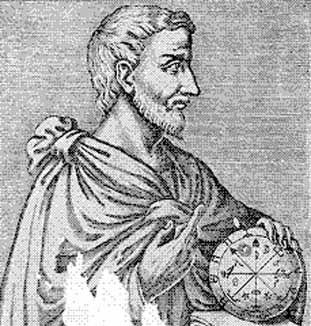 |
Pythagoras of Samos(584B.C.-495BC.) was born in Samos, Greece. His travels took him to Egypt and Babylonia where he became acquainted with the Egyptian and Babylonia mathematicians. He settled in Crotona, a town of Dorian in Southern Italy. His teacher Thales(known as the father of Greek mathematics)stirred his mind in the field of mathematics. Thales ideas were formed from the lines cast by the shadows from the sun of the pillars across the pavement. Figured numbers formed the significance in Pythagorean arithmetic. Figured numbers include triangular numbers, square numbers, pentagonal numbers and irrational numbers. Pythagorous drew attention to other mathematical terms such as parabolas, ellipses and hyperbole. Pythagoras is best known as a geometer for his famous theorem that the square of the hypotenuse of any right triangle equals the sum of the squares of the other two sides. |
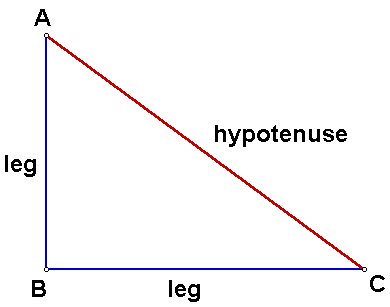
The parts of a right triangle that form the right angle are called the legs. The part of the right triangle which stretches and connects the two legs is called the hypotenuse.
 ;
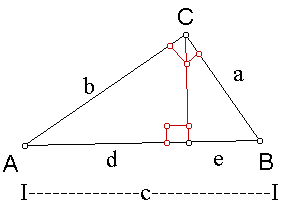
;  is a right angle.
 =
=  +
+