
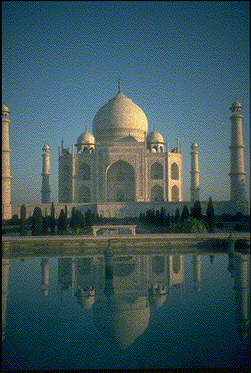
Taj Mahal, India








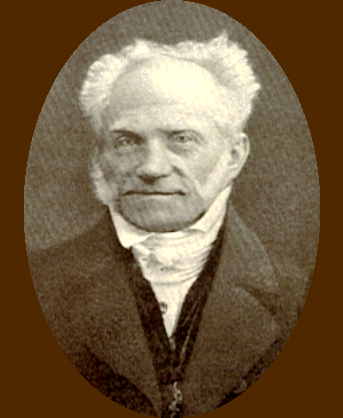
Arthur Schopenhauer
(1876-1936)

This page contains information and resources regarding my research. Click on highlighted text to jump to the desired section of the document. Research interests, publications, current projects, and papers.
Modern European History
Modern German History
Intellectual History
Cultural History
Indian History
World History
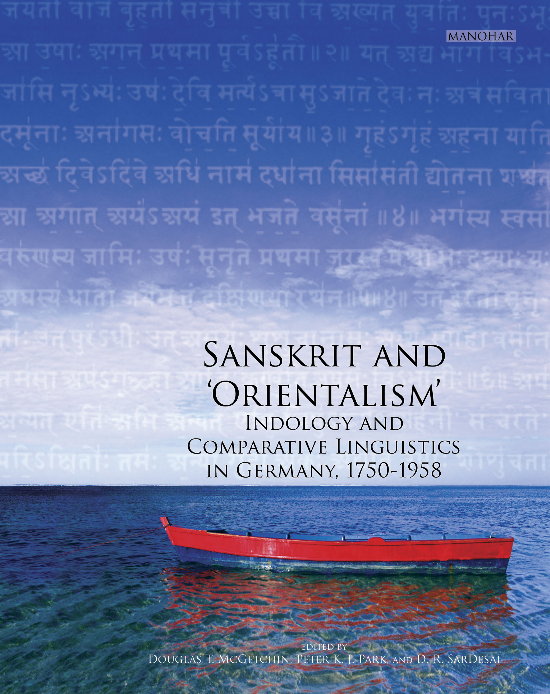
Douglas McGetchin, Peter K. J. Park, and Damodar SarDesai, eds., Sanskrit and “Orientalism”: Indology and Comparative Linguistics in Germany, 1750-1958 (New Delhi: Manohar, 2004).
"Wilting Florists: The Turbulent Early Decades of the Société Asiatique, 1822-1860," Journal of the History of Ideas 64 (2003): 565-580.
For my continuing research agenda, beyond working on several articles, I am developing my dissertation into a book. I am pursuing further research for my chapter on German popular interest in India as expressed in journals, magazines, exhibitions, museums, and other elements of popular culture. I am studying the connection between Indology and the life reform and Social Democratic movements in fin-de-siècle Germany. I am also investigating Indology at Bonn to supplement my work on Berlin and Leipzig, as Bonn University was an early center of Sanskrit study in Germany. I eventually would like to expand my study of German Indology to Nazi and post-1945 German society.
Dissertation
"The Sanskrit Reich: Translating Ancient India for Modern Germans 1790-1914"
Table of Contents
I. Introduction
II. Comparative Indology: Indian Studies in England, France and Germany
III. India Exalted: Literature and Philosophy
IV. Appealing to the Public: Advocating the Adaptation of Indological
knowledge
V. The Internal dynamics of Academic Indology in Germany
VI. Wayward Disciples: Indology Professors, their Students, and the
Spread of Buddhism in Fin-de-Siècle Germany
VII. An Indo-Germanic connection?
VIII. Conclusion
My dissertation, "The Sanskrit Reich: Translating Ancient India for Modern Germans, 1790-1914," investigates the cultural implications of the academic discipline of Indology (the study of South Asian texts, literature, and culture) and the diffusion of this knowledge about ancient India within nineteenth-century Germany. Despite the complete lack of German colonial involvement in South Asia, by 1900, Germany had more university professors studying Sanskrit than all other European countries combined.
German romantics in the late eighteenth century recognized echoes of their own concerns for nature, sentiment, and religious transcendence in ancient Indian literature. Intrigued by this distant world, German scholars enthusiastically promoted the idea of linguistic ties between German and Sanskrit, a language they believed predated Greek. By the late nineteenth century, orthodox university Indology had weaned itself in everyday practice of its earlier romantically-inspired enthusiasm for India, and what remained was a much more narrow positivistic philology. Yet the "cultural treasures" of South Asia provided a viable alternative to those experiencing the despair of the fin-de-siècle and a discontent with what they saw as a European civilization in decline. Intellectuals including Friedrich Nietzsche drew upon ideas from the Hindu Upanishads and Buddhist teachings. While several sources mention the disproportionately prodigious growth of German Indology, as compared to Europe, recent scholars have yet to write a detailed analysis of this historical development.
I argue the interest developed for political, institutional, and cultural reasons. German romantics in the late eighteenth century recognized echoes of their own concerns for nature, sentiment, and religious transcendence in newly translated ancient Indian literature. German scholars also enthusiastically promoted the idea of uniquely strong linguistic ties between German and Sanskrit, a language they argued predated Greek or Latin. They thus strove to establish a cultural superiority over the Greco-Roman world and its French inheritors. Sanskrit became a significant part of Prussia’s developing field of linguistic science, which augmented the prestige of the Prussian state and benefited from generous university faculty appointments. Before the foundation of the German Empire in 1871, language was one of the few factors that unified the otherwise politically fragmented German states. Sanskrit scholarship was an important element supporting this development.
This project blends intellectual and cultural history with the history of education and of science. Most existing histories inadequately explain an “Indo-Germanic” connection by either claiming a unique German-Indian connection based on the romantic rhetoric of the late eighteenth century or denouncing the roots of Nazism in the “Aryan” interests of these Indologists. Both analyses largely ignore the complexity of the discourse around the term “Aryan” and the intense debate during the nineteenth century among Indologists themselves over the use of this linguistic term in racial theories. The legacy of nineteenth-century Indology, like so much in German history, is complex. It not only brought the concept of “Aryan” and the Swastika symbol itself into the German cultural sphere but also promoted non-Western ideas and religions such as Buddhism, and contributed to a realization of Wolfgang von Goethe’s vision of increased international understanding through the study of a “world literature” (Weltliteratur).
The dissertation cites a range of hitherto neglected sources from university
and state archives in Berlin and Leipzig, including the Prussian ministry
of education files, unpublished letters, personal papers of scholars, and
university documents. I also draw upon a wide array of published
primary sources, including popular and academic periodicals, lectures,
contemporary historical accounts of Indology, letters between scholars,
and Indological works.
"The German Study of Sanskrit in the Nineteenth Century," paper delivered to the German Studies Association conference, New Orleans, September 20, 2003.
"Wayward Disciples: Indology Professors, their Students, and the Spread of Buddhism in Fin-de-Siècle Germany" paper delivered on August 10, 2001 at the International Conference of Asian Scholars II, Freie Universität, Berlin, August 9-12, 2001.
"Max Müller Embattled: William Dwight Whitney’s Critique," paper delivered on December 12, 2000, at the Congress of Philosophy and Foundations of Science-V, the International Symposium “After Max Müller: Philosophy in the Dialogue of Civilizations,” India International Centre, New Delhi, December 11-15, 2000. Revised and submitted for publication by the CPFS in the forthcoming Comparative Perspectives on Religion, Language and Culture: Dialogue Across Cultures (Oxford).
"Zum Mittelpunkte des Sanskrit-Studiums" (Into the Center of Sanskrit Study): The Development of Indian Studies in Berlin and Leipzig, 1821-1914," paper delivered at the German Historical Institute's Sixth Transatlantic Doctoral Seminar, Humboldt University, April 26-29, 2000.
"Zum Mittelpunkte des Sanskrit-Studiums" (Into the Center of Sanskrit Study): The Development of Indian Studies in Berlin and Leipzig, 1821-1914," paper delivered at the History of Indology and Comparative Philology in Germany, 1750-1958 conference at the University of California, Los Angeles, April 15, 2000.
"The Sunrise of German Orientalism: Sakuntala and Germany 1790-1830," paper delivered to the German Studies Association conference, Salt Lake City, October 10, 1998.



