

Player characters - page 1 of 2
The players are the ones who will roleplay an imaginary character of their own creation. These characters created by each player are called player characters, of just pcs. They are important because without them the players would be unable to interact with the adventuring world. In other words, there would be no game.
Creating your character
The character you create has a wide variety of aspects you can customize. Since character creation varies between AD&D and D&D, I'll only refer to a general guideline applying to both.
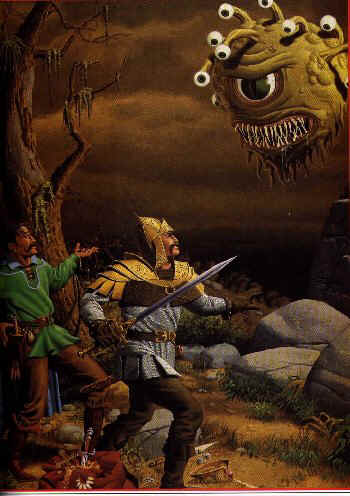
Your character's general aspects are:
Statistics
Class and Kit
Description
Alignment
Statistics: These are a group of numbers that indicate your character's rating in each statistic. These are strengh, dexterity, constitution, intelligence, wisdom and charisma. The numbers often range from 3 to 18, 3 being the worst and 18 the best, altough the numbers can go beyond those limits.
Strengh is a measure of your character's physical strengh and stamina, the stronger the character, more damage will inflict and more equipment will be able to carry. Dexterity is a measure of your character's agility, coordination and balance, the more dexterous the character, the easier will it evade blows in combat and sneak into castles. Constitution is a measure of your character's physical fitness and health, the more constitution the character posesses, the more hit points will it have and more easily will he overcome diseases. Intelligence is a measure of your character's reasoning and memory, the more intelligent the character, more complicated things will it understand. Wisdom is a measure of your character's knowledge, common sense and willpower, the wiser the character, more things will it know. Charisma is a measure of your character's personal magnetism and ability to lead, the more charismatic the character, more easily will it convice people.
In order to determine the score for each statistic, you have to roll a few dice. The amount of dice vary from campaign to campaign, or even depending on the Dungeon Master (explained in the section).
Class and kit: This is the most important aspect of the character. It determines it's proffesion, what he or she will become. The most common classes are:
Fighter
Mage
Thief
Priest
Fighters are armsmen. They live and die by their sword, strengh and toughness. Choose a fighter if you like the action of combat. Mages are people who've spent most of their lives studying and practising the arcane arts of magic. They are very feared by some because they do not understand their power. Choose
a mage if you like to literally have the power in your hands. Thieves are infiltrators. They master the arts of stealth. Their abilities are related of course to stealing, but that's not the only thing they can do. Choose a thief if you prefer to sneak rather than confront directly. Priests are fighters that have a commitment with a special deity. They travel accross the land to expand their faith to others, they have a code of behaviour. Choose a priest if you like to have a specific mission in your life.
Kits are not essential. They apply to certain classes and they aim to create more original characters. A fighter kit can give your character some special advantages over other fighters, but it will also have some disadvantages. Kits are therefore a way to add something new to your roleplaying. You can find some kits available for download in my downloads section.
Description: This is a must-have for every character. Whenever you create a new character, you must decide how he or she will look like, that is, it's appearance such as hair, eyes, clothing, etc. It is so important because you must establish how you are seen by other characters. Of course, this is left entirely for you to choose. You can create a mage that looks like a hippie, or a fighter that dresses in formal clothes. You can have fun imagining the possibilities...
Alignment: The last, but not least, aspect of character. The alignment describes the personality of your character, beliefs and the way he or she sees things. The alignment consists of 2 parts, order and ethics.
Order describes what your character feels towards laws, your character can be lawful, neutral or chaotic. A lawful character always obeys laws, rules, traditions, and any sort of order from superiors, etc. A chaotic character is one who never follows any rules, often doing whatever thing they want. A neutral character stands halfway between the other two.
Ethics describe your character's view of good and evil. The possibilities are good, neutral and evil. A good character always tries to help people, free the captive, do good things. An evil character seeks to better himself and hurt others, do evil things. A neutral character stands halfway between the other two.
When choosing an alignment, you have to choose one of both aspects. The possibilities are:
Lawful Good
Lawful Neutral
Lawful Evil
Neutral Good
True Neutral
Neutral Evil
Chaotic Good
Chaotic Neutral
ChaoticEvil
Previous section: Introduction
Next page of Player characters