Other Countries covered by District 412:
Botswana and Malawi
Overview General Resorts & Excursions Passport/Visa Money Duty Free Public Holidays Health Travel - International Travel - Internal Accommodation Sport & Activities Social Profile Business Profile Climate History & Government Useful Addresses
Zimbabwe is bordered by Zambia, Mozambique, South Africa and Botswana. The central zone of hills gives rise to many rivers, which drain into the man-made Lake Kariba to the northwest, the marshes of Botswana to the west or into the Zambezi River to the northeast. The Victoria Falls are a principal attraction.
Harare: Formerly Salisbury, the capital is Zimbabwe's commercial and industrial centre and also the usual starting point for any visit. It is a clean and sophisticated city, characterised by flowering trees, colourful parks and contemporary architecture.
Bulawayo: Zimbabwe's second city is a major commercial, industrial and tourist centre. The city is home of the National Museum and headquarters of the National Railways of Zimbabwe.
From the forested mountains of the Eastern highlands to the sun-washed grasslands of Hwange National Park, from the hot Mopani Forest to the shores of Lake Kariba, more than 11% of Zimbabwe's land – 44,688 sq km (17,254 sq miles) – has been set aside as parks and wildlife estates.
Traditional dishes include sadza (a stiff maize meal) eaten with meat and/or gravy and a relish.
Nightlife is rather limited outside the cities with the emphasis on eating and discos
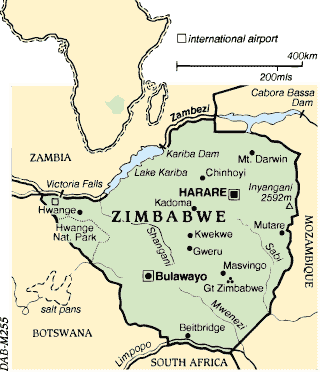
Location: Southern Africa.
AREA: 390,310 sq km (150,873 sq miles).
POPULATION: 12,293,953 (1997).
POPULATION DENSITY: 31.5 per sq km.
CAPITAL: Harare. Population: 1,400,000 (1993).
GEOGRAPHY: Zimbabwe is bordered by Zambia to the northwest, Mozambique to the northeast, South Africa to the south and Botswana to the southwest. The central zone of hills gives rise to many rivers, which drain into the man-made Lake Kariba to the northwest, the marshes of Botswana to the west or into the Zambezi River to the northeast. The highveld landscape is dotted with kopjes (massive granite outcrops). Along the eastern border for some 350km (220 miles) is a high mountainous region of great scenic beauty, rising to 2592m (8504ft) at Mount Inyangani, the country's highest point. Zimbabwe offers some of the best wildlife parks in southern Africa, notably Hwange (southwest), Matopos (south) and Nyanga (northeast) national parks. These, together with the Victoria Falls and Great Zimbabwe, are the principal attractions for visitors.
GOVERNMENT: Republic. Gained independence from the UK in 1980. Head of State and Government: President Robert Mugabe (head of state since 1987 and head of government since 1980).
LANGUAGE: The official languages are English with Shona and Ndebele dialects.
RELIGION: Christianity with traditional beliefs in rural areas, and some Hindu and Muslim minorities.
TIME: GMT + 2.
ELECTRICITY: 220/240 volts AC, 50Hz.
COMMUNICATIONS: Telephone: Full IDD is available. Country code: 263. Outgoing international code: 110. Fax: Widely available. Telegram: Available at post offices and major hotels. Post: Airmail to Europe takes up to one week. Press: The main English-language newspapers are The Herald, The Chronicle, The Financial Gazette and The Sunday Mail.
BBC World Service and Voice of America frequencies: From time to time these change.
BBC:
|
MHz |
21.66 |
15.40 |
11.76 |
6.190 |
Voice of America:
|
MHz |
11.92 |
9.630 |
6.035 |
1.530 |
For the purpose of this guide, Zimbabwe has been divided into three sections: The Highveld, Parks & Wildlife and The Eastern Highlands. The best months to visit are from July to October. For further details contact the Zimbabwe Tourism Authority (see address section).
The Highveld
Running from northeast to southwest down the centre of the country, and connecting its two largest cities, this chain of low mountains is Zimbabwe's most populous area.
Harare: Formerly Salisbury, the capital is Zimbabwe's commercial and industrial centre and also the usual starting point for any visit. It is a clean and sophisticated city, characterised by flowering trees, colourful parks and contemporary architecture. Local sightseeing includes the modern museum and art gallery, the Robert McIlwaine Recreational Park, which has a lake and game reserve, the Lion & Cheetah Park, the Larvon Bird Gardens and the landscaped gardens of aloes and cycads at Ewanrigg Botanical Gardens. Because of its pleasant climate, Harare is known as the 'Sunshine City'.
Bulawayo: Zimbabwe's second city is a major commercial, industrial and tourist centre. The city is rich in historical associations and is the home of the National Museum and headquarters of the National Railways of Zimbabwe. Nearby are the ancient Khami ruins, while to the south is the Rhodes Matopos National Park, notable for its exotic formations of huge granite boulders. Dams with excellent fishing, caves with rock paintings, Cecil Rhodes' grave and a well-stocked game park make this area popular with visitors.
Parks & Wildlife
From the forested mountains of the Eastern highlands to the sun-washed grasslands of Hwange National Park, from the hot Mopani Forest to the shores of Lake Kariba, more than 11% of Zimbabwe's land – 44,688 sq km (17,254 sq miles) – has been set aside as parks and wildlife estates. There are ten national parks and ten recreational parks around the country, plus several botanical gardens, sanctuaries and 14 national safari areas for hunting (which helps to finance the conservation programme and is strictly controlled).
Hwange (formerly Wankie) National Park is Zimbabwe's largest national park, both in size, 14,620 sq km (5,644 sq miles), and in the variety of animals and birds that may be seen. From the three camps, networks of game-viewing roads guide visitors to areas with good animal concentrations and to waterholes where, in the evenings, great numbers of wild animals congregate. At some waterholes platforms are erected from which one can observe game closely and in safety. Hwange is one of the last of the great elephant sanctuaries in Africa and herds of up to 100 elephants may be seen drinking and bathing at the waterholes, particularly at the end of the dry season in September.
120km (75 miles) from the Hwange National Park are the Victoria Falls, the largest waterfalls in the world – 2.5km (1.5 miles) wide, 550 million litres of water plunge every minute 100m (330ft) into a narrow chasm; the spray can be seen 30km (20 miles) away. To gain an overall impression of the Falls, the 'Flight of the Angels' light plane trip is a must, as is a cruise up the mighty Zambezi River. It is possible to walk across to Zambia (with the minimum of formalities) to view from the other side; this is also highly recommended, for the Falls are without a doubt one of the world's grandest natural spectacles and every viewpoint reveals something new. Nearby is the Zambezi National Park, where sable antelopes and other exotic animals graze in a parkland setting.
Mana Pools National Park is one of Zimbabwe's most beautiful national parks, occupying 2196 sq km (848 sq miles) of forest along the shores of the Zambezi River. The animal population includes hippo, elephant, rhino, buffalo and many types of antelope. Game viewing on foot is allowed. The birdlife along the river and in the bush is particularly prolific. It is possible to fish for tigerfish, bream and the giant vundu.
Lake Kariba, in the northwest of the country on the Zambian border, covers 7770 sq km (3000 sq miles) and holds a million gallons of water. Game can be viewed from the comfort of various safari camps, or from well-appointed cruise vessels and self-contained safari-crafts.
Matobo National Park is located close to Bulawayo, Zimbabwe's second major city. The park is noted for its spectacular granite rock formations and its wealth of ancient rock paintings. Cecil Rhodes' tomb can be visited at Malindidzimu (View of the World). The Nswatugi and Pomongwe caves are worth visiting.
Nyanga National Park is situated in the mountain range that covers the eastern part of Zimbabwe. It is an area of high grasslands, evergreen forests, waterfalls, cliffs and lakeside cottages. Trout fishing is very popular and the trout hatchery is well worth a visit. Visitors can also climb Mount Nyangani, the country's highest peak. The World's View offers a panoramic view across northern Zimbabwe. From here, a steep footpath leads to the road to Nyanga village with its English gardens, village common and church.
A holiday in Zimbabwe would be incomplete without a visit to the Great Zimbabwe National Monument. This forms the largest complex of ruins in Africa south of the pyramids in Egypt. The Main Enclosure, or Temple, has walls over 9m (30ft) tall, 4m (14ft) thick and over 228m (250 yards) in circumference, giving approximately 485,521 cubic metres (635,000 cubic ft) of hand-trimmed mortarless stonework. The remains are what is left of a city-state that flourished between the 13th and 15th centuries, trading in gold. Lake Kyle National Park is not far away; there is a well-organised campsite close to the lake.
Note: For safety reasons, visitors may not enter any national park by motorcycle.
The Eastern Highlands
The Inyanga, Vumba and Chimanimani mountain ranges are one of the country's principal holiday areas for both Zimbabweans and tourists and are ideal for those who want to relax and enjoy crisp mountain air. The country's highest mountain, Inyangani (2592m/8504ft), is in this area. The scenery is striking in its variety, with deep valleys, gorges, bare granite peaks, pine-forested slopes and bubbling trout streams rolling down steep cliffs. There are challenging hilly golf courses and pony rides through the heather, as well as the opportunity for mountain climbing, squash, tennis, bowls, fishing, snooker and gambling in the casino. Because of the mountainous and forested terrain, game-viewing in this region is more a matter of chance but for the lucky there are leopards and rare forest antelopes.
|
Passport Required? |
Visa Required? |
Return Ticket Required? |
|
|
Full British |
Yes |
No |
Yes |
|
Australian |
Yes |
2 |
Yes |
|
Canadian |
Yes |
No |
Yes |
|
USA |
Yes |
2 |
Yes |
|
Other EU |
Yes |
1/2 |
Yes |
|
Japanese |
Yes |
2 |
Yes |
PASSPORTS:
Passport valid for at least 6 months from date of entry required by all.VISAS: Required by all except the following:
(a) 1. nationals of Canada, Ireland, Sweden and the UK;
(b) nationals of Bahamas, Barbados, Bermuda, Botswana, Brunei, Fiji, Grenada, Guyana, Hong Kong, Jamaica, Kenya, Kiribati, Lesotho, Malawi, Malaysia, Maldives, Malta, Mauritius, Namibia, Nauru, Norway, St Kitts & Nevis, St Lucia, St Vincent and the Grenadines, Samoa, Singapore, Solomon Islands, Swaziland, Tanzania, Tonga, Trinidad & Tobago, Tuvalu, Uganda, Vanuatu, Zambia;
(c) passengers continuing their journey to a third country within 6 hours by the same or connecting flight, provided holding tickets with reserved seats and documents for onward travel and not leaving the transit area.
Note: 2. Nationals of the following countries may obtain visas on arrival in Zimbabwe, provided holding tickets and documents for return or onward travel and sufficient funds for their stay: Argentina, Australia, Austria, Belgium, Brazil, Chile, Cook Islands, Denmark, Dominica, Dominican Republic, Finland, France, Germany, Ghana, Iceland, Indonesia, Israel, Italy, Japan, Korea (Rep. of), Kuwait, Liechtenstein, Luxembourg, Monaco, Netherlands, New Zealand, Papua New Guinea, Poland, Seychelles, Spain, Switzerland, USA and Vatican City.
Types of visa and cost: Single-entry: £25. Double-entry: £35.
Validity: 3 months from date of issue.
Application to: Consular section at Embassy or High Commission; see address section for details. For Multiple-entry visas, travellers must apply direct to Zimbabwe.
Application requirements: (a) Completed application form(s). (b) Return or onward ticket. (c) Evidence of sufficient funds to cover stay in Zimbabwe. (d) Passport valid for 6 months. (e) Fee.
Working days required: 7.
Temporary residence: Apply to Chief Immigration Officer, Private Bag 7717, Causeway, Harare.
Currency: Zimbabwe Dollar (Z$) = 100 cents. Notes are in denominations of Z$100, 50, 20, 10, 5 and 2. Coins are in denominations of Z$2 and 1, and 50, 20, 10, 5 and 1 cents.
Currency exchange: Major foreign currencies can be exchanged at banks and major hotels at the official exchange rate.
Credit cards: American Express, Diners Club and Visa are widely accepted, whilst MasterCard has more limited use. Check with your credit card company for details of merchant acceptability and other services which may be available.
Travellers cheques: Banks and major hotels will exchange these. To avoid additional exchange rate charges, travellers are advised to take travellers cheques in US Dollars or Pounds Sterling.
Exchange rate indicators against Sterling and the US Dollar: The following figures are included as a guide to the movements of the Zimbabwe Dollar against Sterling and the US Dollar:
|
Date |
Aug'98 |
Sep'99 |
Nov'99 |
May'00 |
|
£1.00= |
35.03 |
61.43 |
62.49 |
56.33 |
|
$1.00= |
21.50 |
38.30 |
37.95 |
37.95 |
Currency restrictions:
The import and export of local currency is limited to Z$500. The import of foreign currency is unlimited, subject to declaration. The export of foreign currency is limited to the amount declared on arrival, supported by the visitor's currency declaration form.Banking hours: 0800-1500 Monday, Tuesday, Thursday and Friday; 0800-1300 Wednesday and 0800-1130 Saturday.
The following items may be imported into Zimbabwe without incurring customs duty:
Goods up to a value of Z$1000 per person inclusive of tobacco, perfume and gifts; for persons of 18 years of age or older, 5 litres of alcoholic beverages (up to 2 litres of which may be spirits).
Note: (a) The import of drugs, honey, pornographic literature, toy firearms, flick knives and lockable knives is prohibited. (b) Permits are issued on arrival for firearms and ammunition. (c) Agricultural products including seeds and bulbs require an import licence.
Jan 1 2000 New Year's Day. Apr 18 Independence Day. Apr 21-24 Easter. May 1 Workers' Day. May 25 Africa Day. Aug 11 Heroes' Day. Aug 12 Defence Forces Day. Dec 25-26 Christmas. Jan 1 2001 New Year's Day. Apr 13-16 Easter. Apr 18 Independence Day. May 1 Workers' Day. May 25 Africa Day. Aug 11 Heroes Day. Aug 12 Defence Forces Day. Dec 22 Unity Day. Dec 25-26 Christmas.
|
Special Precautions |
Certificate Required |
|
|
Yellow Fever |
No |
1 |
|
Cholera |
Yes |
2 |
|
Typhoid & Polio |
Yes |
- |
|
Malaria |
3 |
- |
|
Food & Drink |
4 |
- |
1:
A yellow fever vaccination certificate is required from travellers arriving from infected areas.2: Following WHO guidelines issued in 1973, a cholera vaccination certificate is not a condition of entry to Zimbabwe. However, cholera is a risk in this country and precautions are advisable. Up-to-date advice should be sought before deciding whether these precautions should include vaccination, as medical opinion is divided over its effectiveness.
3: Malaria risk, predominantly in the malignant falciparum form, exists from November to June in all areas below 1200m and throughout the year in the Zambezi Valley although there is negligible risk in Harare and Bulawayo. Resistance to chloroquine has been reported.
4: All water should be regarded as being a potential health risk. Water used for drinking, brushing teeth or making ice should have first been boiled or otherwise sterilised.
Rabies is present. For those at high risk, vaccination before arrival should be considered. If you are bitten, seek medical advice without delay. For more information, consult the Health appendix.
Bilharzia (schistosomiasis) is present. Avoid swimming and paddling in fresh water. Swimming pools which are well-chlorinated and maintained are safe.
Human trypanosomiasis (sleeping sickness) has been reported. Hepatitis A and E are widespread. Hepatitis B is hyperendemic. There may be a small risk of plague in rural areas.
Health care: Medical facilities are good in the major towns and there are well-equipped clinics in most outlying areas. There is no reciprocal agreement with the UK. Health insurance is essential; adequate medical provision is often only provided privately, especially in urban areas. Private hospitals may require health insurance or a cash payment before admission.
AIR: Zimbabwe's national airline is Air Zimbabwe (UM).
Approximate flight time: From Harare to London is 9 hours 50 minutes. (There are no direct flights connecting London with Bulawayo or Victoria Falls; connections from the capital to either take approximately one hour.)
International airports: Harare (HRE) is 12km (7 miles) southeast of the city. Coaches run at regular intervals to the city (travel time – 20 minutes). Taxis are available. Airport facilities include post office (0830-1600 Monday to Friday; 0830-1130 Saturday), restaurant (1200-1430 and 1800-2230), duty-free shop and bank/bureau de change.
Bulawayo (BUQ) is 24km (15 miles) from the city. Limited bus and taxi services are available.
Victoria Falls (VFA) is 22km (13 miles) from the town. Bus and taxi services are available.
Departure tax: US$20 (non-residents) or Z$20 (residents). Children under 12 years and transit passengers are exempt.
RAIL: There are train connections from South Africa through Botswana to Bulawayo. There is a link to Zambia via Victoria Falls.
ROAD: There are roads from Tanzania, Malawi, South Africa, Mozambique, Botswana and Zambia. Off the main routes (Beitbridge and Victoria Falls) travel conditions are often primitive and difficult during heavy rains. For details contact the Embassy or High Commission (see address section).
AIR:
Connections to Kariba, Hwange, Victoria Falls, Bulawayo, Gweru, Masvingo and Buffalo Range are run by Air Zimbabwe and other airlines.RAIL: There are daily trains between Plumtree, Bulawayo, Victoria Falls, Harare, Mutare and Triangle, run by National Railways of Zimbabwe.
ROAD: There is an excellent road network, with paved roads connecting all major towns and many rural areas. Traffic drives on the left. Bus/coach: Blue Arrow Luxury Coaches provides bus services to principal destinations including Harare-Bulawayo (via Chivhu and Kwe Kwe). For more details contact the Zimbabwe Tourism Authority (see address section) or, for ground handlers, contact Tourism Services Zimbabwe in London (tel: (020) 7630 9490; fax: (020) 7931 7693). Car hire: Available at airports and main hotels. Documentation: International Driving Permit or national licence (for up to 90 days); if not in English it must be accompanied by a certificate of authority or translation of text.
URBAN: A reasonable bus service is provided in Harare by a subsidiary of the Zimbabwe Omnibus Company. Tickets are bought in advance from booths. There is also a local bus network in Bulawayo
HOTELS: There are hotels and lodges (which are similar to guest houses and provide bed and breakfast). A list of registered hotels is available from the Zimbabwe Tourism Authority (see address section). Non-residents must pay hotel bills in foreign currency (usually US$) or by credit card. Local currency is not acceptable even on presentation of exchange certificates. Grading: All hotels are graded on a 5-star system, with those classified 1-star or above being registered with the Tourism Authority. Over 70 hotels are registered. Further information can be obtained from the Hotel and Restaurants Association of Zimbabwe (HARAZ), PO Box CY 398, Causeway, Harare (tel: (4) 733 211 or 792 919; fax: (4) 708 872 or 794 015).
CAMPING/CARAVANNING: Most centres and tourist areas have caravan parks and campsites.
Safaris: For further information on the best places to see wildlife, see Parks & Wildlife in the Resorts & Excursions section. Apart from the traditional way of driving along the parks' game viewing roads, canoeing and boat safaris are popular alternatives. At Lake Kariba, which has abundant elephant, buffalo, rhino and smaller game living on its banks, boats can be hired for a day or for over a week. Canoeing safaris ranging from three to ten days are especially popular between April and November along the Zambezi River past the Mana Pools flood plains. Individual travellers should book national parks accommodation in advance. For reservations, contact Central Reservations for Lodges (tel: 706 077/8). For further information on safaris, contact the National Parks and Wildlife Management, National Botanical Gardens, Borrowdale Road, PO Box CY 140, Causeway, Harare (tel: 707 624 or 792 786); or the Zimbabwe Association of Tour and Safari Operators, 75 Union Avenue, Harare (tel: 730 771 or 733 211).
Adventure sports: At the mighty Victoria Falls, the 111m- (364ft-) bridge linking Zimbabwe to Zambia offers one of the world's highest bungee jumps (at around US$100 per jump). Whitewater rafting through the Zambezi Gorge is at its wildest between July and August. Canoeing and kayaking can be practised on the more subdued river stretches above the falls. The flight of the angels is a 15-minute scenic flight over the falls (for approximately US$60). For further information on adventure sports near Victoria Falls, see also Sport & Activities in the Zambia section.
Hiking and mountaineering: The string of mountains and the lush countryside in Zimbabwe's Eastern Highlands, which form a natural border with neighbouring Mozambique, are particularly sought after by walkers and trekkers. Climbing Zimbabwe's highest mountain, Mt Nyangani, takes around 1 hour and 30 minutes; the climb is relatively easy, although climbers should note that mists can roll in very suddenly. The highlands also offer good opportunities for horseriding.
Fishing: Zimbabwe offers excellent freshwater fishing, the best locations being Lake Kariba (famous for its tigerfish), the Zambezi River above the Victoria Falls (known for its giant catfish), the streams of the Eastern Highlands and the many lakes. Permits are only required for trout fishing. Zimbabwe has 69 angling clubs which visitors may wish to contact for local advice. Further details can be obtained from the National Anglers Union (tel: 753 183).
Golf: There are around 40 golf clubs, most of which have 18-hole courses. The Eastern Highlands have the highest concentration of courses. The Zimbabwe Open is an annual competition attracting world class players. For a map and brochure giving details of golf courses, contact the Zimbabwe Tourism Authority (see address section).
Although football and cricket are the national sports, tennis is becoming increasingly popular in Zimbabwe. The game attracts a considerable amount of spectator enthusiasm and tennis tournaments held in the country, particularly those involving the national Davis Cup Team (which has performed extremely well, even against the world's best teams), are characterised by a festive mood.
FOOD & DRINK: Zimbabwe is a cosmopolitan society and enjoys both local and international cuisine. Eating out is popular and comparatively cheap. A traditional dish is sadza (a stiff maize meal) eaten with meat and/or gravy and a relish. Table service is the norm in restaurants. Drink: Beer is the most widely consumed alcoholic beverage. Imported wines, spirits and liqueurs are available in hotels. Traditional maize beer, whawha, is made in large quantities on special occasions. Public bars are almost always part of a hotel. Licensing hours in Zimbabwe are 1030-1500 and 1630-2300. Major hotels have 24-hour bars and room service.
NIGHTLIFE: Rather limited outside the cities with the emphasis on eating and discos, but larger cities have nightclubs, cinemas and repertory theatres. The three main tourist areas have casinos.
SHOPPING: A sales tax of 10-22% is added to all purchases, the higher rate being on luxury items, except those which are to be exported. Special purchases are copper, wooden and soapstone carvings, gameskin and leather products, pottery and basketwork. Shopping hours: 0800-1700 Monday to Friday and 0800-1300 Saturday.
SPECIAL EVENTS: The following are a selection of events celebrated annually in Zimbabwe. For a full list, contact the Zimbabwe Tourism Authority (see address section).
Mid-Feb Zimbabwe Travel Expo. Apr/May Zimbabwe Trade Fair, Bulawayo. Aug International Book Fair, Harare; Zimbabwe Agricultural Fair, Harare. Sep/Oct Festival of Traditional Song and Dance, Harare. Sep-Nov Zimbabwe National Jazz Festival, Harare.
SOCIAL CONVENTIONS: Urban culture in Zimbabwe is greatly influenced by Western culture and education but in rural areas traditional values and crafts continue. Shaking hands is the customary form of greeting. European courtesies and codes of practice should be observed when visiting someone's home. Return invitations are appreciated. Giving
a token of appreciation is optional. Casual wear is suitable for daytime and men are only expected to wear suits and ties for business meetings. Smart restaurants or hotel bars require male guests to wear a jacket and tie. Smoking is common, although it is prohibited on public transport and in some public buildings. Tipping: A 10-15% tip is usual.
ECONOMY: Zimbabwe has a strong agricultural base: tobacco and other cash crops, including sugar, coffee, cotton, maize, are key export earners. Livestock rearing is also important. The mining industry produces gold and nickel, mainly for export, as well as smaller quantities of a host of other minerals including silver, emeralds, lithium, tin, iron ore, manganese, cobalt, coal, diamonds and a number of rare metals. Large coal deposits and hydro-electric plants supply the country's power stations. Manufacturing industry, which is well developed by regional standards, improved significantly as a result of import substitution projects set up while international trade sanctions were applied against Rhodesia during the Unilateral Declaration of Independence (UDI); food processing, metals, chemicals and textiles are the most important of these. In the service sector, tourism has grown rapidly during the last two decades. Although better developed than many of its neighbours, Zimbabwe's economy remains heavily dependent on South Africa. However, the sharp decline in the value of the Zimbabwe dollar during 1998 has caused serious difficulties for the government, which was already under financial pressure through low commodity prices and other internal factors, and the economy is now probably in its worst condition since independence. Zimbabwe is a member of the Southern African Development Community and has signed up to Common Market for Eastern and Southern Africa. After South Africa, Zimbabwe's main trading partners are Germany, Japan, the UK and the USA.
BUSINESS: Normal courtesies should be observed and men should wear a suit and tie. The atmosphere will generally be less formal than in many European countries. Office hours: 0800-1630 Monday to Friday.
COMMERCIAL INFORMATION: The following organisations can offer advice: Ministry of Industry & Commerce, Private Bag 7708, 13th Floor, Mukwati Building, 4th Street, Causeway, Harare (tel: (4) 729 801; fax: (4) 704 116 or 729 311; or Zimbabwe National Chambers of Commerce (ZNCC), PO Box 1934, Equity House, Rezende Street, Harare (tel: (4) 753 444; fax: (4) 753 450; e-mail: [email protected]).
CONFERENCES/CONVENTIONS: Contact the Zimbabwe Tourism Authority (see address section).
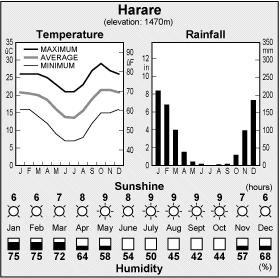
Although located in the tropics, temperate conditions prevail all year, as the climate is moderated by altitude and the inland position of the country. The hot and dry season is from September to October, and the rainy season from November to March. The best months to visit are April to May and August to September. Night-time temperatures can fall below freezing.
Required clothing: Light- to mediumweights with warmer clothes for evenings and rainwear for the wet season.
HISTORY:
Present-day Zimbabwe was the site of a large and complex African civilisation in the 13th and 14th centuries. The people of the area resisted European colonisation until the late 1890s, when British mining interests under Cecil Rhodes' British South Africa Company (BSAC) seized control. The BSAC ran the country, called 'Southern Rhodesia', until 1923, when it became, nominally, a British colony. This followed a referendum (for whites only) on joining the Union of South Africa. Despite attractive terms from South African leader Smuts, there was a heavy vote against the merger. From 1953-63 Southern Rhodesia formed part of the Central African Federation with neighbouring Northern Rhodesia (now Zambia) and Nayasaland (now Malawi). In 1965, to resist decolonisation, the settlers, with South African support, issued a Unilateral Declaration of Independence (UDI). This triggered a bitter civil war between the white minority government and fighters for African independence, ending only in 1980 with the granting of independence and the holding of a general election under British auspices, which was won decisively by Robert Mugabe's ZANU Party. The main focus of dissent in the early years was Joshua Nkomo's ZAPU opposition party. From 1985, however, the two parties moved towards a merger, which was achieved peacefully in January 1988. Named ZANU-PF, the party swept the board in the 1990 national elections, taking 147 of 150 seats. With Nkomo's party neutralised as an opposition force, the charismatic ex-guerrilla commander Edgar Tekere became the principal opposition to Mugabe and his party's continued domination of Zimbabwean politics. However, despite a strong showing in the 1990 elections, Tekere's party was still overwhelmed by ZANU-PF and has since faded. Mugabe sought another 6-year term in 1996. His only opponents were the veteran opposition politicians Abel Muzorewa and Ndabadingi Sithole, both of whom had been involved in the transitional Government of the late 1970s, but all but withdrew from the electoral process shortly before the poll. Mugabe won overwhelmingly on a desultory turn-out. On the economic front, Mugabe has committed his Government to pursuing liberal economic policies. Zimbabwe's historically strong stance against apartheid ensured generally good relations with the Mandela government in South Africa. As the largest members of the Southern African Development Community, the principal pan-national trade body in the region, the two countries have worked together to consolidate and expand the organisation. However, the bilateral relationship has come under great strain during 1998 following Zimbabwe's decision to intervene in the civil war in the Democratic Republic of Congo in support of the newly-installed Government of Laurent Kabila. The war is very unpopular within Zimbabwe, and has served to focus the mounting discontent with the Mugabe Government and its policies. Discontent over the war added to growing corruption, the failure to institute land reform, chronic unemployment and high inflation. The amorphous and disorganised nature of the opposition meant, however, that there was no immediate threat to the Mugabe Government. This changed at the beginning of 1999 with the formation of the Movement for Democratic Change, led by Morgan Tsvangirai, leader of the Zimbabwe Congress of Trade Unions. The Movement's first major test came in February 2000 when, with the economy deteriorating still further, the Government sought a mandate to alter the constitution to increase presidential powers. Although the MDC's trade union base guaranteed strong support in the towns, ZANU-PF's previously solid support in the countryside was expected to deliver the positive result sought by Mugabe. On this occasion, however, public opposition throughout the country was such that the new constitution was rejected. Mugabe's grip on power was now uncertain as never before, but it became increasingly clear that the veteran leader would not give up without a struggle. His strategy was simple: to engage in wide-ranging intimidation of the opposition. During the spring of 2000, MDC activists, particularly in rural areas, were subjected to systematic violence organised by so-called 'war veterans' (in fact composed of organised ZANU-PF gangs and supported by the police and intelligence service). Several were killed. Simultaneously, the land issue – a constant source of frustration given that much of the best land remains under the control of the white minority – was stoked up by organised occupations and further violence, again with 'war veterans' to the fore. While there is no doubt that the land distribution issue must be settled equitably, the Mugabe government's treatment of it has historically been ill-organised and corrupt. The elections due in 2000 have now been scheduled for the end of June. The effects of recent developments upon the efficacy of the MDC as an organised political force are hard to gauge, but the party should make a reasonable showing – particularly in urban constituencies – even if they do not manage to unseat ZANU-PF. Much depends upon the integrity of the election process, for which Commonwealth monitors should be available.GOVERNMENT: Under the terms of the 1980 constitution, executive power is formally vested in the president, consulted by a prime minister, who in reality wields most power. He, in turn, is advised by the Cabinet, which is responsible to the bicameral parliament, which wields all legislative authority. This consists of a House of Assembly, with 150 members, of whom 120 are elected by universal adult suffrage, 12 are nominated by the president, ten are traditional Chiefs and eight are Provincial Governors.
Zimbabwe Tourism Authority (ZTA)
PO Box CY286, Causeway, Harare, Zimbabwe
Tel: (4) 752 570. Fax: (4) 758 828. E-mail: [email protected]
Web site:
http://www.tourismzimbabwe.co.zwHigh Commission for the Republic of Zimbabwe
Zimbabwe House, 429 Strand, London WC2R 0QE
Tel: (020) 7836 7755 or (0891) 600 172 (recorded information line; calls cost 60p per minute). Fax: (020) 7379 1167. Opening hours: Monday to Friday 0900-1700; 0900-1300 (visa section).
Zimbabwe Tourism Office
Address as High Commission.
Tel: (020) 7240 6169. Fax: (020) 7240 5465.
Opening hours: 0900-1300 and 1400-1700 Monday to Friday.
British High Commission
Postal address: PO Box 4490, Harare, Zimbabwe
Street address: Corner House, Samora Machel Avenue/Leopold Takawira Street, Harare, Zimbabwe
Tel: (4) 774 700 or 772 990. Fax: (4) 774 617. E-mail: [email protected]
Embassy of Zimbabwe
1608 New Hampshire Avenue, NW, Washington, DC 20009
Tel: (202) 332 7100. Fax: (202) 483 9326 or 265 7921.
E-mail: [email protected]
Zimbabwe Tourism Office
1270 Avenue of the Americas, Suite 2315, New York, NY 10020
Tel: (212) 332 1090. Fax: (212) 332 1093.
Deals with enquiries from all of North America.
Embassy of the United States of America
Postal address: PO Box 3340, Harare, Zimbabwe
Street address: 172 Herbert Chitepo Avenue, Harare, Zimbabwe
Tel: (4) 794 521. Fax: (4) 796 488. E-mail: [email protected]
High Commission for the Republic of Zimbabwe
332 Somerset Street West, Ottawa, Ontario K2P 0J9
Tel: (613) 237 4388/9. Fax: (613) 563 8269.
E-mail: [email protected]
Canadian High Commission
Postal address: PO Box 1430, 45 Baines Avenue, Harare, Zimbabwe
Street address: Baines Avenue, Harare, Zimbabwe
Tel: (4) 733 881 or 733 885. Fax: (4) 732 917.
Country dialling code: 263.
Overview General Resorts & Excursions Passport/Visa Money Public Holidays Health Travel - International Travel - Internal Accommodation Sport & Activities Social Profile Business Profile Climate History & Government Useful Addresses
Any dead links should be reported to [email protected]
Disclaimer: The information on Zimbabwe has been summarised from various sources and is not necessarily the view of the Government of Zimbabwe its people or District 412, Lions Clubs International or any other Organisation, Group, Business or Individual connected with them.