Other Countries covered by District 412:
Botswana and Zimbabwe
Overview General Resorts & Excursions Passport/Visa Money Duty Free Public Holidays Health Travel - International Travel - Internal Accommodation Sport & Activities Social Profile Business Profile Climate History & Government Useful Addresses
Zimbabwe is bordered by Zambia, Mozambique, South Africa and Botswana. The central zone of hills gives rise to many rivers, which drain into the man-made Lake Kariba to the northwest, the marshes of Botswana to the west or into the Zambezi River to the northeast. The Victoria Falls are a principal attraction.
Harare: Formerly Salisbury, the capital is Zimbabwe's commercial and industrial centre and also the usual starting point for any visit. It is a clean and sophisticated city, characterised by flowering trees, colourful parks and contemporary architecture.
Bulawayo: Zimbabwe's second city is a major commercial, industrial and tourist centre. The city is home of the National Museum and headquarters of the National Railways of Zimbabwe.
From the forested mountains of the Eastern highlands to the sun-washed grasslands of Hwange National Park, from the hot Mopani Forest to the shores of Lake Kariba, more than 11% of Zimbabwe's land – 44,688 sq km (17,254 sq miles) – has been set aside as parks and wildlife estates.
Traditional dishes include sadza (a stiff maize meal) eaten with meat and/or gravy and a relish.
Nightlife is rather limited outside the cities with the emphasis on eating and discos
General
AREA: 118,484 sq km (45,747 sq miles).
POPULATION: 10,441,000 (1997).
POPULATION DENSITY: 88.1 per sq km.
CAPITAL: Lilongwe. Population: 395,500 (1994, including suburbs). Blantyre, with a population of 446,800 (1994), is the largest city in the country.
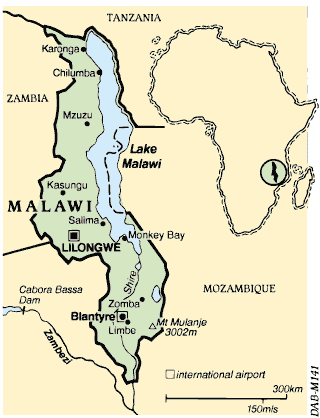
GEOGRAPHY: Malawi shares borders to the north and northeast with Tanzania, to the south, east and southwest with Mozambique and to the north and northwest with Zambia. Lake Malawi, the third-largest lake in Africa, is the dominant feature of the country, forming the eastern boundary with Tanzania and Mozambique. The scenery varies in the country's three regions. The Northern Region is mountainous, with the highest peaks reaching to over 3000m (9843ft), and features the rolling Nyika Plateau, rugged escarpments, valleys and the thickly forested slopes of the Viphya Plateau. The Central Region is mainly a plateau, over 1000m (3300ft) high, with fine upland scenery. This is the country's main agricultural area. The Southern Region is mostly low-lying except for the 2100m-high (6890ft) Zomba Plateau south of Lake Malawi and the huge, isolated Mulanje Massif (3000m/10000ft) in the southeast. The variety of landscape and the wildlife it supports make this relatively unspoilt country particularly attractive to visitors.
GOVERNMENT: Republic since 1966. Gained independence from the UK in 1964. Head of State and Government: President Bakili Muluzi since 1994.
LANGUAGE: The national language is the widely spoken Chichewa but the official language, and that of the business community, is English.
RELIGION: 75% are Christian, 10% Muslim, 10% follow traditional beliefs and there is a small Hindu minority.
TIME: GMT + 2.
ELECTRICITY: 220/240 volts AC, 50Hz. The standard plug is square 3-pin.
COMMUNICATIONS: Telephone: IDD is available. Country code: 265 (no area codes). Outgoing international code: 101. Fax/E-mail: There are facilities for travellers in the main towns, including those in hotel business centres. Telegram: Public facilities for sending telegrams exist at the Main Post Offices. Post: Letters take about seven to ten days to reach Europe by airmail. Post offices are generally open 0730-1200 and 1300-1700 Monday to Friday. Post offices in some of the larger towns may be open 0900-1000 Sunday, but only to sell stamps or to accept telegrams. Press: There are two main daily newspapers, The Daily Times and The Nation. The Malawi News is published weekly and there are now a number of other newspapers.
BBC World Service and Voice of America frequencies: From time to time these change.
BBC:
|
MHz |
21.66 |
17.89 |
11.94 |
6. |
190 |
Voice of America:
|
MHz |
17.10 |
15.41 |
9.575 |
0.909 |
For convenience, the country has been divided into four sections: North, Lake Malawi, Central and South. There is also a section giving information on the Wildlife Reserves and National Parks in Malawi
The regional capital, Mzuzu, has one major hotel and several smaller establishments. The town is approached from the south by a road across the rolling hills of the Viphya Plateau or by the lakeshore road. There are two game areas in the region: the beautiful and unique plateau of Nyika National Park and the Vwasa Marsh Game Reserve. Both have new luxury lodges as well as simpler accommodation. Also in the region is the famous Livingstonia Mission with its interesting museum. Access is difficult up the escarpment road but the Mission can also be reached from the east via Rumphi. Nearby, the Manchewe Falls spill off the escarpment. BACK
Stretching from the northeastern-most tip of Malawi to Mangochi in the south is the massive Lake Malawi. The surface area of the lake covers nearly 24,000 sq km (15,000 sq miles), and lies in the deep, trough-like rift valley which runs the length of the country. The shores of the lake are generally sandy and the resort areas are largely bilharzia free. There are no tides or currents. Most of the hotels provide pleasure craft enabling visitors to enjoy water-skiing, sailing, fishing, snorkelling and windsurfing. Lake Malawi is known to contain more species of fish than any other lake in the world: over 350 at the latest count. Some of the rarest tropical fish in the world are unique to the lake, which is also the home of fish eagles, black eagles, several varieties of kingfishers, terns and many other birds.
Likoma Island, near the Mozambique lakeshore, is worth a visit – there are excellent swimming facilities off the beaches and a very interesting Anglican Cathedral. Accommodation is limited.
One of the best ways of seeing Lake Malawi is to cruise in the 630-ton Ilala II, the lake's mini-liner which travels between Monkey Bay and Karonga in the north of the country. The 1052km (654-mile) voyage gives the passenger the opportunity to visit lake ports and to view the spectacular mountain scenery.
Cape Maclear, near Monkey Bay, has a beautiful sandy beach and is in the Lake Malawi National Park, the world's first freshwater reserve. It is here that the fish-rich lake is seen at its best. There is no luxury accommodation but plenty of mid-range and budget lodges. There are plans for a hotel.
Nkhotakota, on the central lake shore, is one of Africa's oldest market towns and was once a centre of the slave trade. There are mid-range lodges here from which one can visit the nearby national park. Further north is Nkhata Bay, a busy port and market and a favourite stopping place for overlanders. There is a much budget accommodation around the bay. BACK
Senga Bay, near the market town of Salima, is the main lakeshore resort of the central region. Lizard Island, home to many varieties of lizard and eagle, is one of many off-shore islands.
About an hour's drive west from Salima is Malawi's capital, Lilongwe. Alongside the traditional Old Town, with interesting markets, is the modern city and seat of government with its imaginative architecture in a garden setting. There is a wide range of hotels in Lilongwe.
Northwest of the capital is the vast Kasungu National Park with a great variety of wildlife and excellent accommodation. North of Lilongwe is the famous Kamuzu Academy (the 'Eton of Africa'). This is also the region supplying much of the country's important tobacco crop. BACK
Blantyre, Malawi's commercial capital and largest town, was established at the end of the 19th century. It is really two towns: Blantyre and Limbe, joined by a development corridor. Visits can be made to the National Museum, to St Michael and All Angels Church (associated with Dr David Livingstone) and to Mandala House (the oldest European building in Malawi).
North of Blantyre is the university town and former capital, Zomba. Towering above the town is the 1800m (6800ft) Zomba Plateau with its vast forests, waterfalls and lakes. There is a newly rebuilt luxury hotel as well as lodges and a campsite. The views from the plateau are stunning and it is possible to drive around or walk on the plateau top.
To the southeast are large tea estates, above which rises the magnificent Mulanje Massif, a huge block of mountains of more than 640 sq km (250 sq miles) rising to over 3000m (9850ft) at its highest point at Sapitwa. For the tourist, Mulanje offers a wide variety of activities, from rock climbing and mountain walking to the more leisurely pursuit of trout fishing. Much of the massif is accessible and guides can be hired. Forest huts provide simple accommodation. Mulanje is best visited between April and December.
There are a number of game parks and reserves in the Southern Region but best known are Liwonde, north of Zomba and Lengwe in the Lower Shire Valley. The Lower Shire Valley is different from the rest of the country, low lying, hotter and dominated by the great river which drains Lake Malawi. Here are vast sugar plantations at Sucoma. BACK
National Parks & Game Reserves
Malawi has nine national parks and game reserves but six are especially recommended for visitors. There are also many attractive and accessible forest reserves. All the parks and reserves are uncrowded and give visitors an excellent experience of unspoilt wilderness.
Nyika National Park is situated in the north of the northern region. Its unique rolling grassland covers most of the Nyika Plateau, which lies at an altitude of 2000-3000m (6562-9843ft). The whaleback hills are broken by deep valleys and occasional patches of evergreen, natural forest and bubbling streams. Nyika is known to sustain many rare birds and butterflies, game and a multitude of flowers, including an incredible range of orchids. At Chelinda there is a variety of accommodation including new luxury log cabins. The lodges and camp are set high up on the edge of a pine forest, overlooking trout-filled lakes. The enormous plateau has zebra, antelope, leopard and hyena as well as elephant on the lower slopes. A speciality of Chelinda is its horse safaris. There is an airstrip for visitors arriving by air.
Vwasa Marsh Game Reserve is to the west of Mzuzu. A camp with luxury cabins has been established overlooking Lake Kazuni. There is a variety of game including elephant, buffalo and hippo as well as a large number of bird species. There is a mix of woodland, open grassland and marsh. This is a totally unspoilt reserve.
Kasungu National Park, situated in the northwest of the central region, 112km (68 miles) from Lilongwe, consists of some 2000 sq km (770 sq miles) of woodland. The park is best known for its elephants, which appear in the early morning and evening to drink from dambos or river channels. The grasslands support large herds of buffalo, as well as a variety of antelope such as kudu and reedbuck. Predators such as lion and leopard may be seen. Accommodation in the park is easily accessed at Lifupa where there are luxury rondavels as well as a separate self-catering camp.
Liwonde National Park is situated in the Shire Valley, south of Lake Malawi and north of Zomba. It is the most popular of the national parks. The River Shire flows along the eastern border of the park allowing for boat safaris. The river is frequented by vast numbers of hippo, and elephants and crocodiles can also be seen. There is a wide range of game in the park, including rhino and various antelope. Through introductions, Liwonde will soon have the big five for visitors to see. The birdlife includes one of the greatest varieties of species in Africa. There is accommodation in the park at Mvuu, including a luxury lodge and a separate permanent camp and camping site. Walking and driving safaris (in four-wheel-drive vehicles) are on offer. There is a landing strip for visitors coming by air. A new luxury safari lodge is planned for the future in another part of the park.
Lake Malawi National Park lies close to Monkey Bay, towards the southern extremity of the lake. Opened in 1980, it was the world's first freshwater national park and its setting and attractions are world-renowned. Tropical fish, which can be viewed with the use of scuba equipment and masks, are a speciality of the park, while further inland klipspringer, bushbuck and vervet monkeys may be seen. Access to the park is easy throughout the year. There is a limited range of accommodation (mid-range and budget) but a hotel is planned. Many visitors make day-trips from the hotels on the lakeshore south of Monkey Bay.
Lengwe National Park is in the Lower Shire Valley and is only 130 sq km (80 sq miles) in extent. The park has the distinction of being the farthest point north where the rare Nyala antelope can be found. Also here is the diminutive Livingstone's Suni, one of the smallest of antelopes, as well as the rare Blue or Samango monkey. These and other game can be viewed from concealed hides. There is very limited accommodation but a day's visit from Blantyre is possible.
Of the other game reserves, the vast Nkhotakota Game Reserve is little developed and lacks drivable tracks. However, there is a good range of game including lion and elephant. Accommodation can be had at nearby Nkhotakota town. Majete and Mwabvi Game Reserves are in the Lower Shire Valley. Majete has little viewable game and Mwabvi is difficult to access. BACK
|
Passport Required? |
Visa Required? |
Return Ticket Required? |
|
|
Full British |
Yes |
No |
Yes |
|
Australian |
Yes |
No |
Yes |
|
Canadian |
Yes |
No |
Yes |
|
USA |
Yes |
No |
Yes |
|
Other EU |
Yes |
1 |
Yes |
|
Japanese |
Yes |
Yes |
Yes |
PASSPORTS:
Passport valid for at least 6 months beyond date of intended departure required by all.VISAS: Required by all except the following:
(a) nationals of countries indicated in the chart above;
(b) 1. nationals of Belgium, Denmark, Finland, Germany, Ireland (Rep.), Luxembourg, The Netherlands, Portugal and Sweden (nationals of other EU countries do need visas) for up to 90 days;
(c) nationals of Commonwealth countries (except Cameroon, India and Nigeria) for up to 90 days;
(d) nationals of Iceland, Israel, Madagascar, Nepal, Norway and San Marino for up to 90 days.
Note: Passengers can extend their stay by obtaining a residence permit, valid for 6 months from date of entry.
Types of visa and cost: Tourist and Business: £38.
Validity: 3 months from date of issue.
Application to: Consulate (or Consular section at Embassy or High Commission); see address section for details.
Application requirements: (a) 2 application forms. (b) 2 passport-size photos. (c) Fee. (d) Valid passport. (e) Onward ticket. (f) Proof of means of support during residence in country. (g) Letter from company/sponsor, where required.
Working days required: In most cases, applications will be processed in 5 working days, but for nationals of India, Nigeria and Pakistan, applications may take up to 4 weeks.
Temporary residence: Application should be made prior to arrival. Contact the Controller of Immigration Services, PO Box 331, Blantyre, Malawi.
Currency: Kwacha (K) = 100 tambala. Notes are in denominations of K200, 100, 50, 20, 10 and 5. Coins are in denominations of K1 and 50, 20, 10, 5, 2 and 1 tambala.
Currency exchange: US Dollars, Pounds Sterling, Deutschmarks or South African Rand are readily exchanged but lesser-known currencies may prove difficult to exchange.
Credit cards: Acceptance of credit cards is limited, but in the capital and in main hotels MasterCard, Diners Club and American Express can be used. Check with your credit card company for details of merchant acceptability and other services which may be available.
Travellers cheques: As with major currencies, including US Dollars and Sterling, travellers cheques can be exchanged in banks, hotels and other institutions. In remote areas, the Treasury Office of Local District Commissioner's offices will cash travellers cheques. To avoid additional exchange rate charges, travellers are advised to take travellers cheques in US Dollars, Pounds Sterling, Deutschmarks or South African Rand.
Exchange rate indicators against Sterling and the US Dollar: The following figures are included as a guide to the movements of the Kwacha against Sterling and the US Dollar:
|
Date |
Jun'99 |
Oct'99 |
Nov'99 |
May'00 |
|
£1.00= |
69.82 |
72.54 |
74.80 |
74.05 |
|
$1.00= |
43.55 |
44.05 |
45.43 |
49.89 |
Currency restrictions: The import of local currency is unlimited. The export of local currency is limited to K200. The import of foreign currency is unlimited if declared. The export of foreign currency is allowed up to the amount declared on entry.
Banking hours: 0800-1400 Monday to Friday.
The following goods may be imported into Malawi by passengers aged 16 and over without incurring customs duty:
200 cigarettes or 250g of tobacco in any form; 1 litre of spirits and 1 litre of beer and 1 litre of wine.
Prohibited items: The import of firearms is prohibited unless a permit has been bought in advance from the Registrar of Firearms, Box 41, Zomba.
Jan 1 2000 New Year's Day. Jan 15 John Chilembwe Day. Mar 3 Martyrs' Day. Apr 21-24 Easter. May 1 Labour Day. Jun 14 Freedom Day. Jul 6 Republic Day. Oct 9 Mothers' Day. Dec 11 National Tree Planting Day. Dec 25-26 Christmas. Jan 1 2001 New Year's Day. Jan 15 John Chilembwe Day. Mar 3 Martyrs' Day. Apr 13-16 Easter. May 1 Labour Day. Jun 14 Freedom Day. Jul 6 Republic Day. Oct 8 Mothers' Day. Dec 10 National Tree Planting Day. Dec 25-26 Christmas.
Note: If a public holiday falls on a Saturday, the preceding day will be a holiday; if on a Sunday, the next day will be a holiday. Ad hoc public holidays or extensions may also be declared, sometimes at short notice.
|
Special Precautions |
Certificate Required |
|
|
Yellow Fever |
No |
1 |
|
Cholera |
Yes |
2 |
|
Typhoid & Polio |
Yes |
- |
|
Malaria |
3 |
- |
|
Food & Drink |
4 |
- |
1:
A yellow fever vaccination certificate is required from travellers over one year of age arriving within six days of leaving or transiting infected areas.2: Following WHO guidelines issued in 1973, a cholera vaccination certificate is not a condition of entry to Malawi. However, cholera is a risk in this country and precautions are essential. Up-to-date advice should be sought before deciding whether these precautions should include vaccination, as medical opinion is divided over its effectiveness. See the Health appendix.
Note: It has been reported that cholera vaccination certificates have been demanded at the border with Tanzania; if immunisation is necessary, avoid the use of local needles under all circumstances.
3: Malaria risk exists all year throughout the country. The predominant malignant falciparum strain is reported to be highly resistant to chloroquine and resistant to sulfadoxine-pyrimethamine.
4: All water should be regarded as being potentially contaminated. Water used for drinking, brushing teeth or making ice should have first been boiled or otherwise sterilised. Milk is unpasteurised and should be boiled. Powdered or tinned milk is available and is advised, but make sure that it is reconstituted with pure water. Avoid dairy products which are likely to have been made from unboiled milk. Only eat well-cooked meat and fish, preferably served hot. Pork, salad and mayonnaise may carry increased risk. Vegetables should be cooked and fruit peeled.
Rabies is present. For those at high risk, vaccination before arrival should be considered. If you are bitten, seek medical advice without delay. For more information consult the Health appendix.
Bilharzia (schistosomiasis) is present, and has been confirmed to occur in some parts of Lake Malawi. Avoid swimming and paddling in slow-moving or stagnant fresh water. Swimming pools which are well-chlorinated and maintained are safe. Trypanosomiasis (sleeping sickness) is reported. Hepatitis A, B and E are present. Meningococcal meningitis can occur, especially in the dry season. Filariasis also occurs. Avoid tick and insect bites, as they can result in viral diseases.
Health care: Health insurance is essential. It is advisable to take personal medical supplies.
AIR: Malawi's national airline is Air Malawi (QM), which operates flights to London. Other airlines serving Malawi include British Airways and Air Zimbabwe. There are connections from Amsterdam to Lilongwe, via Nairobi on KLM/Kenya Airways. There are also connections between Malawi and Kenya, Tanzania, Zambia, South Africa and Zimbabwe.
Approximate flight time: From Lilongwe to London is approximately 12 hours.
International airports: Lilongwe (LLW) (Lilongwe International) is 22km (13 miles) from the city (travel time – 20 minutes). Taxis and a bus service are available to the city from the airport. Airport facilities include a duty-free shop, post office, local travel agents, car hire (Avis and SS Rent-a-Car), bank/bureau de change, restaurant and bar.
Blantyre (BLZ) (Chileka) is 18km (11 miles) from the city. There is a coach service to the city. Airport facilities include car hire (Avis and SS Rent-a-Car), restaurant and bar.
Departure tax: A passenger service charge of US$20 (payable in US currency) is levied on all international flights. Malawi passport holders can pay in local currency (K150).
ROAD: There are road connections with Mozambique at Mwanza in southwestern Malawi and at Ciponde in the east; with Tanzania at the Songwe River Bridge in the far northwest of the country; and with Zambia on the main Lilongwe–Lusaka highway near Chipata in the west. The route into Zimbabwe via the Tete corridor in Mozambique has been considered unsafe in the past but is now widely used by both visitors and business people.
AIR: The air network Air Malawi links Blantyre and Lilongwe with local airports at Mzuzu, Karonga, Club Makokola, Chelinda and Likoma. In addition, planes are available for charter through local travel bureaux.
Departure tax: K75 is payable on domestic flights.
LAKE: Cruises on Lake Malawi are available by local steamer. Food and cabins are available. For details contact Malawi Railways (Lake Services) or local travel bureaux.
RAIL: Malawi Railways operates the lines in the country. The main route (see map) connects Mchinji, Lilongwe, Salima, Chipoka, Blantyre, Limbe and Nsanje to the Mozambique port of Beira. The connection to Beira has been suspended since 1985. For further information, contact Malawi Railways, PO Box 5144, Limbe (tel: 640 844; fax: 643 262). Trains tend to be slow and crowded and are little used by tourists.
ROAD: Traffic drives on the left. There are over 13,500km (8400 miles) of roads in the country. All major roads are tarmac and most secondary roads are all-weather. Bus: There is a good bus system, including an express service, connecting main towns. The journey from Mzuzu to Karonga is particularly spectacular. Luxury coaches connect Blantyre–Mzuzu–Lilongwe. Car hire: This is available in major towns. Cars should be reserved well in advance as they are very much in demand. Chauffeur-driven cars are also available. Documentation: Nationals of certain countries, including the UK, do not require an International Driving Permit. A national driving licence is sufficient.
URBAN: Bus: There are services in all major cities. Taxi: These are in short supply and cannot be hailed on the street. Taxi drivers expect a tip.
JOURNEY TIMES: The following chart gives approximate average journey times (in hours and minutes) from Lilongwe to other major cities/towns in Malawi.
|
Air |
Road |
|
|
Blantyre |
0.40 |
4.30 |
|
Mzuzu |
1.00 |
5.00 |
|
Zomba |
- |
4.00 |
|
Karonga |
1.30 |
6.30 |
|
Salima |
- |
1.00 |
|
Mangochi |
1.00 |
4.30 |
HOTELS: There is a range of hotels in the main towns: Lilongwe, Blantyre/Limbe and Mzuzu. The same is true along the lakeshore with a concentration in the south between Monkey Bay and Mangochi. Zomba Plateau has a new luxury hotel.
REST HOUSES: A programme of privatisation has seen many of the rest houses and forest reserve lodges transformed into luxury or mid-range lodges, the equivalent of established hotels.
NATIONAL PARKS: Recent years have seen a transformation in four of the parks and reserves: Liwonde, Kasungu, Nyika and Vwasa. Single privately-run safari camps/lodges have replaced government camps in all of these parks. New luxury en-suite accommodation is provided in permanent tents, rondavels, log cabins or bamboo huts. There is also good quality mid-price accommodation and a campsite. Full catering is available. Booking ahead is important especially at weekends and in holiday periods. See also National Parks in the Resorts & Excursions section.
CAMPING: There are campsites along the lakeshore, often near the hotels, and elsewhere in the resort and forest areas. Most game parks and reserves have campsites. Sites are usually well equipped and camping is excellent during the dry season: April to November.
Malawi is becoming well known for the number of activities it can offer visitors. Game viewing in the national parks is especially attractive to those wanting to experience trekking and viewing in entirely natural surroundings without tarred roads filled with convoys of four-wheel-drive vehicles. Birdwatching is excellent throughout the country, which is something of a birdwatcher's paradise at any time in the year.
Lake Malawi offers a range of watersports along its whole length. Fishing is especially attractive on the southern lakeshore north of Mangochi and at Senga Bay. Tournaments take place each year and catches include the good- to-eat Sungwa. There are also opportunities to fish for yellow fish, lake salmon and lake tiger. Elsewhere angling for trout is easily arranged at Chelinda on Nyika Plateau. There is good fishing in the lake salmon-rich rivers of Nkhotakota Game Reserve and on Zomba Plateau – again for trout.
Scuba diving and snorkelling are increasingly popular in Lake Malawi because of the attraction of seeing the brilliantly coloured fish, the mbuna. Instruction in these sports for beginners as well as for experienced practitioners is possible at many resorts. Swimming, water-skiing, sailing and canoeing are all available along the lakeshore. The Lake Malawi 500km Sailing Marathon, which is the world's longest freshwater sailing race, is held each year in June or July and attracts an international entry.
The risk of contracting bilharzia when engaging in watersports in Lake Malawi is minimised if sensible precautions are taken: bathers should swim only at the resort areas known to be free of bilharzia, avoiding parts of the lake where there is still water or human habitation. Many areas of the lake are bilharzia-free.
There is plenty of scope for mountaineering. Rising to a height of 3000m (9850ft), Mount Mulanje is the highest mountain in central Africa and has proved to be an irresistible lure to climbers. The massif has the longest sheer rock face in Africa. Dedza, south of Lilongwe, and Michiru Ndirande and Chiradzulu, near Blantyre, also offer challenging slopes. Trekking and walking are popular on the Nyika Plateau where guides and porters are available for one- to six-day wilderness trails. The same arrangements apply on Mount Mulanje where huts are available for hire. There is excellent walking on Zomba Plateau.
Horseriding is available on Nyika Plateau, where safaris on horseback are popular, and on Zomba Plateau, where there is also a dressage school. Cycling has more recently been added to Malawi's list of activities for tourists and has also attracted the interest of charity organizations. Popular areas include Nyika and Luwawa Forest.
Tennis, golf and squash are available at some hotels and at sports clubs in Lilongwe, Blantyre and Mzuzu.
FOOD & DRINK: Fresh fish from Lake Malawi is the country's speciality, chambo (Tilapia fish) being the main lake delicacy. There are trout from streams on the Zomba, Mulanje and Nyika plateaux. Hotel restaurants and many of those in the cities are of a high standard. They offer a wide choice of excellent food including haute cuisine, the unique Lake Malawi dishes and the best Malawi beef. Poultry and dairy produce are plentiful and tropical fruits are abundant in season. Drink: The local beer is very good and imported beer and soft drinks are widely available. Malawi gin, which is well known and inexpensive, and tonic have reached almost cult status. Wine is imported largely from South Africa.
SHOPPING: Malawi produces a variety of colourful arts and crafts. Items are invariably handmade and there is no factory production of curios. Purchases include woodcarvings, wood and cane furniture, soapstone carvings, decorated wooden articles, colourful textiles, pottery, beadwork, cane and raffia items. The standard of woodcarving is one of the highest in Africa. The Mua Mission, south of Salima, where carvers are trained, has an excellent shop. Traditional musical instruments are also sold throughout Malawi. Shopping hours: 0800-1700 Monday to Saturday. Markets and roadside stalls function every day.
SPECIAL EVENTS: Dance plays a part in most ceremonies in Malawi, an important dance being the Gule Wamkulu, with its heavily carved masks, feathers and skin paint. It is performed by the Chewa and Mang'anja, and this and other national dances can be seen at the annual Malawi Republic Day celebrations held the first week in July.
ECONOMY: The economy is almost entirely agricultural, with both subsistence and cash crops including tobacco, sugar, tea and maize being farmed. Despite being self-sufficient in food, Malawi has a vast balance of payments deficit and is heavily dependent on foreign aid, both bilateral and from the World Bank. Manufacturing industry has grown steadily, accounting now for about one-sixth of economic output, and is concentrated in light industrial import substitution projects such as textiles, chemicals, agricultural implements and processed foodstuffs. Tourism is set to become a major source of foreign exchange as the industry sees planned but sensitive growth. Economic policy has followed an orthodox course of privatisation and liberalisation: while this has had success in bringing down inflation, the social impact has been severe. Malawi is a member of the Southern African Development Community and, in 1993, signed the treaty establishing a Common Market for Eastern and Southern Africa (COMESA). The UK is Malawi's most important single trading partner, taking one-third of the country's exports and providing 15% of Malawi's imports. South Africa, Japan, Germany and the Netherlands are Malawi's other important trading partners.
BUSINESS: Suits or a jacket and tie are suitable for business meetings in cities. Similar to the European system, appointments should generally be made and business cards are used. Offices tend to open early in Malawi. Best months for business visits are May to July and September to November. Office hours: 0730-1700 Monday to Friday.
COMMERCIAL INFORMATION: The following organisation can offer advice: Associated Chambers of Commerce and Industry of Malawi, PO Box 258, Chichiri Trade Fair Grounds, Blantyre (tel: 671 988; fax: 671 147).
CONFERENCES/CONVENTIONS: Malawi's only dedicated conference centre is the Kwacha International Conference Centre in Blantyre, with seating for up to 500 persons. Details of this and hotels with conference facilities can be obtained from the Malawi Tourism Information Service (see address section).
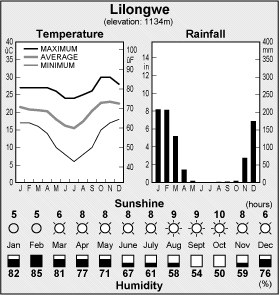
Varies from cool in the highlands to warm around Lake Malawi. Winter (May to July) is dry and nights can be chilly, particularly in the highlands. The rainy season runs from November to March. Around Lake Malawi, in winter, the climate is particularly dry with pleasant cooling breezes.
Required clothing: Lightweights are worn all year in the Lake Malawi area, with warmer clothes advised in the mountains, particularly during winter and on chilly evenings elsewhere. Visitors to Nyika and Zomba should note that the nights can be cold. Dark or 'natural' coloured clothing should be worn for game viewing.
HISTORY: Formerly Nyasaland, Malawi was once named Maravi, or 'reflected light', perhaps referring to the brilliant glitter on Lake Malawi as the sun shines on it. The shores of Lake Malawi have been inhabited for thousands of years and recent archaeological excavations have revealed evidence of settlements dating back to the late Stone and Iron Ages. The majority of the present population descend from Bantu tribes (ancestors of the present Chewa, Nyanja, Lomwe, Yao, Tumbuka, Sena, Tonga, Ngoni and Ngonde tribes) who arrived in the region some time before the first Arab slave traders and Portuguese explorers. British colonial settlers and missionaries, men such as the famous Dr David Livingstone, moved into the area in the late 1850s. With the growth of commerce and expanding plantations of successful cash crops, Malawians migrated towards settlers' estates in search of work. Colonial domination became inevitable, and in 1891 the British declared the country the British Protectorate of Nyasaland. In 1953 the British federated Nyasaland with Northern and Southern Rhodesia (now Zambia and Zimbabwe), but Nyasaland seceded in 1963, following elections which gave Dr Hastings Kamuzu Banda's Malawi Congress Party (MCP) a majority in the Legislative Council. Banda had previously enjoyed a diverse career, including as a medical practitioner, before entering politics. In 1964, Nyasaland became independent as Malawi and, two years later, Dr Banda declared it a republic and a one-party state. Membership of the Malawi Congress Party is compulsory for all citizens. In 1971 Dr Banda became President for Life, and during his subsequent reign retained a firm grip on all aspects of the country. Opponents of the regime were jailed or exiled. Banda's foreign policy also attracted widespread criticism, specially his support of the apartheid regime in South Africa (Malawi was the only black-ruled African state to maintain an embassy there and to receive state visits). His initial support (later reversed) for the South African-backed guerrillas in Mozambique was also unpopular among fellow African leaders. But by 1993, the ailing Banda was forced to concede political pluralism in Malawi and a referendum in July that year endorsed a transition to multi-party democracy. After the adoption of a new constitution, simultaneous parliamentary and presidential elections were held in May 1994. Mulizi won the latter and his party, the UDF, the former. The dominant political issue in the country then became the trial of Banda and his right-hand man, John Tembo, on charges of the murder of four opposition politicians in 1983. They were acquitted in December 1995, although various investigations into misdemeanours, mainly financial, continued. These came to an inconclusive end upon Banda's death in November 1997. Mulizi won a second term in office at the presidential election of June 1999, defeating his main opponent, Malawi Congress Party opponent Gwanda Chakwanda, and taking 52% of the poll. Simultaneous elections for the national Assembly gave the UDF 93 seats, just short of an absolute majority but enabling it to rule in alliance with the support of smaller parties and non-partisan elements.Abroad, Malawi has aligned itself with the post-liberation government in South Africa, the main political and economic force in the region. Domestically, the AIDS epidemic is the dominant social issue: in common with other governments in the region, the Malawians often seem overwhelmed by the scale of the problem.
GOVERNMENT: The president is head of state, and holds all executive powers. Legislative authority is vested in the unicameral National Assembly with 112 members, elected for a 5-year term.
Malawi Department of Tourism
PO Box 402, Kateni House, Blantyre, Malawi
Tel: 620 300. Fax: 620 947 or 621 923.
E-mail: [email protected]
Web site: http://www.malawi-tourism.com
Ministry of Tourism, Parks and Wildlife
P/Bag 326, Lilongwe 3, Malawi
Tel: 781 073. Fax: 780 650 or 743 676.
High Commission for the Republic of Malawi and Ministry of Tourism Office
33 Grosvenor Street, London W1X 0DE
Tel: (020) 7491 4172. Fax: (020) 7491 9916.
E-mail: [email protected]
Opening hours: 0930-1700 Monday to Friday.
Malawi Tourism Information Service (UK)
Tel: (0115) 982 1903. Fax: (0115) 981 9418.
E-mail:
[email protected]British High Commission
PO Box 30042, Lilongwe 3, Malawi
Tel: 782 400. Fax: 782 657.
Embassy of the Republic of Malawi
2408 Massachusetts Avenue, NW, Washington, DC 20008
Tel: (202) 797 1007. Fax: (202) 265 0976.
Embassy of the United States of America
PO Box 30016, Area 40, Flat 24, Kenyatta Road, Lilongwe 3, Malawi
Tel: 783 166. Fax: 780 471.
High Commission for the Republic of Malawi
7 Clemow Avenue, Ottawa, Ontario K1S 2A9
Tel: (613) 236 8931. Fax: (613) 236 1054.
E-mail: [email protected]
Consulate in
: Toronto.The Canadian High Commission in Lusaka deals with enquiries relating to Malawi.
Country dialling code: 265.
Overview General Resorts & Excursions Passport/Visa Money Duty Free Public Holidays Health Travel - International Travel - Internal Accommodation Sport & Activities Social Profile Business Profile Climate History & Government Useful Addresses
Any dead links should be reported to [email protected]
Disclaimer: The information on Malawi has been summarised from various sources and is not necessarily the view of the Government of Malawi its people or District 412, Lions Clubs International or any other Organisation, Group, Business or Individual connected with them.