Other Countries covered by District 412:
Malawi and Zimbabwe
Overview General Resorts & Excursions Passport/Visa Money Duty Free Public Holidays Health Travel - International Travel - Internal Accommodation Sport & Activities Social Profile Business Profile Climate History & Government Useful Addresses
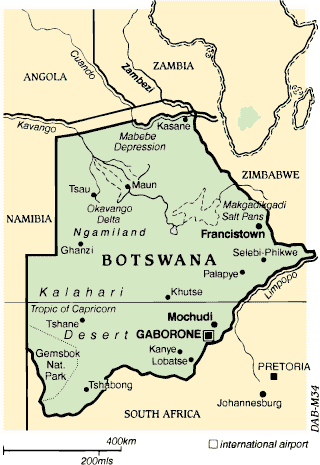
Botswana borders South Africa to the south and east, Zimbabwe to the northeast and Namibia to the north. The tableland of the Kalahari Desert covers most of the country and the national parks cover an additional 17%. The vast arid sand veld of the Kalahari occupies much of north, central and western Botswana.
Gaborone, the capital, is situated in the southeast of the country and features an excellent National Museum with natural history and ethnological exhibitions, but it is Botswana's national parks and game reserves that are the real attraction.
The Okavango Delta area, northwards in the Kalahari Desert, is home to over 300 exotic species and a variety of fauna. It is extremely beautiful, composed of vast grass flats, low tree-covered ridges and lagoons.
The Moremi Wildlife Reserve in southern Africa, covering 1812 sq km (700 sq miles) in the northeast corner of the Okavango Delta, is spectacular. Small boats travel the delta through lagoons abundant with birdlife. Most lodges and safari camps have restaurants and licensed bars.
General
AREA: 581,730 sq km (224,606 sq miles).
POPULATION: 1,533,393 (1997).
POPULATION DENSITY: 2.6 per sq km.
CAPITAL: Gaborone. Population: 110,973 (1998).
GEOGRAPHY: Botswana is bordered to the south and east by South Africa, to the northeast by Zimbabwe, to the north and west by Namibia and touches Zambia just west of the Victoria Falls. The tableland of the Kalahari Desert covers most of Botswana. National parks cover 17% of the country. To the northwest is the Okavango Basin, where the Moremi Wildlife Reserve and the Chobe National Park support abundant wildlife. To the far southwest is the Kalahari Gemsbok National Park. The majority of the population lives in the southeast around Gaborone, Serowe and Kanye along the South African border. The vast arid sandveld of the Kalahari occupies much of north, central and western Botswana. The seasonal rains bring a considerable difference to the vegetation, especially in the Makgadikgadi Pans and the Okavango Basin in the north. The latter, after the winter floods, provides one of the wildest and most beautiful nature reserves in Africa.
GOVERNMENT: Republic since 1966. Head of State and Government: President Festus Mogae since 1998.
LANGUAGE: English is the official language. Setswana is the national language.
RELIGION: 30% Christian. The majority of the population holds animistic beliefs. There are small Muslim communities. The Bahá'í Faith is also represented.
TIME: GMT + 2.
ELECTRICITY: 220-240 volts AC, 50Hz. 15- and 13-amp plug sockets are in use.
COMMUNICATIONS: Telephone: IDD is available to over 80 countries. Country code: 267. Outgoing international code: 00. There are very few public phone boxes. Mobile telephone: Dual band width. Local providers include Mascom. Coverage is limited to the main inhabited areas. Fax: Use of this service is increasing. Internet/E-mail: Roaming agreements in operation. Local ISPs include IBIS and Mega. Telegram: There are facilities in Gaborone and other large centres (usually in major hotels and main post offices). Post: There are post offices in all towns and the larger villages, open 0815-1245 and 1400-1600 weekdays and 0800-1100 Saturday. Services are slow but cheap. Airmail service to Europe takes from one to three weeks. There are post offices in all the main towns, although there are no deliveries and post must be collected from boxes. Press: The daily newspaper is the Dikgang tsa Gompieno (Botswana Daily News), published in Setswana and English. Other English-language newspapers include Mmegi (The Reporter), The Midweek Sun, The Botswana Gazette and The Botswana Guardian.
BBC World Service and Voice of America frequencies: From time to time these change.
BBC:
|
MHz |
17.83 |
15.40 |
7.160 |
6.005 |
Voice of America:
|
MHz |
17.92 |
15.58 |
7.415 |
1.530 |
Resorts & Excursions
Gaborone: The capital is situated in the southeast of the country. There is an excellent National Museum open from 0900-1800 Tuesday to Friday and 0900-1700 weekends, with natural history and ethnological exhibitions. As well as permanent displays, there are also temporary exhibitions and various symposia and conferences. The visitor will find Sites of Historic and Natural Interest In and Around Gaborone a useful pamphlet. Gaborone has several good bookshops and libraries, including the University of Botswana Library which has a 'Botswana Room' devoted solely to publications on the country. There are good craft shops and markets in the town, where pottery, basketwork, leatherwork and handwoven objects may be bought.
Excursions: Nearby is the Gaborone Dam, a centre for watersports, and day trips can be made to see local crafts at Oodi, Thamaga and Pilane. A trip to the weaving centre at Lentswe-La-Odi, just north of Gaborone, is especially recommended. Local craftwork can be bought here at a fraction of its cost in the big cities. The centre is a non-profitmaking organisation, with proceeds going back to the craftspeople. Mochudi, also north of Gaborone, is the regional capital of the Bakgatla tribe and has an interesting museum (the Phuthadikobo Museum) which chronicles the history of the Bakgatla people in fascinating detail. Serowe, located even further north of Gaborone on the way to Francistown, is one of the largest villages in Botswana and seat of the Bangwato tribe. The Khama III Memorial Museum, located in the Red House at the base of the Serowe Hill, has memorabilia of the Khama Family, the family from which Botswana's first President, Sir Seretse Khama, emerged. On Khama III's grave (Sir Seretse's grandfather) is a bronze duiker sculpted by the famous South African artist Anton van Wouw. Francistown, a 19th-century goldrush town, is a stopping-off point for visitors on the way to the Okavango, Moremi and Chobe game reserves and is also served by Air Botswana from Gaborone. A new museum, the Supa-Ngwao Museum, has opened in Francistown with an information centre and a craft shop with books and maps.
National Parks
Botswana is a vast dry land with over 80% of the country being semi-desert (sand with thorn and scrub bush), so there are many remote areas to visit, with abundant wildlife. All national parks and game reserves have camping areas with capacity for up to six persons each.
Undoubtedly the most striking region is the Okavango Delta area in the north of the country in the Kgalagadi (or Kalahari) Desert and easily accessible from Maun between June and September. Home to about 36 species of mammals, 200 species of birds, 80 species of fish and a wealth of flora, the Delta was created by shifts of the earth's surface forcing a river system away from its natural path (to the Indian Ocean), to form the greatest inland delta system in the world. The region is extremely beautiful, covering an area of about 15,000 sq km (6000 sq miles) and composed of vast grass flats, low tree-covered ridges and a widespread network of narrow waterways opening into lagoons. The thick papyrus reeds which thrive in these waters make much of the northern section impenetrable except by dug-out canoe (mokoro). The waters, however, are often a clear blue, and crocodiles, hippos and hundreds of fabulous birds can be seen, as well as elephants, zebras and giraffes. There are three lodges in Maun; Island Safaris, Crocodile Camp and Okavango River Lodge. At Island Safaris there is a swimming pool, and films are shown. Chief's Island may be reached by air or by mokoro and there is a tented camp at Xaxaba. The whole area is a designated national park.
One of the most beautiful and perhaps the most spectacular game reserves in southern Africa is the Moremi Game Reserve, covering 1812 sq km (700 sq miles) in the northeast corner of the Okavango Delta. Small boats travel along the delta, visiting lagoons like Xakanaxa, Gcobega and Gcodikwe with their abundance of birdlife. The roads are, however, particularly bad in this region. There is a risk from both tsetse fly and malaria. South of here, the Gcwihaba Caverns, about 240km (150 miles) from Tsau, contain beautiful stalactites. The name means 'Hyena's Hole' in the Quing language of the Bushmen. Other parks of interest in this region include the Gemsbok National Park, the Central Kalahari Game Reserve and the Kutse Game Reserve.
The Tsodilo Hills are situated north of the Okavango Delta close to the border with the Caprivi Strip (Namibia), and are the site of over 1700 rock paintings, painted between approximately AD1000 and 1800, and mostly portraying animal life. They are thought to be the work of ancestors of the Basarwa and Bantu groups still living in the region (who have labelled the hills Male, Female and Child). There are strong similarities between these paintings and those found on sites in Zimbabwe, Tanzania, South Africa and Lesotho. The hills are reached by air or road but there are no camping facilities or water supplies so visitors should allow for water, food and fuel needs.
The Chobe National Park with an area of approximately 11,700 sq km (4517 sq miles) is the home of a splendid variety of wildlife, including the white rhinoceros and the elephants who move in their thousands along the well-worn paths of the Chobe River every afternoon to drink. There are also herds of buffalo to be seen at the river's edge, as well as hippo, lechwe, kudu, impala, roan and puku. With the exception of certain sections, which are closed in the rainy season during November to April, the park is open throughout the year. The best time to visit it is between May and September when it is possible to see several thousand animals in a day. An exclusive lodge has recently been completed within the National Park, 12km (8 miles) from Kasane, which is situated 69km (42 miles) west of the Victoria Falls on a good tarmac road. Although the most developed of Botswana's parks and reserves, many of the roads in the area are passable only by four-wheel-drive vehicles.
The Nxai Pan National Park, situated only 32km (20 miles) north of the main Francistown to Maun road, is completely flat and covered with grass cropped short by the large quantity of wildlife that visits during the rainy season. The area is famous for the Makgadikgadi Pans, once a huge prehistoric lake, and now a flat salt sheet which floods in the rainy season and becomes populated by thousands of brilliant pink flamingoes. Herds of zebra and wildebeest also come to drink here. When the Makgadikgadi loses its water the animals move on to the Boteti River where they remain until the following rainy season, which heralds their movement northwards again to the Nxai Pan. There are basic camping facilities in the area, but essentials such as water, food and fuel should be brought in.
Central Kalahari Game Reserve is the second-largest game reserve in the world. Khutse Game Reserve is an expanse of dry savannah land in the centre of the Kalahari which, when filled with water, attracts hundreds of bird species. It is located about 240km (150 miles) northwest of Gaborone. Camping facilities are basic, and water, food and fuel should be brought. There are still a few small bands of Bushmen (Basarwa) living in this region, one of the last Stone Age races on earth, some of whom guide visitors around the reserve and teach them about edible and moisture-bearing plants and how many of the animals survive despite the lack of water. Kalahari Gemsbok National Park, in the southwest of this region, has deep fossil river beds and high sand dunes. The park can be reached by a paved road from Gaborone to Tsabong, after which a four-wheel-drive vehicle is necessary. Many herds of gemsbok and springbok (as well as other species of antelope), cheetah and lion can be seen here and the best time to visit is from March to May. The Kalahari Gemsbok and Mabuasehube game reserves have combined to form the Gembsbok National Park. The area is known for its salt pans which reflect amazing colour changes during the day. Antelope, foxes and over 170 bird species (including buzzards, vultures and eagles) can be viewed here, particularly during the months from July to September.
Passport/Visa
|
Passport Required? |
Visa Required? |
Return Ticket Required? |
|
|
Full British |
Yes |
No |
Yes |
|
Australian |
Yes |
No |
Yes |
|
Canadian |
Yes |
No |
Yes |
|
USA |
Yes |
No |
Yes |
|
Other EU |
Yes |
No |
Yes |
|
Japanese |
Yes |
No |
Yes |
PASSPORTS:
Passports valid for at least 12 months required by all.VISAS: Required by all except the following for stays of up to 90 days:
(a) nationals referred to in the chart above;
(b) nationals of Commonwealth countries (except nationals of Bangladesh, Cameroon, Ghana, India, Mauritius, Mozambique, Nigeria, Sierra Leone and Sri Lanka, who do require visas);
(c) nationals of Iceland, Liechtenstein, Norway, San Marino, Switzerland and Uruguay;
(d) transit passengers provided continuing their journey by the same or first connecting aircraft and not leaving the airport.
Types of visa and cost: General Entry; single- or multiple-entry. All visas cost £5.
Validity: Maximum of 90 days from the date of arrival. No visitor is allowed to seek employment.
Application to: Consulate (or Consular Section at Embassy or High Commission); see address section.
Application requirements: (a) 2 completed application forms. (b) 2 passport-size photos. (c) Passport valid for at least 12 months. (d) Fee.
Temporary residence: Anyone wishing to stay for more than 90 days should contact the Immigration and Passport Control Officer, PO Box 942, Gaborone.
Currency: Pula (P) = 100 thebe. Notes are in denominations of P100, 50, 20, 10 and 5. Coins are in denominations of P2 and 1, and 50, 25, 10, 5 and 1 thebe. Various gold and silver coins were issued to mark the country's 10th anniversary of independence, and are still legal tender.
Currency exchange: Money should be exchanged in banks at market rates. Owing to limited facilities in small villages, it is advisable to change money at the airport or in major towns.
Credit cards: MasterCard, American Express, Diners Club and Visa are accepted on a limited basis. Check with your credit card company for details of merchant acceptability and other services which may be available.
Travellers cheques: To avoid additional exchange rate charges, travellers are advised to take travellers cheques in US Dollars or Pounds Sterling. Most hotels accept travellers cheques, but the surcharge may be high.
Exchange rate indicators against Sterling and the US Dollar: The following figures are included as a guide to the movements of the Pula against Sterling and the US Dollar:
|
Date |
Jul'98 |
Oct'98 |
Apr'99 |
Nov'99 |
|
£1.00= |
7.57 |
7.67 |
7.46 |
7.59 |
|
$1.00= |
4.57 |
4.54 |
4.66 |
4.61 |
Currency restrictions:
There are no restrictions on the import of local or foreign currencies, provided declared on arrival. Export of local currency is limited to P50 and foreign currencies up to amount declared on arrival.Banking hours: 0900-1530 Monday to Friday and 0815-1045 Saturday.
The following goods may be taken into Botswana without incurring any duty:
400 cigarettes or 50 cigars or 250g of tobacco; 2 litres of wine and 1 litre of spirits; 50ml of perfume and 250ml of eau de toilette; goods up to the value of P500.
Jan 1 2000 New Year's Day. Apr 21 Good Friday. Apr 24 Easter Monday. May 1 Labour Day. Jun 1 Ascension Day. Jul 1 Sir Seretse Khama Day. Sep 30-Oct 1 Botswana Day. Dec 25-26 Christmas. Jan 1 2001 New Year's Day. Apr 13 Good Friday. Apr 16 Easter Monday. May 1 Labour Day. May 24 Ascension Day. Jul 1 Sir Seretse Khama Day. Sep 30-Oct 1 Botswana Day. Dec 25-26 Christmas.
|
Special Precautions |
Certificate Required |
|
|
Yellow Fever |
No |
- |
|
Cholera |
No |
No |
|
Typhoid & Polio |
Yes |
- |
|
Malaria |
1 |
- |
|
Food & Drink |
2 |
- |
1:
Malaria risk exists from November to May/June in the northern part of the country (Boteti, Chobe, Ngamiland, Okavango and Tutume districts/subdistricts), predominantly in the malignant falciparum form. A weekly dose of 300mg chloroquine plus a daily dose of 200mg proguanil is the recommended prophylaxis.2: Tap water is considered safe to drink, although drinking water outside main cities and towns may be contaminated and sterilisation is advisable. Milk is pasteurised and dairy products are safe for consumption. Local meat, poultry, seafood, fruit and vegetables are generally considered safe to eat.
Bilharzia (schistosomiasis) is endemic. Avoid swimming and paddling in fresh water. Swimming pools which are well-chlorinated and maintained are safe. Trypanosomiasis (sleeping sickness) is transmitted by tsetse flies in the Moremi Wildlife Reserve, Ngamiland and western parts of the Chobe National Park. Protective clothing and insect repellant are recommended. Tick-bite fever can be a problem when walking in the bush. It is advisable to wear loose-fitting clothes and to search the body for ticks. The disease may be treated with tetracycline, though pregnant women and children under eight years of age should not take this medicine. Hepatitis A occurs. Hepatitis B is hyperendemic.
Health care: The dust and heat may cause a problem for asthmatics and people with allergies to dust. Those with sensitive skin should take precautions. Botswana's altitude, 1000m (3300ft) above sea level, reduces the filtering effect of the atmosphere. Hats and sunscreen are advised.
There are hospitals in all main towns. All main towns have chemists, and pharmaceutical supplies are readily available. Health insurance is essential. There is a government medical scheme and medicines supplied by government hospitals are free.
AIR: The national airline is Air Botswana (BP) which only operates within Africa. There are no direct flights from London to Gaborone but regular connections can be made from Johannesburg. Other airlines serving Botswana include South African Airways.
Approximate flight time: From Gaborone to London is 15 hours (including stopovers).
International airport: Sir Seretse Khama International (GBE) is 15km (9 miles) northwest of Gaborone. There are no regular bus services to and from the airport but several hotels run minibuses (combis). Taxis are available to the city centre (travel time – 15 minutes). Airport facilities include left luggage (0530-1800), bank (Barclays Bank available for all flights), bar (0800-1830), snack bar (0800-1830), restaurant (0800-1830), post office (0800-1700), shops and car rental (Avis and Imperial).
There is a major airport at Kasane (north Botswana). Amuch International Airport was opened at Maun in July 1996, receiving direct flights from Johannesburg, Windhoek and Gaborone. See below for information on private charters to neighbouring countries.
RIVER: A car ferry operates across the Zambezi River to Zambia.
RAIL: There are good connections between South Africa and Botswana (Johannesburg–Mafikeng–Ramatlhabama–Gaborone) and Botswana and Zimbabwe (Gaborone–Francistown–Bulawayo–Harare). From Gaborone to Bulawayo takes 20 hours; passengers are advised to take their own food and drink as the buffet has a limited range.
There are three classes, and sleeping compartments are available. First-class cars have comfortable reclining seats. Complicated formalities may be necessary for crossing the border from Zimbabwe and to or from South Africa, where the South African Customs Union agreement is in operation.
Botswana has assisted in the construction of the Limpopo line from Zimbabwe to Mozambique, an act which will speed up the availability of alternative routes into Botswana. Other plans include extending the network into Namibia.
ROAD: There are reasonable roads running roughly along the same routes as the railway, linking Botswana with South Africa and Zimbabwe. Bus: Services are available from Namibia and Zimbabwe. Frequent services operate between Gabarone and Johannesburg.
AIR: Major areas of the country are linked by air. There are airports in Francistown, Maun, Selebi-Phikwe, Ghanzi, Pont Drift, Kasane and Jwaneny. Charter companies in Gaborone include: Kalahari Air Services (PO Box 41278, Gaborone; tel: 351 804) offering charters to Namibia, South Africa, Lesotho, Swaziland, Zimbabwe and Zambia; and Air Charter Botswana, PO Box 41278, Gaborone (tel: 351 804).
RAIL: The main railway line runs between Ramatlhabama and Francistown. Work on upgrading and extending the rail network continues. In Botswana, children under seven travel free and children aged 7-11 pay half fare.
ROAD: Botswana has tarmac roads on the following routes: running from south to north from Lobatse to Francistown up to Ramokgwebana and from Lobatse to Jwaneng; running from Francistown to Kazungula via Nata. There are over 2500km (1500 miles) of bitumised roads in the country. Others are either gravel or sand tracks. There are plans to construct a road network with more major highways. Reserve fuel and at least 20 litres of water should always be carried on journeys into more remote areas, and visitors are advised to make careful enquiries before setting out. Bus: There are bus services between Gaborone and Francistown, and from Francistown to Nata and Maun. Buses from Francistown to Maun run every day, leaving every hour from 0730 to 1600. The journey takes about 6 hours. Timetables can be obtained from bus operators. Travel within major towns is by taxi. Car hire: Services are available in Gaborone, Francistown or Maun. Four-wheel-drive vehicles are necessary in many areas. Traffic drives on the left and seat belts must be worn. It is advisable to keep the petrol tank at least half full as distances between towns can be long. There is a speed limit of 120kph (75mph) outside built-up areas, and about 60kph (37mph) in built-up areas. Speed limits are strongly enforced with high fines. Documentation: An International Driving Permit is not legally required, but recommended for stays of up to six months; thereafter, a Botswana driving licence must be obtained, which will be issued without a test if a valid British licence is produced.
URBAN: Public transport within towns consists of share-taxis or minibus services operating at controlled flat fares. Exclusive use of taxis is sometimes available at a higher charge although fares should always be agreed before setting off.
JOURNEY TIMES: The following chart gives approximate journey times from Gaborone (in hours and minutes) to other major cities and towns in Botswana.
|
Air |
Road |
Rail |
|
|
Francistown |
0.50 |
5.00 |
6.35 |
|
Selebi-Phikwe |
1.00 |
4.30 |
- |
|
Jwaneng |
- |
1.30 |
- |
|
Orapa |
- |
5.00 |
- |
|
Lobatse |
0.20 |
0.45 |
1.50 |
|
Maun |
1.30 |
12.00 |
- |
|
Kasane |
2.50 |
13.30 |
- |
|
Tshabong |
2.00 |
15.00 |
- |
|
Ghanzi |
1.25 |
11.00 |
- |
HOTELS: Although there is no grading system, all hotels generally maintain a reasonable standard, particularly those in main centres in the east of the country. The largest number of hotels and motels are in or near Gaborone and Francistown, some with air-conditioning, swimming pools and facilities for films, bands and entertainment. Most other hotels have fairly basic amenities.
SAFARI LODGES & CAMPS: Varying standards and facilities are to be found in all the main centres and game reserves. These include Francistown, Kasane, Maun, the Okavango Delta, the western Chobe National Park, the Moremi Wildlife Reserve and Tuli Block. Facilities vary greatly; some are merely campsites with ablution blocks and can be very reasonably priced, while others, such as the Mowana Safari Lodge, provide luxurious rooms, room service, bar and restaurant, conference rooms and shops. Some lodges such as Tsaro and Xugana in the Okavango Delta are hired out as one unit to groups of six. Others, such as Lloyd's Camp in western Chobe and Nxamaseri Camp in the Okavango Delta, provide accommodation in luxury safari tents. Many of these camps are able to hire out equipment and boats, and offer experienced guides.
CAMPING: There are campsites at Moremi Game Reserve, Chobe National Park, Nxai Pan National Park and Makgadikgadi Pans National Park. Permission should be sought before camping on private land. Grass fires should not be started, and all litter should be buried or removed. The presence of lions in some of the more remote areas makes it advisable to exercise extreme care.
A booklet entitled Where To Stay In Botswana, giving details of prices and facilities, may be obtained from the Department of Tourism (see address section). The following is an umbrella organisation comprising hotels and lodges, travel agents, tour operators and airlines: The Hotel and Tourism Association of Botswana (HATAB), Private Bag 00423, Gaborone (tel: 357 144; fax: 303 201; e-mail: [email protected]).
Wildlife: Botswana's magnificent wildlife can be observed in the national parks; for details of these, see Resorts and Excursions. Visits can be arranged independently or with tour operators. Four-wheel-drive vehicles tend to be expensive to hire and budget travellers are not encouraged. Botswana is particularly good for horseback safaris and it is also possible to go on elephant-back safaris. Entry permits are required for all reserves. Visits can be booked up to 12 months in advance through Embassies and High Commissions or through the Parks and National Reserves Office in Gaborone (tel: 661 265; fax: 661 264). The best time of year to visit the parks is between April and October because most of the big game disappears from view during the rainy season. In the dry winter season however, the animals congregate around water sources. For further details contact the Department of Tourism (see address section).
Fishing trips, water-skiing, motorboat and canoe hire are available to varying degrees. Near to Gaborone is a dam with a yacht club offering sailing, water-skiing and fishing; use of facilities is available to visitors at the invitation of a club member.
FOOD & DRINK: Restaurants and bars can be found in main towns, often within hotels. Most lodges and safari camps also have restaurants and licensed bars, though food is generally basic outside major hotels and restaurants. Drink: There is local beer and in general no restrictions on alcohol.
SHOPPING: Woodcarvings, handcrafted jewellery, woven goods and attractive basketry are recommended. Shopping hours: 0830-1300 and 1400-1700 Monday to Friday, 0830-1300 Saturday.
SPECIAL EVENTS: Highlights on Botswana's calendar include: Apr 2000 Botswana Defence Force Day. Jul President's Day (celebrated with traditional dancing, musical events, including performances by the Defence Force Band, and karate shows). Sep Botswana Day (marked by colourful parades).
SOCIAL CONVENTIONS: As most people in Botswana follow their traditional pattern of life, visitors should be sensitive to customs which will inevitably be unfamiliar to them. Outside urban areas, people may well be unused to visitors. Casual clothing is acceptable and in urban centres, normal courtesies should be observed. Photography: Airports, official residences and defence establishments should not be photographed. Permission should be obtained to photograph local people. Tipping: A discretionary 10% in urban centres.
ECONOMY: As a key foreign exchange earner, livestock farming is the most important part of Botswana's agricultural sector. In addition, there is substantial subsistence agriculture, cultivating maize, sorghum and millet. The country's other main export industry is mining, extracting diamonds (of which Botswana is the world's largest producer by value), nickel, gold, cobalt, copper, salt and coal (the principal source of energy) and soda ash. Other minerals which have yet to be exploited include iron, manganese, chromium ore, silver, plutonium and uranium. The small manufacturing sector is largely devoted to the production of food products and textiles. Botswana is closely connected to South Africa economically, although it has broken its former dependence on the Rand. The country is a member of the Southern African Customs Union (SACU) – along with Lesotho and Swaziland – and of the Southern African Development Conference. The country's imports come from within SACU, other African countries (notably Zimbabwe) and Korea. Europe is the key export market. Although prudent management and successful development of new mineral resources have afforded Botswana healthy economic growth during the 1990s, the vulnerability of the agricultural sector to bad weather and commodity price fluctuations has led the government to seek a diversification of the national economic base. The current priority is to develop a service sector, with tourism and financial services as the best prospects.
BUSINESS: Lightweight or tropical suits should be worn. Office hours: 0800-1700 April-October; 0730-1630 October-April. Government office hours: 0730-1630 all year round.
COMMERCIAL INFORMATION: The following organisations can also offer advice: Botswana Conference and Exhibition Centre, Private Bag BO3, Gaborone (tel: 375 555; fax: 304 263; e-mail: [email protected]); or Botswana National Chamber of Commerce and Industry, Private Bag 004, Gaborone (tel: 359 292; fax: 372 462).
Climate
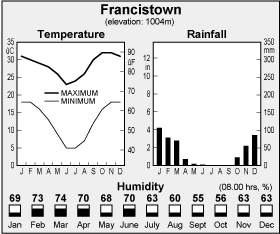
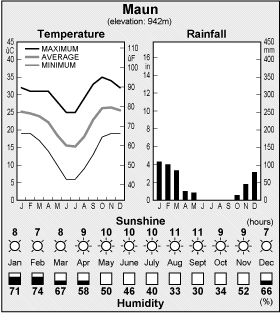
Mainly temperate climate. Summer is between October and April and is very hot combined with the rainy season. Dry and cooler weather exists between May-September with an average tempreature of 25º (77º). Early mornings and evenings may be cold and frosty in winter. Annual rainfall decreases westwards and southwards
History & Government
HISTORY: Until the early 17th century, Botswana was inhabited by Bushmen, until they were largely overwhelmed by immigrant tribes during the 1600s. Botswana was initially brought under British colonial control in the 19th century by the British South Africa Company, who supervised the territory, which became known as Bechuanaland Protectorate. The country achieved independence in 1966 and Seretse Khama became the country's first President, a position he retained until his death in 1980. The party which he had led, the Botswana Democratic Party (BDP), has dominated the country's politics since independence. It has won majorities in the National Assembly in each of the six elections held since then. The main opposition party, the Botswana National Front (BNF), has made substantial progress against the BDP at local level. The split is largely a town/country one with the BDP strongest in rural areas and the BNF attracting most of its support from the towns. Despite its growth, the BNF has yet to displace the BDP as the country's governing party. In 1994, after his party had claimed two-thirds of the assembly seats, BDP Party leader Quett Masire was elected to a third presidential term. Masire stepped down from the post in March 1998 allowing his deputy, Festus Mogae, to take over the presidency until the next parliamentary elections. These were held in October 1999 and saw another overwhelming victory for the BDP which took 33 of 40 seats with just under 60% of the poll. Abroad, Botswana has generally treaded softly with respect to its large southern neighbour, South Africa, not least because of its considerable economic dependence. However the advent of democratic government in Pretoria has relieved the pressure for caution and Botswana is benefiting both politically and economically from developments to the south. Relations with its other neighbours are normally cordial; Gaborone is the permanent home of the Southern African Development Conference which seeks to promote economic development in the region.
GOVERNMENT: Executive power is held by the President, who is elected by the legislature, the National Assembly (40 out of the 44 members of which are elected by universal adult suffrage). The President, currently Dr Masire, appoints a cabinet and receives advice from the House of Chiefs, comprising chiefs from tribes which were once autonomous.
Department of Tourism
Ministry of Commerce and Industry, Private Bag 0047, Gaborone, Botswana
Tel: 353 024. Fax: 308 675.
Botswana High Commission
6 Stratford Place, London W1N 9AE
Tel: (020) 7499 0031. Fax: (020) 7495 8595. Opening hours: 0900-1700 Monday to Friday.
British High Commission
Private Bag 0023, Gaborone, Botswana
Tel: 352 841. Fax: 356 105.
Embassy of the Republic of Botswana
1531 New Hampshire Avenue, NW, Washington, DC 20036
Tel: (202) 244 4990/1. Fax: (202) 244 4164.
E-mail:
[email protected]Web site:
http://www.gov.bwEmbassy of the United States of America
PO Box 90, Gaborone, Botswana
Tel: 353 982. Fax: 356 947. E-mail: [email protected]
Web site:
http://usembassy.state.gov/posts/bc1/wwwhmain.htmlThe Canadian High Commission in Harare deals with enquiries relating to Botswana (see
Zimbabwe section).Country dialling code: 267.
Overview General Resorts & Excursions Passport/Visa Money Duty Free Public Holidays Health Travel - International Travel - Internal Accommodation Sport & Activities Social Profile Business Profile Climate History & Government Useful Addresses
Any dead links should be reported to [email protected]
Disclaimer: The information on Botswana has been summarised from various sources and is not necessarily the view of the Government of Botswana its people or District 412, Lions Clubs International or any other Organisation, Group, Business or Individual connected with them.