|
 Water
Water
|
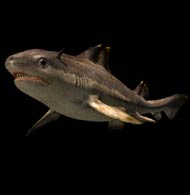 Hybodus was an early shark. Judging by the size of its teeth Hybodus was about 2 metres long and almost certainly had the typical streamlined shape that all sharks have had since their first appearance in the Devonian period, over 360 million years ago. Its jaws housed two types of teeth, reflecting a varied diet. One set was sharp, suitable for seizing slippery prey like fish and squid. Its other teeth were flat and strong, for crushing the casings of shelled animals like molluscs and sea urchins.
The little that palaeontologists do know about prehistoric sharks is mainly gleaned from their teeth, which are constantly being shed and replaced through its life. They are the only parts of its body that normally fossilise, and are relatively common. They are very abundant at some locations, and have been found in marine deposits of Jurassic age across the world.
Shark skeletons are made of cartilage not bone, and so do not fossilize well. However, there are rare fossils of its spiny dorsal fin. The fin might have been used as a means of defence - if another sea creature tried to swallow the shark, it could raise its dorsal fin to make this a difficult, unpleasant job.
|
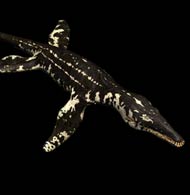 At almost 25 m long Liopleurodon was the biggest carnivore that ever existed. It had four large paddle-shaped limbs, which made it a powerful swimmer. With an enormous 3 metre long mouth which contained teeth twice as long as those of Tyrannosaurus, it was a formidable predator. Its teeth were arranged in a distinctive rosette at the end of its snout. The remains of Liopleurodon attacks are preserved in the fossil record. Half-eaten ichthyosaurs and teeth marks in plesiosaur flippers are clear evidence of their voracious appetites.
Recent studies on the skull of Liopleurodon have shown that it could sample the water in stereo through its nostrils. This allowed it to tell where certain smells came from. If it swam along with its mouth open, water would pass straight up into scoop-shaped nostril openings in the roof of it's mouth, before passing out through the nasal openings in front of the eyes.
Liopleurodon fossils are relatively common and well preserved in several marine deposits throughout Europe. It was a type of pliosaur, or short-necked plesiosaur. Pliosaurs are a group of plesiosaurs, one of a type of reptiles that returned to the sea. Plesiosaurs appeared in the Early Jurassic period and rapidly split into two major groups: long-necked forms like Cryptoclidus, and short-necked forms, or pliosaurs like Liopleurodon.
|
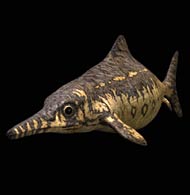 Ophthalmosaurus, one of a group of marine reptiles called ichthyosaurs, had a graceful 5 m long dolphin-shaped body. Its almost toothless jaw was adapted for catching squid and fish. It had the largest eyes of any vertebrate. Fossil evidence shows that its eyeballs were surrounded by a ring of bone, which would have given support against water pressure. This suggests that it hunted in deep dark water.
When ichthyosaur fossils were first excavated during the 1820s, palaeontologists were puzzled by their tailbones, which bent downwards. Ichthyosaurs were reptiles so it was thought that their tails should be straight, like lizards. The mystery was solved when some ichthyosaur fossils were found with impressions of the skin and an outline of a fish-like tail fin. The bent tailbone curved downwards to form the lower half; the upper half was made of cartilage.
Other fossils of adult animals containing the complete skeletons of young have been found. In some, the babies' tails poked out and their heads were still in the mother's belly. These indicate that ichthyosaurs gave birth to live young, who had to emerge tail-first so as not to drown before they could get to the surface to breathe. Modern whales and dolphins do this. More than fifty skeletons of female ichthyosaurs have now been found which contain embryos of unhatched young inside. Numbers of young range from two to eleven, although two or three young at a time seems most usual.
|
|