|
 Air
Air
|
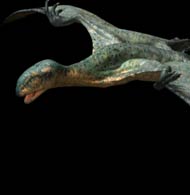 Anurognathus was a tiny pterosaur and a cousin of the dinosaurs. Its body was very small (9 cm) compared with its extensive wings (50 cm) and it had a stubby tail. Anurognathus was a specialised insectivore and had a compact 2 cm head full of needle-like teeth. Its short, deep skull was characteristic of the primitive pterosaurs. In time they evolved longer and thinner heads.
Palaeontologists believe that Anurognathus ate insects like lacewings and damsel flies, but that some of the dragonflies may have been too big for it to tackle. There is a theory that it may have conducted operations from the backs of large sauropods, such as Diplodocus. This is what some birds do today, sitting on the backs of animals in grazing herds. They feed on the insects that lives on their backs and those that are disturbed as the herd moves.
Only one skeleton of Anurognathus has been found and this was in the Solnhofen limestone of Bavaria, Germany
|
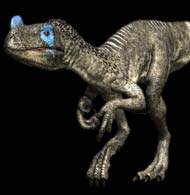 Rhamphorhynchus was a primitive type of flying reptile with wings up to 1 metre long. These were made of skin stretched between an elongated finger from its hand, down to its ankle.
It had a long straight tail (20 cm) stiffened with ligaments which ended in a diamond-shaped rudder. It is believed that one of the ways Rhamphorhynchus hunted was by dragging its beak in the water . When it came into contact with prey, it would snap its needle-sharp teeth shut, and toss the food into it's throat pouch, a structure that has actually been preserved in some rare fossils.
Rhamphorhynchus fossils have been recovered from Jurassic marine clays in southern England but the finest specimens come from the Solnhofen quarry in Bavaria, southern Germany. The fine-grained limestone of this famous quarry has yielded numerous beautifully preserved remains of Rhamphorhynchus. Many of these fossils not only preserve the bones but also show impressions of soft tissues such as the wings and tail.
|
|
