|
 Land
Land
|
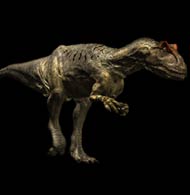 Allosaurus was a carnivorous "lizard-hipped" dinosaur or theropod. It had a bony red crest above each eye, a strong s-shaped neck. Its teeth were 5-10 cm long and curved backward with serrated front and back edges. Allosaurus' strong back and neck aided its jaws in tearing off chunks of flesh.
It had quite short arms which ended in three long hook-like claws. These were important for attacking and holding on to prey. Allosaurus fed on sauropods and other large game.
Allosaurus was a carnivorous "lizard-hipped" dinosaur or theropod. It had a bony red crest above each eye, a strong s-shaped neck. Its teeth were 5-10 cm long and curved backward with serrated front and back edges. Allosaurus' strong back and neck aided its jaws in tearing off chunks of flesh.
It had quite short arms which ended in three long hook-like claws. These were important for attacking and holding on to prey. Allosaurus fed on sauropods and other large game.
Although not really built for speed, it had two sturdy legs and a powerful tail. It was a fearsome predator of its time.
The genus Allosaurus is based on the virtually complete skeleton discovered by M. P. Felch in 1883.
More than 60 complete and partial Allosaurus skeletons have been recovered from the Morrison Formation between Wyoming and New Mexico, in the USA. It is the largest and most common carnivore found in these widespread deposits. At the Cleveland Lloyd Quarry in Utah, USA, Allosaurus is by far the most numerous fossil type and is represented by at least 44 individuals. These ranged in size from adults to juveniles
|
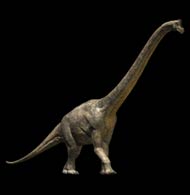 Brachiosaurus was one of the biggest land animals ever. Its weight has been estimated at about 80 tonnes, twenty times heavier than a large elephant. It takes its name from the prodigious length of its front legs. Unlike other dinosaurs it's front legs were longer than it's hind ones, so that its back sloped upwards towards the head. In the Natural History Museum in Berlin there is a mounted Brachiosaurus skeleton; its head is 13 metres above the ground and its upper arm bone is over 2 metres long. It dwarfs the Diplodocus standing next to it.
With close cropping teeth for nipping food, Brachiosaurus was adapted to eat the most elevated plant material such as conifer leaves and fruit. Its upright stance and elevated neck meant that it could graze from trees at heights no other sauropod could reach. With comparatively short jaws, and chisel-like teeth it could nip leaves and fruit from tall conifer trees. It had unusually large nostrils on the top of the skull which may indicate that it had a powerful sense of smell.
It was first described by Elmer Riggs on the basis of an incomplete skeleton discovered in 1900 at the Grand Junction, Colorado, USA. A few years later several very fine skeletons were found at Tendaguru in Tanzania.
|
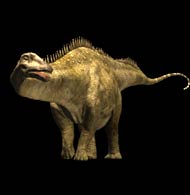 Diplodocus was a "lizard-hipped" dinosaur. It was a sauropod, a group which were especially abundant in the Late Jurassic period. It was the longest of the land animals but not the heaviest. Much of its length was taken up with its strong whip-like tail. It had a brain the size of a fist, and a concentration of nerves in the base of its spine. This helped it to cope with it's enormous size, and control its hind legs and tail.
Diplodocus had simple peg-like teeth for stripping soft foliage like ferns but it could not chew. It swallowed stones which it held in its stomach. These gastroliths, as they are called, helped by grinding down the plant material.
The largest Diplodocus is usually noted as weighing 15 tonnes and being 27 metres long. Fossil evidence of a huge animal called Seismosaurus was found in New Mexico and many palaeontologists believe it is really an old Diplodocus. It weighed 30 tonnes and was 45 metres long.
So far four distinct species have been identified from fossils in the Morrison Formation of Colorado and Wyoming, in the USA. These include five near complete Diplodocus skeletons. In each case the skull has been missing. Skulls from partial skeletons have been used to complete the reconstructions.
|
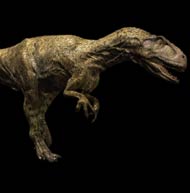 Despite the limited fossil remains it is clear that Eustreptospondylus was a bipedal, carnivorous, theropod dinosaur, related to the line that ultimately gave rise to Tyrannosaurus. Only one fossilised specimen of Eustreptospondylus has been found in a quarry north of Oxford, England. The skeleton was found in marine clays so it was probably a carcass that had drifted out to sea.
The single skeleton is of an animal about 5 metres long. This is fairly small for a theropod. However vertebrae of this specimen looked as if they had not finished growing so this individual was probably not fully grown, and just how big this animal got is not certainly known.
|
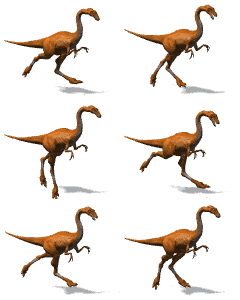
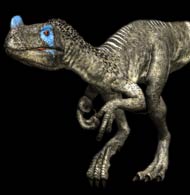 Ornitholestes was a "lizard-hipped" dinosaur with light, hollow bones. It was an agile two-legged predator and its long tail gave it great manoeuvrability and balance for hunting. Its head was relatively small and short with sharp, conical teeth and a little crest on the top of its nose. It was small enough to live deep in the forest, where it fed on lizards, small mammals and carrion. It could grab these with its strong hands that had 2 long clawed fingers and one short one.
Ornitholestes was a close relative of Coelophysis. It was also very closely related to the evolutionary line that produced the birds. It had wrists that allowed it to tuck its hands up close to its body in the same way a bird holds its wings. A partial Ornitholestes skeleton that included the skull and jaw was discovered in 1900 at Bone Cabin Quarry in the Morrison Formation of Wyoming, USA. This is the only specimen apart from an incomplete hand from another individual.
|
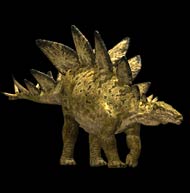 Stegosaurus was a herbivorous "bird-hipped" dinosaur, which cropped vegetation with its powerful beaked mouth. It had four sturdy legs - its back ones were considerably longer and straighter than its front ones.An eyecatching row of large pointed plates ran down its back. Their role is unclear. It was thought that they were used as armour, or as a form of heat control. Palaeontologists now believe that they were used for display - both for putting off attackers and for attracting a mate.
For defence it used its formidable tail - a short and muscular weapon equipped with four 1 metre long spikes. It also had a series of bones under its neck that acted like chain mail to protect its throat. The first Stegosaurus fossil was discovered in Colorado by M. P. Felch in 1877. Stegosaur fossils are widely distributed from the United States to China showing how successful this dinosaur group was.
There are many different types of stegosaur, of which Stegosaurus is the largest. Fossils from three different species of Stegosaurus have now been identified from the Morrison Formation in the western USA. These finds have included complete skeletons and juveniles.
|
|
