|
That attempt was not long in coming, and the Canadians were to feel its fury.
On June 7, Canadian troops renewed their advance. The Royal Winnipeg Rifles and
The Regina Rifles reached their original D-Day objectives with comparative ease.
It was a different story for The North Nova Scotia Highlanders and The
Sherbrooke Fusiliers Regiment (27th Armored) ordered to occupy two villages on
the outskirts of Caen. At Buron, the Canadians grappled with ready and waiting
German Panzer troops. Intense house-to-house fighting ensued before the Germans
were driven out of the town.
PHOTO:
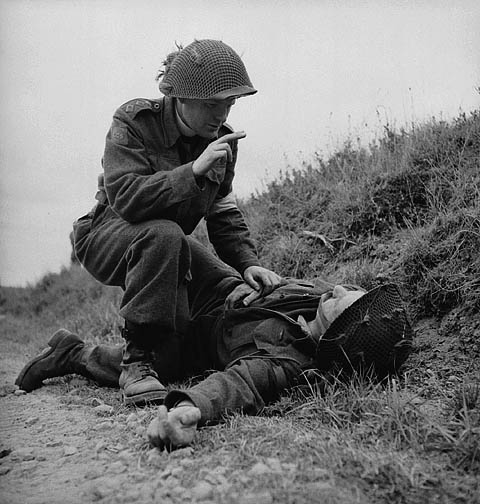
H/Captain Robert L. Seaborn, chaplain of the 1st Battalion, Canadian Scottish
Regiment, saying a prayer over a soldier of the 3rd Canadian Infantry Division
near Caen, France
That was only the beginning, as the bulk of the Canadian force bypassed Buron
and moved on Authie. There they ran into the elite 12th SS Panzer Division which
consisted of fanatical Hitler Jugend. These inexperienced 18 year olds
proved willing to die for their Fuehrer. Moreover, they were led by tough
officers, all veterans of the savage fighting on the Eastern Front. These
ruthless troops gave no quarter, and the Canadians facing them had never before
seen their like.
The Germans fell upon the Canadians with devastating results. One company of
North Novas was obliterated. The shells of the Sherbrookes' tanks simply bounced
off the armour of the German Mark IVs, whose longer-range guns soon reduced many
of the highly flammable Shermans into burning hulks. The losses were high on
both sides as ferocious hand-to-hand fighting broke out. The Canadians inflicted
considerable casualties, but on this day they were outmatched and overwhelmed.
Driven out of Authie and Buron, the North Novas and Sherbrooke Fusiliers barely
survived.
PHOTO:
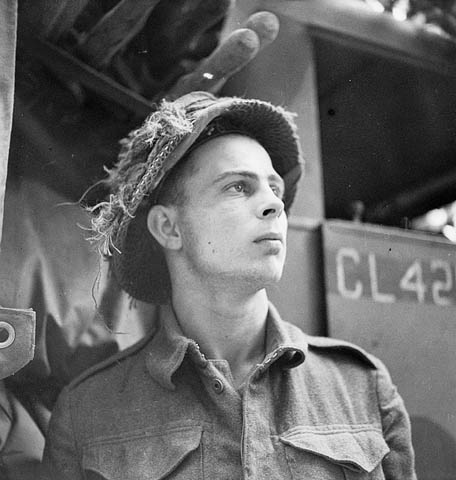
Private René Corby, Le Régiment de la Chaudière near Caen, France
There was more punishment to come. The next day the SS troops attacked The
Regina Rifle Regiment and The Royal Winnipeg Rifles. The outcome was just as
calamitous. Surrounded and running short of ammunition, the Winnipegs at Putoten
Bessin had to retreat under incessant fire. That night, The Canadian Scottish
and tanks of The 1st Hussars succeeded in recapturing the town at heavy cost.
"Never a wounded man whimpered", The Canadian Scottish war diary claimed; "the
opposite in fact was the case and time and again badly wounded men had to be
ordered back."
The Reginas had a much closer call. SS tanks and infantry overran the
infantry battalion's front line and infiltrated its headquarters area. A wild
nightlong mêlée took place. The regiment's war diary recorded, "The whole sky
was lit up by blazing roofs and burning tanks...." Only some inspired work with
PIATs (the infantry's anti-tank weapon) and the propitious arrival of The
Sherbrooke Fusiliers' Shermans salvaged a desperate situation. "Everyone fought
magnificently and although the picture looked black, there was no sign of
wavering anywhere."
PHOTO:
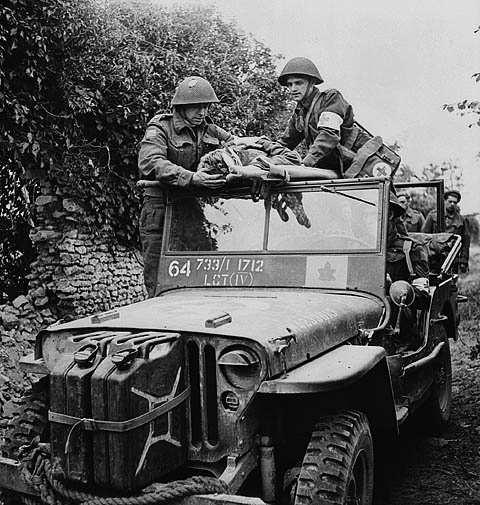
Unidentified chaplain helping to evacuate a wounded soldier near Caen, France
All in all, it had been a grim indoctrination for Canada's citizen soldiers.
In two days, the North Novas, Sherbrookes, Winnipegs, and Scottish suffered
almost 600 casualties. But, while it bent, the Canadian line did not break. The
contest between the two armies had ended in a draw. And though the Canadians had
painfully learned to dread the cold efficiency of their adversaries, they also
realized that they could hold their own. The 12th SS had momentarily stopped the
Canadian advance, but it had paid dearly for the privilege.
The Canadians struck back on June 11, but the gains were limited. Elements of
Le Régiment de la Chaudière and The Fort Garry Horse joined British units in a
hotly contested, but ultimately successful, attack on the SS in the town of
Rots. However, an assault on the village of Le Mesnil Patry by The Queen's Own
Rifles and The 1st Hussars ended in tragedy. Riding aboard the fast-moving
tanks, the Canadians came under lethal fire from well-sited enemy armor and
artillery. Some of the attackers penetrated the village on sheer daring alone,
but it was all for naught. "I have never witnessed a battle of this intensity,
before or since", recalled one officer of the Queen's Own. Nineteen Shermans
from the lead squadron of the Hussars were destroyed only two escaped the fire
of the terrible Nazi 88s. In all, the two regiments had 114 killed and 65
wounded.
After six debilitating days of continuous fighting, the 3rd Canadian Division
and the 2nd Armored Brigade totaled up their losses. Just over 1,000 Canadians
had died, nearly 2,000 had been wounded, and more suffered from battle
exhaustion. But the Canadians had secured their portion of the Allied
bridgehead. By the beginning of July they were again trying to enlarge it,
against an enemy well-schooled in defensive techniques and forbidden by Hitler
to relinquish any ground.
|