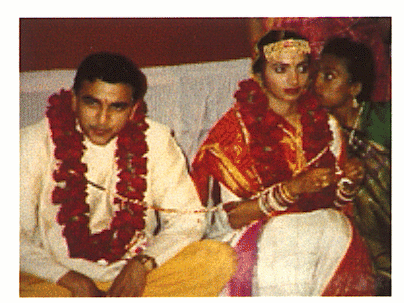
����� Murli is in a hurry at the San Francisco International Airport. He is going to India to get married - to a girl he has
never met. He is planning to get married and come back with his bride in two weeks. Murli seems more excited than
nervous and explains why arranged marriages are necessary.
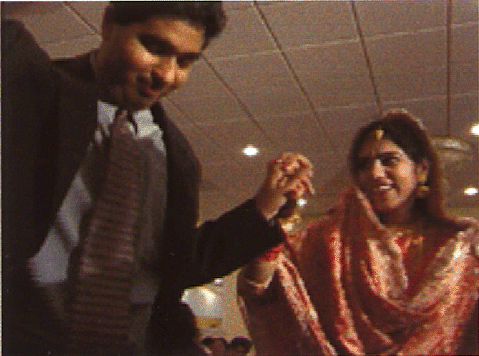
����� Next, comes the highlight of the documentary, a traditional Sikh wedding. The North Indian state of Punjab is largely
populated by Sikhs, and they stand out among the other Indians because of their turbans and long beards. Sikhs are
known for their hard work, as well as for their friendly and extroverted nature. Rajdeep is getting married to Manjot.
Their marriage is an arranged marriage,
with traditional music, religious chanting, solemnity of a holy union,
gaiety ofajoyous occasion, aroma of spicy food, and rustle of expensive silk.
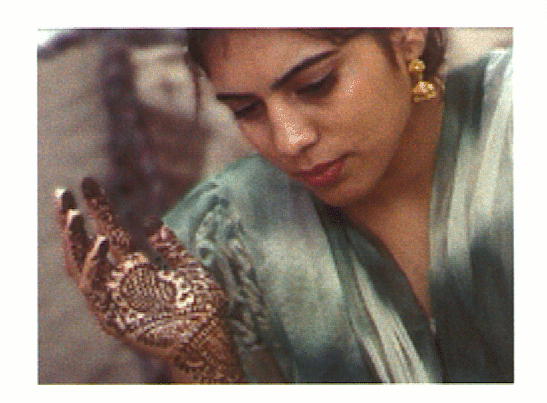
First, there is the pre-wedding ceremony of decorating the bride's hands and
feet with henna, which is followed by the engagement and ultimately the wedding.
In the engagement, the bride's family visits the groom's family with gifts for the groom.
The wedding takes place in the presence of the Sikh Holy Book (Guru Granth Sahib) in a Sikh temple.
Every wedding ritual is accompanied by the singing of holy hymns and songs, increasing the piety of the occasion. And finally the party! A wedding isn't complete without a party. Everyone, even the bride and the groom, is dancing to the tune of folk fusion music. The party truly shows the fun-loving nature of the Sikh people. Even an old uncle of the Bride gets into the groove when he dances with a glass of liquor on his head. The bride's sister provides a personalized narration for the wedding.
����� Then we move on to the interviews. Mrs. Savita Gokhale, a professional matchmaker, explains that
arranged marriages have been traditionally popular in India, but now love marriages are becoming common.
Traditionally, matchmakers have played an important role in Indian marriages, whether in the form of the
local priest, a talkative aunt, or a socially busy neighbor.
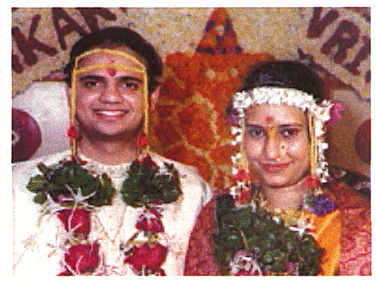
����� Omkar and Vrinda have been married for three months. Their parents arranged their marriage through
a matchmaker. This couple represents the changing face of arranged marriage in India. Even though the parents initiate the proposal, the wedding takes place only if their daughter or son agree. In Golden Gate Park, Omkar is teaching Vrinda to rollerblade. Unable to keep their eyes off each other, whispering, and giggling constantly, it is apparent that they are newly married. Through a matchmaker.
����� Mr. and Mrs. Jani have been married for 45 years, and their daughter also had an arranged marriage.
Mr. and Mrs. Jani met each other only once before they got married,
which was a radical thing for those times in India.
Their daughter got married five years ago and had a chance to meet the prospective groom
several times and go out with him before making her decision. Mr. Jani is an astrologer,
so he explains the basis of arranged marriages according to the Indian scriptures.
����� Raj is a software professional working in the Silicon Valley, and Rati is a medical technician.
Their marriage is a love marriage. They met at an Indian convention and got married in the United States.
Raj's parents were not too thrilled about his decision to find his spouse on his own, especially since his
mother had great plans for him in India.
Anupam is a 25-year-old bachelor working for a software company in the Silicon Valley. His parents are
solidly opposed to love marriage, because they think it hurts the family structure. Most of Anupam's friends have
a love marriage, so he feels ambivalent about arranged marriage.
In the end, Murli returns after two weeks in India, but this time he is not single. He is with his bride, Sahiti.