|
The Plummet into Irrelevance |
|
People and phenomena that went from being
prevailing forces in the world |
|
What word describes a person or an idea that once held unquestioned fame, power and influence over millions of people and then just dropped out of sight? "Trend" and "fad" don't fit, because they denote passing fancies that no one expects to last. "Forgotten" is fine, except that we seem not to forget other people or ideas from exactly the same time period. Why is that? Why do we know who Martin Luther was (I'll bet there's a Lutheran church within two miles of your house) but can't recall Thomas Aquinas? Why do we know Bob Dylan but not Rod McKuen? But I'm giving the story away -- what we're looking at is a pretty rare occurrence, I guess, which may be why it's hard to define. I've come across several instances of this strange state of affairs, which I'll present here for no better reason than that I thought they were fascinating. If you want to add to this list or know of something I've left out, let me know. |
|
First, the Criteria:
I think I have some subjects that meet all of these, some that only meet one or two, and some that are arguable. Nonetheless...
Okay? What intrigues me is that many academicky folks feel a duty to expand on minor characters, obscure aspects of civilization and previously ignored theories -- but are totally at a loss if you bring up what were once the most influential characters of their time. History is all in the telling, and also in the remembering. |
|
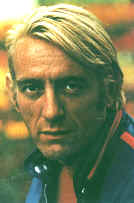
| Rod
McKuen
Oh man... Rod is the best-selling poet of all time. Really! His million-selling book, "Listen to the Warm,"(1967) was reprinted 36 or more times. He composed a lot of musical scores and released a bunch of gold albums, and was nominated for an Oscar twice. Cover versions of his maudlin rhapsodies and depressing spoken word pieces sold in the millions. He started out as a beatnik in the North Beach scene of the late 1950s, but that's not how anyone (least of all the beatniks) remember -- or don't remember -- him. In the 60s, Frank Sinatra recorded a whole album dedicated to Rod. Rod toured the world, selling out huge venues (I have his double live LP). Probably the only song of his you know today is a cover version of his "Seasons in the Sun," recorded, ironically, by some band whose name we forget. He was considered by many "experts" to be the new direction in poetry. He was anthologized into poetry books and discussed among the literati of the 1960s and 1970s. His works were taught in universities. So what happened? Everyone woke up out of a huge dream and realized what they were saying, and perhaps more what Rod was saying about butterflies and dandelions. The generation that praised him suddenly shut up, and by the next generation, that silence of denial had turned into irreversible oblivion for Rod. He stepped out of the limelight (severe depression he said -- no surprise) and his niche was quickly and shamefacedly plastered over, and his image rubbed out like a tattoo of an ex-girlfriend's name. Note: Not one of Rod's books is in print. Some of his albums were optimistically released on CD, but good luck finding anything. (I picked up his "Greatest Hits 1" and "2" for a total of $5.99, making them almost comparable to blank CDs (with cases)). His own pathetic website is selling them "until they run out," then there are no more. Any thrift store is sure to have several of his books and records, which always indicates a huge audience at one time. So is Rod McKuen a treasure that time has cruelly mistreated and should be rediscovered? Well, yes and no. Have a listen to his music, if you can find it (and you always can at the thrift store). You will howl with laughter when he wants you to be sad, and completely miserable when he is exuberant. I even bought an autographed picture of Rod on e-Bay for $3.99. I was the only bidder. Now that's a plummet. |
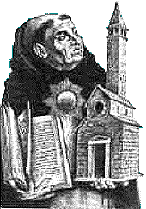
Thomas
Aquinas
Does the term, "Thomism" ring a bell? Thought so. Back in the 1200s, the Italian clergyman Thomas Aquinas took it upon himself to stir up a lot of trouble in the Church by trying to clarify everything in theology through a faulty reasoning method he picked up from Aristotle. He wrote endless volumes of stuff, none of which you are capable of reading, but check out "Summa Theologica" by "The Dumb Ox." Or if you're pressed for time or sleep, try the Selected Writings. By the way -- what you won't get from those little Amazon plugs -- Thomas was THE major philosophical thinker of the middle ages, and more or less shaped ALL medieval philosophy, influenced countless lives, and is still considered by the Catholic Church to be the approved interpreter of Christianity (not that any Catholic knows this). For his pains, he gets, on Amazon.com TWO REVIEWS (positive, at least)! Thomas' most famous work, the interminable Summa Theologica, is a series of theological and philosophical questions that starts from simple principles and moves to greater and more absurdly irrelevant details (it is from here that we get the argument about angels dancing on the head of a pin, although he was never actually so entertaining). Unfortunately, this grandiose inverted pyramid structure, with everything balanced on one base stone, totally collapses if you remove that stone. For TofA, premise number one was his quick "proof that God exists." Unfortunately, soon after his death, his proof was nulled and voided by better philosophers who came up with better proofs of God, or proofs of no God, or who casually snapped Thomas' brittle logic in a couple of quick "if...thens" and moved on to more important things, like modernity. So much for leaving a legacy. And what about recognition from modern
Christians? ALSO -- Amazon is great for reviews, but you really ought to run down and get books from your local independent bookseller -- they'll even order it for you. |
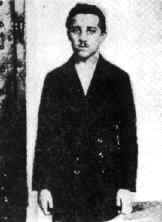
| Gavrilo
Princip
He kills an archduke in 1914,which starts the First World War, which costs
millions of lives, reorganizes Europe (and directly sets the stage for WWII) and
ends centuries of tradition -- and he ends up filed under
"huh?" NEWS ITEM : This week, Sarajevo decided to memorialize Princip's earth-shattering event. Here's the BBC story on just how far into irrelevance this had plummeted: Gavrilo and Ferdinand today. Apparently, the historic site is a bus-stop, a gypsy mini-market and a bunch of rubble. Plus, no one cares. Send your donations today! By comparison: Lee Harvey Oswald kills one president (maybe), starts no war, really disrupts nothing more than the state of mind of a country that hadn't had a presidential assassination for about 60 years -- but he gets a hundred books written about him, movies and a household name. The question at hand is: What do you have to do to be renowned, and why do some of the seemingly biggest players get sent to the Obscure File? |
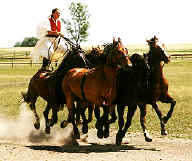
The
Hungarians
I went looking for a picture of a "Magyar horseman" and this is all I found. I think that's a good place to begin. Ask any Hungarian (and his name, more than likely, is Attila -- no kidding) and he'll tell you how the Hungarians (Magyars) once roamed all of Europe trashing kingdoms and armies at will, from Russia to Spain. Then it all fell apart and now only travelers and scholars can find Hungary on a map -- and that's not even where they came from, just where they ended up cornered in on all sides. Let me check my facts and whatnot, and I'll fill in some more later on this subject. |
| The
Portuguese
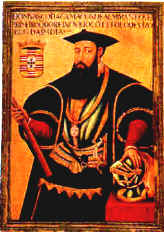
You may recall a paragraph or two about them in the intro section of your high school US history textbook. And then? They linked Europe to India, Africa, South America, Japan and China and established colonies all the way from Morocco to Indonesia and later discovered California (Joao Cabrilho, who you may know as Cabrillo). They also started the slave trade. The Portuguese language was spoken on the coasts of four or more continents, and was the lingua franca of the seven seas. The Pope divided the new world into two parts between them and Spain at one point. So what happened? I'll tell you shortly. |
"K" in Prague writes: Surely any discussion of irrelevance must include the
Austrians, especially when said discussion touches on the Hungarians and
Portuguese.
|