| De Tomaso Cars 4 Sale |
| Submit car advertisements to: |
| I have not personally inspected any of these cars, unless otherwise stated. I suggest using the Buyers Guide, and inspect any car yourself. |
 |
 |
 |
 |
 |
| Buyer Checklist |
|
|
| Last Updated 11/13/05 |
| All Material Protected by Copyright � 2005 |
| 1682 |
| The master and slave cylinders are both original, scruffy-looking, but
apparently functional.
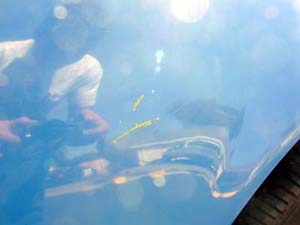
The car has a stock, early-style radiator; given that the car doesn�t overheat (gets up to 230 indicated when idling on a 110-degree day but does NOT boil over, Kevin says), it has probably been modified in accordance with the TSBs. Still, it *is* 35 years old.... Stock fans are gone, replaced with Flex-A-Lite dual sucker fans, controlled both by a manual switch on the dash, and by an adjustable thermoswitch. The fans are hot-wired to the battery, meaning that they run on after the engine is switched off, until the radiator cools down. There is no jack, tool kit or spare tire. The washer bottle is present, but empty, and may or may not work. The front trunk has been recarpeted; the various ID plaques in the front trunk are missing, and the VIN stamped into the chassis itself has been covered over with carpet; the dashboard VIN tag is still present. The exterior of the car could best be described as a 20-footer. It was originally painted that 1971-only slime green color, but at some point early in its life, it was repainted what appears to be the stock Grabber Blue color (to include the lower valences and rocker panels, which should be satin black). The paint has held up well overall, but there are several deep and noticeable scratches where the blue has been removed, leaving the green showing through from underneath. (See above.) All badges and scripts are present and accounted for. The glass is all original and appears to be in excellent condition, as does the chrome trim. |
| Review Page 2 |
| A Mike Drew Review |
 |
| There is no evidence of any corrosion anywhere else on the car, including the
windshield bottom edges, radiator support/front valance, floor pans, or
anywhere near the wheelhouses. The only minor corrosion appears to be in front of
the gas tank. All cars of this era were fitted with half-height gas tank
shields, which allows the spinning left rear tire to toss dirt over the top of the
tank; it collects at the junction of the back side of the B-pillar post and the quarter panel, turns to mud when wet, and then rusts these pieces from the inside out. There is one tiny bubble in the paint on the quarter panel, and two similar bubbles on the B-pillar post; I would argue that this is absolutely trivial and not worth getting exercised over, although I would strongly urge that a later-style full-height shield be fitted. |
 |
|
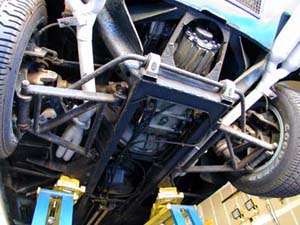
I put the car up on my lift so I could peek at the underside. I am happy to
report that this car has NO rust worth mentioning. Although the rear chassis
tubes don�t have drain holes in them, a single drain hole was drilled in
between the two tubes, which appears to have done the job--the tubes themselves are absolutely rock-solid, as evidenced by zero damage caused by repeated whacks with a hammer and a pointed punch. |
| Photos by Mike Drew |