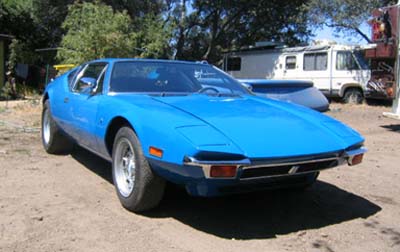
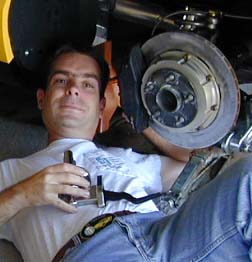
Today I was fortunate enough to meet a fellow named Kevin who lives way up in
Clearlake, CA. (about two hours west of Sacramento, and perhaps an hour east
of Mendecino). Kevin has a 1971 Pantera, THPNLY01682, a 6/71 build car. He
purchased it back in June from its long-time owner, with the intent of fixing
it up and selling it. Kevin, by the way, is a semi-retired professional
mechanic. He drove about two hours down to my house so that I could look at the
car. (Actually, the thing quit on him leaving his home town, due to a Mallory
coil failure; he had to retrofit a standard coil to get going again).
The car came to him with unknown mileage; the speedometer cable broke at
48,000 miles. Based on the overall condition I would guess that the car has
something approaching 80-90,000 miles. The car came to him with a freshly built
spare engine; he removed the original (stock) engine and installed the new one.
There is no documentation on the new engine, but it was apparently built by a
speed shop in the South San Francisco area. It is a .030 over 351C, with
Speed Pro forged pistons, closed-chamber heads (he believes), a Comp Cams
solid-lifter cam (grind unknown) and Comp Camps roller rockers. The engine came with
an Edelbrock Performer intake, but Kevin switched it for a Weiand
(single-plane, I believe). Because it gets so hot in Clearlake, he fitted a 1-inch poly
carb spacer to try to keep the fuel from boiling in the carb.
The carb, by the way, is a little 600 cfm Holley, arguably too small for the
engine (although it does provide snappy response, at the expense of peak
power).
He reported that he had many problems with fuel contamination until he
discovered that somebody unknown had dropped a piece of rubber hose into the gas
tank, and it was slowly dissolving and plugging up the fuel filters. Once he
fished that out, the problems went away--but the car still wears multiple fuel
filters, just in case.
Because the engine had just been installed in the car within the past few
months I didn�t bother checking the coolant or the oil.
Water hoses are all new, although one was home-made because he lost one hose
from the vendor-sourced hose kit. Water pipes have been replaced with
polished stainless steel. The original pressure tank is still there (and by the way,
yesterday I learned that the early cars, like this one, had stainless steel
pressure tanks from the factory), but the overflow tank fell out of his truck
one day, and has been replaced by a simple and cheap plastic tank. Although the engine compartment is quite grungy, there is no obvious sign of
any fluid leaks from the engine. Kevin reported that he had an oil leak from
the intake manifold and recently re-sealed it using a proper one-piece �turkey
tray� gasket.
The car originally came with a Dash-1 gearbox; like many cars of this
vintage, it was replaced with a Dash-2 gearbox, probably at a very early age. It
still has the Dash-1 side plates and the tail-mount. It�s grungy, and had oil
dripping from the bottom, which may indicate a leaking front seal. I meant to
check the fluid level and top it off if necessary, but I forgot. |