|
|---|
Cawston & Keremeos
|
|
KEREMEOS
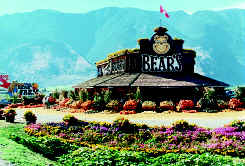
In the heart of the Similkameen Valley, surrounded by the Cascade Mountains and the natural landmark of the K Mountain stands the small town called Keremeos also known as "The Fruit Stand Capital of Canada." Dozens of colourful fruit stands line the highway as this area has the longest growing seasons in B.C.
The name Keremeos was originally derived from an old Indian word "Keremeyeus" which meant either "Windy Crossing Place," "Where the Valleys Meet," or "Meeting of the Winds." The first one is probably the more plausible because the prevailing winds sweep down the valley almost continuously. Hold on to your hats!!
In addition to its well equipped commercial section, there are many attractions. The Red Bridge over the Ashnola River Road leads you to the Cathedral Provincial Park. This 33,000 hectare mountain wilderness of azure lakes, alpine meadows and jagged peaks is in the Okanagan Range of the Cascade mountains. The resort accepts reservations at the Lodge or just for the jeep ride to the majesty of the mountains and lakes.
A single-cell jailhouse has been turned into a museum. The Grist Mill and gardens have delicious munchies served in the Tea Room. There is swimming at the public swimming pool and the Similkameen river adds tubing, boating and fishing. The May long weekend showcases two spectacular events. The Rodeo and the Pow Wow are must sees for early visitors to the area.
Be sure to stop for a look around as you pick up your fruit and vegetables to take home or just spend a day at the river.
CAWSTON
Immediately south of Keremeos, traveling Highway 3, the Similkameen stretches out into a fertile valley several miles wide. Nestled within a patchwork of mainly organic farms you discover the sunny village of Cawston.
The natural beauty and relaxed life-style of this farming community has attracted musicians, artists, photographers, crafts people and those who simply want to enjoy a quieter life-style.
In addition to the church, restaurant, grocery stores, auto mechanics and an art gallery, there is an elementary school, well used Community Hall and a ball park adjacent to the Similkameen river.
During the summer months, cool off in the many swimming holes in the river, and picnic while you watch the canoeists and kayakers go with the flow down the river.
Cawston is the perfect place to spend a very relaxed day.
With thanks to Beth Sellars
Follow the signs on highway 3 and visit the working heritage site of the Grist Mill. You will pull into a parking lot amid beautiful heritage gardens and step over the threshold into the past. As you enter the gift shop and look out the windows toward the creek, you can spot the manager of the site, Cuyler Page, riding an antique bicycle, on his rounds to the various sections of his domain.
The ladies in the Tea Room greet you with delicious desserts and thirst quenching drinks. Their period costume dresses make your trip to the past very real.
The mill itself was carefully reconstructed from a jumble of machinery that had been stacked under a roof. When you ask Page about his reconstruction of the mill, he can tell you many a story based on his research, detective work and just plain luck.
Barrington Price, who originally built the flour mill in 1877, next to Keremeos Creek, used a flume to regulate the flow of water, so as not to damage the wheel during high water times. Most of the business for the mill came from the prospectors on their way to the Kootenay gold fields. His local customers started to grow grain and supplied his needs for the growing business.
Business boomed and Price invested heavily in new equipment to make white flour. Soon after this, he ran into financial problems and ended up loosing his ranch in 1883. He leased out the mill. The mill continued operation until 1897 when a new, larger, mill was built in Enderby. It became cheaper to ship the wheat to this mill in the North Okanagan, and the small mills, such as the one in Keremeos, were forced to close.
The mill was eventually converted into a chicken house, while the grinding, sifting and cleaning equipment was stored under a roof. The isolated location spared it from looters and when the time came to restore it, the components were there.
In the early 1980’s Cuyler Page set to work on the giant puzzle of a building and a pile of machinery. This machinery had worked on a series of belts and pulleys so everything had to be positioned in the right places. No other mill was around to look at so old photos and clues, such as nails, grease marks and holes in floor boards, enabled the Grist Mill to be restored.
The area around the mill has plots of heritage flower and vegetable gardens as well as an heirloom apple orchard. There is a wheat field displaying many of the forerunners of modern varieties. In all of this, time stands still. It is a shock to come back to our real world.
Copyright � 2001 Desert Sun Publishing B.C. All rights reserved.
Revised: December 04, 2002 02:14 AM.