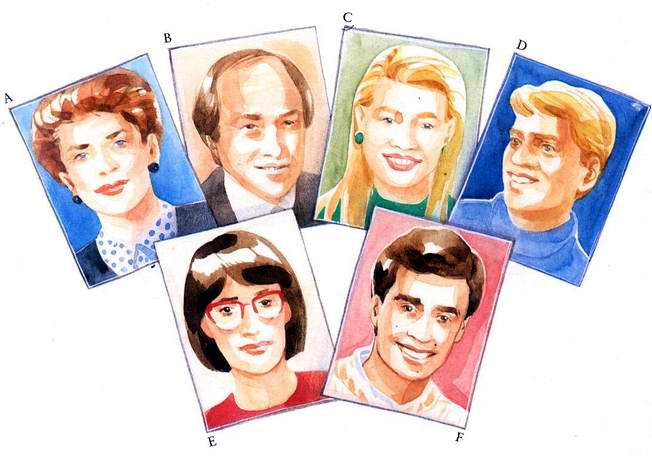
1.
Listen to the recordings and answer the questions.
First
recording
1. What is the man's name?
2. Which is his picture?
3. Who is the woman? |
Third
recording
8. Who is speaking?
9. Which is her picture?
10. Which is Sally's picture? |
Second
recording
4. Who is the first speaker?
5. Who is the other speaker?
6. Who are they talking about?
7. Which is his picture? |
Fourth
recording
11. Who is the first speaker? |
2.
Look at these words and expressions. Can you remember
which of them came in the recordings? Listen again and
check.
Look
You're just too old
Well, yes, OK
That's it
So what?
I don't agree |
even
Well, yes I know
What's he like, then?
Well, you know
I must say
actually |
perhaps
perhaps not
I don't know
On the other hand
though
still |
I do think
maybe
maybe not
|
|
3.
Read the conversation and put
the expressions into the right
places. (More than one answer is
possible in some cases.)
|
JOHN:
............. ,
Marry, the problem
is, we're
............. too
different.
|
|
MARRY:
OK, we're different.
............. ?
People are
different. |
|
JOHN:
Well, we don't have
the same interests.
We don't
............. like
the same people. |
|
MARRY:
............. not.
............. , we
get on very well
together most of the
time. |
|
JOHN:
............. ,
Marry. I don't think
we do. |
|
MARRY:
Well, OK, John,
maybe there are some
problems. But
............. we
should go on
trying for a bit
longer. |
|
JOHN:
............. ,
Marry. Do you think
we're getting
anywhere? |
|
MARRY:
.............
either. Let's have
one more try,
.............
|
|
JOHN:
OK. One more try. |
4.
Pronunciation.
Practise these
sentences.
You're too
old.
Maybe you're right.
Yes, you are.
We're the same age.
Yes, we are.
My eyes are a bit small.
Yes, they are.
He's got a great sense of humor.
Yes, he has.
You've got pretty eyes.
You haven't got any money. |
I can
speak three languages.
He can dance all night.
Yes, he can.
You can't dance.
I can't say the same.
No, he isn't.
Age isn't important.
Why isn't she happy?
He hasn't got any hair.
No, he hasn't. |
|
5.
Prepare a short
conversation like
one of the
recordings in
Exercise 1.
Possibilities:
|
|
a.
a conversation about
another person |
|
b.
a row with another
person |
|
c.
a conversation with
yourself about
somebody (or about
yourself). |
|
In the conversation,
use be,
can, have got,
and some of the
expressions from
Exercise 2. Practise
the conversation and
then let other
students listen to
it. |
|
|
Be |
I am (I'm)
you are (you're)
he/she/it is (he's/she's/it's)
we are (we're)
you are (you're)
they are (they're) |
am I?
are you?
is he/she/it?
are we?
are you?
are they? |
I am not (I'm not)
you are not (you're not / you aren't)
he/she/it is not (he's not etc./he isn't etc.)
we are not (we're not / we aren't)
you are not (you're not / you aren't)
they are not ( they're not / they aren't) |
|
Can |
I can swim (I
can to swim)
he/she/it can swim (he/she/it cans ...)
etc. |
Can you
swim? (Do
you can ...
?)
etc. |
|
I cannot
(can't) swim
etc. |
|
Have
(got) |
I have
got
(I've
got)
you have got (you've got)
he/she/it has got (he's/she's/it's got
we have got (we've got)
you have got (you've got)
they have got (they've got) |
have I
got?
have you got
etc. |
I have
not
(haven't)
got
he/she/it has not (hasn't) got
etc |
| Learn/revise: picture; get on (well) together (got, got); go on ...ing (went, gone); prethy; first; second; third; fourth; look; just; well; too; even; actually; though; still; maybe; the same; a bit; most of the time; on the other hand; So what?; not ... either. |
|
PLAY TRACK 2 |