|
||||||||||||||
|
Wanderdog: run for it! |
|||||||||||||
One of the most wonderful dogs I’ve met in my life was Chance the chocolate Labrador. He was a wise old soul in a goofy Lab body, and he brought great joy to everyone he met, human and canine alike. Chance was seven years old when he escaped his yard and was struck and killed by a car. His life ended too soon, and I found myself wondering why it had to be that way. Chance was a wandering spirit, like so many of our dogs are. Through a gap in his yard’s six-foot-tall fence, he wagged wildly at passing bicycles and children, wishing for nothing more in the world than to give hello smooches to anyone and everyone. His desire to escape his spacious yard was so strong that it overcame the love he had for his home and the better judgment I know he possessed, not to mention the sturdy hardwood fence and the underground Invisible Fence, which was remotely hooked to an electronic prong collar around his neck. Chance was a moment-to-moment dog, and I imagine he never looked back. Fencing companies charge hundreds of dollars to replace inadequate fencing with something taller, stronger, and safer. A good underground fence with all the bells and whistles can cost $1800. We throw our hearts and wallets into a desperate effort to keep our dogs in the yard. Yet thousands of dogs run away from home every year. Clearly love and money aren’t enough to keep them home. This problem--like any canine behavioral problem--is impossible to solve until you understand it. The most common drive that sends our dogs yonder is instinct. Simply put, domestic dogs are genetically driven to run, hunt, and breed. Unfortunately, in the last couple hundred years, dogs have been pushed en masse to a lavish lifestyle which, though they may enjoy it, they are not built for. Despite their various shapes and sizes, domestic dogs are just a genetic wag away from being wild wolves. Their wolf cousins (or more accurately “brothers”; there is less than two-tenths of one percent difference between the DNA of a grey wolf and that of a Chihuahua) are built to cover great distances. At a healthy trot of five miles per hour, a wolf may cover thirty miles in a day. And this trip may cover only a fraction of their territory. Now, looking at your toy poodle or snub-nosed pug, you may have your doubts that within lurks a long-distance runner. (If you’re watching your terrier bounce off the wall, I’m sure there’s not a doubt in your mind that this is a full-grown wolf in a tiny package.) But don’t fool yourself; small or massive, dogs have an ingrained need to run, far and long. Some are better built for it than others, but we should never underestimate the wolf in our dogs. In the case of hounds, herding breeds, and most retrievers, the wolf’s desire to hunt (“prey drive”) has been refined and honed to an almost supernatural urge. Anyone who’s been lucky enough to care for a Greyhound knows that these normally amicable dogs can go from easy-going couch potato to laser-focused hunting machine in no time flat. And once a sight hound has found something he wants to chase, no power on earth will pull him away. The prey drive in some dogs is so strong that an unfortunate cat passing the yard can push the dog to break through the fence and pursue. The desire to breed may be the strongest instinct a dog possesses. In the animal world, if you are able to breed and pass on your genes to a new generation, you have won the ultimate prize. An un-neutered male dog may smell a female in heat five blocks away, and nothing will keep him from finding her. Many dogs leave home simply out of boredom. Remember that your dog’s sense of smell and hearing are amazingly acute. Remember that he loves to learn; learning and adapting kept his ancestors alive. He needs mental and physical stimulation to stay healthy and happy. Dogs are very complex animals. (Yes, even your dog!) We often underestimate their sensitivity to their family and environment. An emotionally charged environment may be enough to drive them over the fence. They may run away if they don’t get enough attention. On the other hand, sometimes our dogs don’t get enough “me time” to just be themselves. A dog may run if he feels inadequate in training or performance, or can’t live up to what’s expected of him. So how do you keep your wandering pooch at home? There are several short-term solutions. The Invisible Fence, although expensive, is effective in many cases. A cheaper, less invasive solution involves running a rope through L-brackets along the inside top of the fence and stringing up free-spinning lengths of PVC pipe to keep the dog from gaining a grip on the fence with his paws. But these solutions treat the symptoms, not the disease. If you really want to keep your dog safe, you have to investigate his reasons for leaving in the first place. The preceding causes and drives are only a few of the reasons your dog may leave home, but I believe they are the most common. Are you indulging your dog’s natural instincts? Does your dog get safe, supervised time to do what he’s bred to do? Does he get a chance to run as far and long as he wants to at least once a week? Does he get to chase, search, or hunt as much as he needs to? (Educational and fun toys such as Kongs and Buster Cubes, properly stuffed with treats and hidden or buried, can do wonders.) Is your dog spayed or neutered? That one’s really important, so I’m going to say it again: IS YOUR DOG SPAYED OR NEUTERED? (Contact the Larimer Humane Society for a S.N.I.P. voucher to help you out with the cost of your dog’s “fix”. It is one of the kindest gestures you can make toward your best friend!) Is he bored, stressed, unhappy, or under stimulated? You know your dog best. It’s up to you to investigate his reasons for running away. Then it’s up to you to use that imagination you’ve been suppressing since you were ten years old! Creativity is your best ally in your mission to keep the dog where he belongs. Get some advice, get some training, get some toys, and get thinking! A happy, healthy dog has no reason to run away.
|
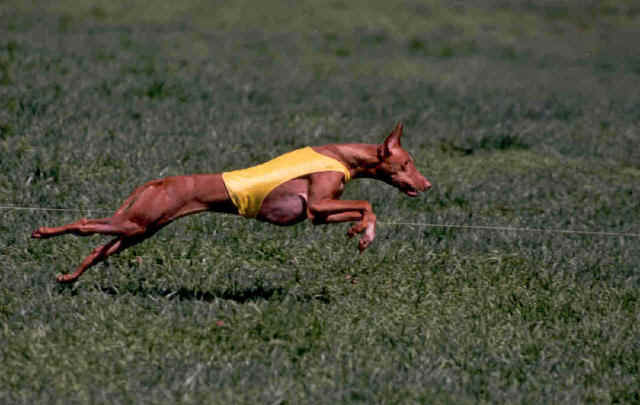
This Pharaoh Hound is doing what's in his blood: running! He's also hunting - that's a lure he's chasing. Remember that you can't fight genetics. A dog's unique needs must be satisfied for the sake of his happiness and sanity |
|||||||||||||