All dogs are entitled to, and deserve:

|
Healthy food
|
|
|
A secure environment
|
|
|
Mental and physical stimulation
|
|
|
Positive socialization
|
|
|
Play
|
|
|
Quiet time
|
|
|
Companionship
|
|
|
A job
|
|
|
Understanding
|
|
|
Exercise
|
|
|
Quality health care |
If you're looking at this site, these are probably all things you agree every dog deserves. I'd like to go through them and clarify what they
mean:
One: healthy food. There are a lot of commercially distributed dog foods out there. Pet food is an $11
BILLION a year industry. Nestle (owners of Purina, Alpo, Fancy Feast, Friskies, Mighty Dog), Heinz (9 Lives, Kibbles-N-Bits, Amore, Nature's Recipe), Colgate-Palmolive (Science Diet), Proctor and Gamble (Eukanuba, Iams), Mars (Mealtime, Pedigree, Sheba, Nutro); these are not corporate names that we associate with dog food. These are the companies that own the dog food industry, and make an unbelievable profit manufacturing cheap, undigestible, nutritionally deficient pet food. Dogs are carnivores, not cooks! They need meat and bones, and lots of them! Check the "Links" section for NaturalPetFood.com and learn about the AFS raw diet for dogs and cats. Then order some for your dog! Or, if you're not quite comfortable with the raw diet yet, try www.wysong.net for the Wysong brand pet diets.
Two: a secure environment. Dogs deserve a solid fence at least six feet tall, jump-proof and dig-proof. They deserve a safe, secure gate. We are responsible for making sure that the places in which our dog spends time are free of toxins and harmful chemicals, loud noises, and other potential dangers.
Three: stimulation. Most owners know that a bored dog is a bad dog. If you don't create ways to amuse him, he'll amuse himself and chances are you won't like it. Check the "What's New" page for my favorite brainy dog toys, and check the "Links" page for online pet supply shops.
Four: positive socialization. Socialization is essential for building a dog's confidence and helping him to overcome fear. Positive exposure to a wide variety of circumstances, places, and people will enrich his life and help him to fit into human society. Socialization must be done carefully and should be done with the help of a professional.
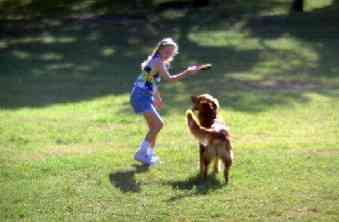
Five: play. We've all read studies in recent years about the relationship between physical health and mental health. Playing with your dog is a fun way to keep him in shape and maintain the muscle he'll need in his sunset years. Play is also an essential bonding mechanism between you and your dog.
Six: quiet time. Just like any person, even the most outgoing dog wants the occasional "time-out" all to himself. The best present you can buy your dog is a crate. (Check
out eBay for inexpensive used crates.) The crate is a windowed box, usually plastic but sometimes wire, where your dog can go to have some "me time". The crate should be large enough for him to turn around in, with a thick pad or doggy bed on the bottom and some fun toys inside. There is a door on the crate for emergencies or travel, but almost always it should be left open for the dog to come and go as he pleases. He'll appreciate having his own private "den".
Seven: companionship. Canines are social animals just as humans are. A dog deprived of companionship can develop behavioral problems and chemical depression. Yes, a dog *can* be lonely! If you can't always be with your dog, consider adopting a second (or third or fourth!) to keep him company. In general, a spayed female and a neutered male close in age will get along famously. Introduction of a new pet is another thing that should be done with the help of a professional, just because first impressions tend to last a long time with dogs.
Eight: a job. We all have goals, things that we consider our purpose in life. If you don't give your dog a job, he'll likely invent one, such as digging up your entire backyard. Teach your dog any goofy task you can think of. Fly ball (a wonderful dog sport--check the "Links" page), herding, and agility are all wonderful "jobs" for dogs to have. Teach him to do tasks you see service dogs or dogs on TV performing. Remember that you can teach a dog to do anything he's physically capable of doing.
Nine: understanding. I am infallible. Everything I do goes exactly how it is expected to. I am at all times brilliant. I do not have "off" days. I am, in fact, perfection incarnate, and as such expect the same from my non-english-speaking dog. Wait.... You see what I'm getting at. It would be impossible for us to go through life making zero mistakes. We learn from our mistakes, and so we grow. We place expectations on our dogs that we'd never place on our children. So let's give him a break. Let's be understanding teachers.
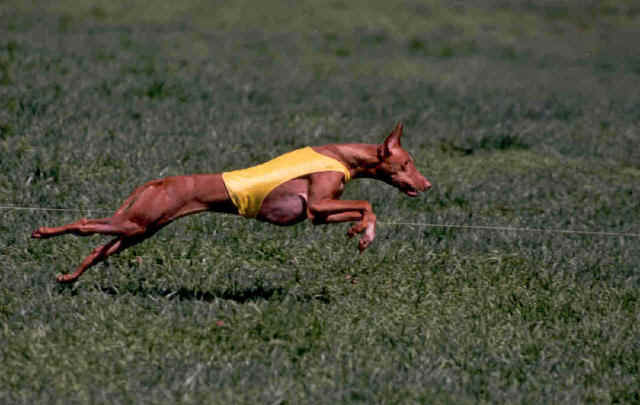
Ten: exercise. It's estimated that dogs in cities get about a tenth of the exercise they need to be healthy. Wolves, the domestic dog's first cousin, can run for hours and cover miles of territory. Of course, your average Chihuahua is not going to be capable of such a journey, but he does deserve as much exercise as he wants to have. Running in dog parks blows off steam and allows your dog to interact and speak his own language with other dogs.
Eleven: quality health care. This is a no-brainer. Take your dog to a vet that *you'd* go to if you could. I find that a vet who remembers my dog's name before they remember mine is worthy to work on my dog. Find a vet you are comfortable talking to, and one who seems confident. Ten years' experience on the job doesn't hurt, either, unless you find someone "stuck in his ways". The veterinary science is always changing and growing, so find a vet
who stays abreast of the latest developments.
[ click
to return to the Archives index ]
|
|
|