 |
||||||||||||
 |
 |
 |
||||||||||
 |
 |
 |
 |
 |
 |
 |
 |
 |
 |
|||
 |
 |
 |
||||||||||
 |
 |
|||||||||||
 |
 |
 |
||||||||||
 |
||||||||||||
|
||||||||||||
|
|
|
||||||||||
|
|
|
|
|
|
|
|
|
|
|||
|
|
|
||||||||||
|
|
|||||||||||
|
|
|
||||||||||
|
||||||||||||
Bad Kreuznach, Germany - Where I live

|
Best-beloved of Heaven art thou, beautiful city which bore me, blessed above a thousand others. Joy and plenty dwell in thee and love is thy foundation. He who laid the first corner-stone of thy gates, the master-builder, was indeed favoured of heaven. Thy friends honour thee, thy proud sons bear thee in their thoughts wherever thou sendest them, by land or sea. FRIEDRICH MULLER, POET AND PAINTER (born Kreuznach 1749, died Rome 1825)
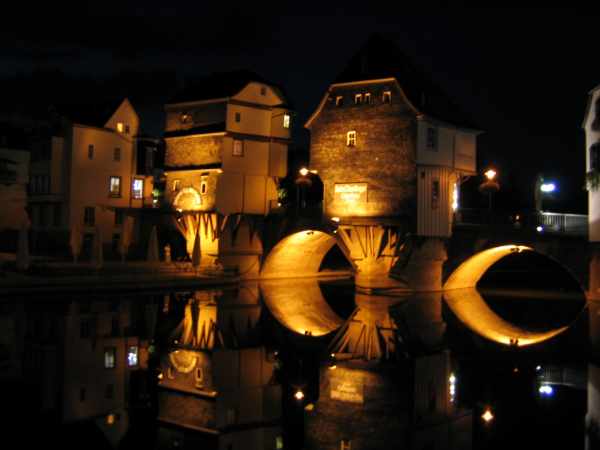
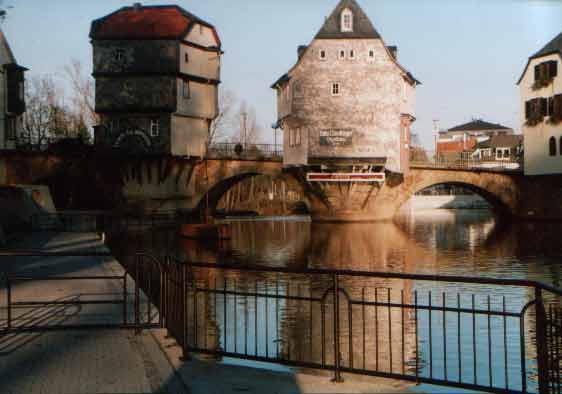
(Above:Bridge Houses of Bad Kreuznach) Bad Kreuznach Today Today there are 44,000 people that live in the city itself. Bad Kreuznach is the provision midpoint (shopping, food, ..ect) for a region with 150,000 inhabitants. The city has central meaning especially based on its economic strength for the region. 28,500 people work here, and two-thirds are commuters from the surrounding countryside. Altogether Bad Kreuznach has 16,500 businesses which consists of small and medium sized businesses. However, there are also well known companies such as Michelin Tire, Schneider Optics, and Seitz Filter. Bad Kreuznach is a town of many aspects — a spa, a commercial and industrial centre, the centre of a wine-growing district — and few other places can offer such a happy blend of contrasts between the natural advantages of a spa and the modernity of a city, between tradition and progress, natural beauty and technical innovations, distinctive local traditions and worldwide connections. A single visit to Bad Kreuznach leaves an unforgettably happy impression of harmony, of great variety within a small area. That the people of Kreuznach, with some juristification like, to call it "the town of roses and nightingales" reveals something of its incomparable magic. The point where the Nahe emerges from its narrow valley of porphyry cliffs and finds its way into the open, wearing down the soft tertiary marine sediment to form a broad plain, is a natural site — from the points of view of geography, economics and ease of access — for the centre of the Nahe region. This is an ancient settlement area which has yielded rich rewards to excavating archaeologists. Magnificent relics of ancient times, which have much to tell us about the lives and deaths of whole populations, are preserved in the Karl Geib Museum.
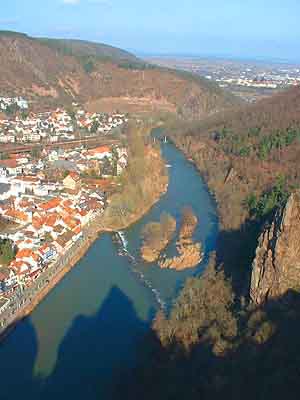
A view of the river at the Southern tip of the City Above on the hill is the ruins of the Kauzenberg) The town and its history
The wandering tribes of the Old Stone Age left many traces of their passage through the valley of the Nahe, but as early as 6 000 years ago our area had been permanently settled by farmers who cultivated the fertile loam. The farmers of the Neolithic linear pottery culture were replaced by the barrow-builders of the Bronze Age. In the late Bronze Age the area was inhabited by a highly civilized people which combined with other tribes living further south, in the La Tene period, to form the people of the Celts. Two extensive segmented circular ramparts, on the hilltops of the Hardt and Cans, were laid out by the Celts to protect the important crossroads, undoubtedly also a tribal and commercial centre, and also the salt-water springs — these were probably known even at that date — in what is now the Salinental. In the years between 58 and 51 BC the Romans conquered the left bank of the Rhine. For more than 400 years our region formed part of their empire. In the first century AD the eastern boundary of the Roman sphere of influence still ran along the Rhine. The Romans used the crossroads of Kreuznach, which lay behind the frontier, as a settlement for their veterans, who were either farmers or craftsmen. Seventy-five of their names have come down to us on the so-called "tablets of curses" which were found during excavations. Bad Kreuznach thus possesses what may be a unique curiosity: a list of inhabitants, even if not a complete one, from which it may be deduced that the total population was considerably larger. This Roman settlement retained its Celtic name of Crucinia, in Latin that is "Crucinia-cum" or "the home of Crucinius". The cultural and civilizing achievements of the Romans fill us with gratitude and admiration even now: not only did they transform the ancient tracks into paved roads but they built bridges and stone houses. The period was distinguished by a unified administration system, safety of communications and a stable monetary system. Many crafts received fresh stimulus and whole new industries were created; fruit-growing and gardening were improved, and last but not least the Romans introduced the vine, the produce of which is still one of the population's principal sources of income today and is esteemed for its superior quality. Until 260 AD the country remained at peace. Roman estates grew up on the best land, and extensive domains provided supplies for the troops. About the middle of the first century AD the native population consisted of the Celts, with whom some Germanic immigrants had already intermingled, theVangioni, a Germanic tribe who had been transferred at the beginning of the first century to the left bank of the Rhine; and the former Roman soldiers from all the world over who had settled in the area, and who were romanized to a considerable extent. Many Roman estates belonging to rich landowners had palatial villas added to them. In one of these villas, on what is now the Hiiffelsheimer Strasse, two Roman mosaic pavements were found in 1897 and 1966; they are rightly claimed to be among the finest north of the Alps. The pavement found in 1897 is one of the local museum's treasures on account not only of its subject — gladiators in an amphitheatre — but of its under-floor heating (hypocaust). Research has shown that it dates from about 250 AD.
When in about 260 AD the Germanic tribes crossed the Rhine and broke through the Roman boundary there was much destruction, and it took about 40 years for order to be restored. In order to protect the hinterland the Emperor Valentinian had forts built some way from the newly fortified towns along the Rhine, on the major crossroads — in Cruciniacum this was done between about 364 and 370 AD. Of this substantial construction, which lay not far from the railway track to Binger-briick, there remains only a fragment — a section of the surrounding wall, popularly known as the "heathens' wall". The most recent excavations have revealed part of its foundations. After the Roman general Stilicho had withdrawn his legions from the Rhine to protect Italy, in about 400 AD, the Germanic tribes, who had been held back for 500 years, could press forward almost unchecked across the Rhine. While the Romano-Celtic upper class withdrew into the interior of Gaul the native population, in as far as it survived the disasters of war, was pressed into service by the Germanic newcomers to work as farm labourers or craftsmen, and gradually became absorbed into the new ruling race. The Burgundians had a temporary settlement in the area between the Nahe and the Rhine (from 408 till 443 AD). After their departure the area was the scene of a conflict between the Alemanni, coming up from the south, and the Franks, coming down from the north; the Franks, being victorious, settled in the conquered territory. Most of the place names ending in "heim" mark settlements from the period of Frankish invasions (450-600 AD). The Roman state lands and villas, and the broad forests, became Merovingian royal domains, and royal manors were used partly for managing the estates and partly to house the constantly travelling kings. The palace (palatium) of Kreuznach has been shown to lie inside the walls of the fort. Not far away stood the first church of St Martin, where Frankish aristocrats were buried. A rich, so-called ''prince's grave" in Planig, near Kreuznach. dating from about 525 AD, obviously also belongs to this royal domain. The old Roman cemetery in Kreuznach was still used by the Franks. At that time there grew up on the left bank of the Rhine a manor belonging to the royal estates, the cemetery of which has been found. The palace of Kreuznach was however soon overshadowed by the imperial palace of Ingelheim, built from 790 onwards by Charlemagne. Louis the Pious paid several visits to Kreuznach (as shown by documents of the years 819 and 839). The earliest medieval town grew up close to the palace and its church of St Martin. The treaty of Verdun (1843) gave the Kreuznach area together with Worms and the Nahegau, to the eastern kingdom; here the most important estates were to be found, here the most vital of the Main roads crossed, and here lay the important archbishopric of Mainz. The Soonwald formed the frontier to the west. The royal palace grew into a small market town with a mint of its own ("villa crucenacus" in 822, "villa Crucinaca" in 845, "Crucinacho" in 882, "Crucinacha villa in dominicata" in 977, and "Crucinache" in 1225). The town's modern name is not therefore derived from the word "cross" — it has developed out of an old Celtic place name (Cruciniacum — the home of Crucinius). Not until the name was no longer understood did the corruption "Kreuz" ("cross") come into being, to be sanctioned by the three crosses of the town's coat of arms. The two chequered blue and gold bars were taken from the coat of arms of the former overlords, the counts of Sponheim.
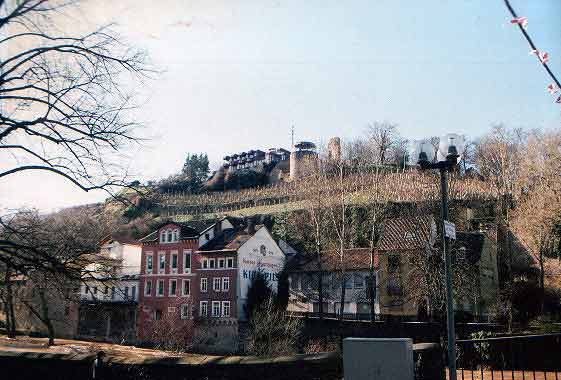
Like almost all other royal domains the Kreuznach property was gradually handed over to provincial counts, nobles, and monasteries. As early as 741 the newly founded bishopric of Wiirzburg was granted the church of St Martin. After the town and church had been destroyed — probably by the Hungarians — the church was rebuilt in 923 and dedicated to St Kilian. Presumably, however, the palace was not rebuilt. Later on the Rhenish Counts vom Stein appear as owners of town and church lands. About the middle of the llth century the rest of the imperial domain was given by the Emperor Henry III to the bishopric of Speyer. It is not known when the left bank of the Nahe was granted to the Counts of Sponheim. In any event they built the royal domain into a real town, had a hunting seat there, with a chapel — later extended to form the church of St Nicholas — encouraged the market and made the settlement into an economic and military centre for the nearer of their two territories. The Kauzenburg (pic above), towering above the town, became the seat of the Kreuznach branch of the family.
Castle, garrison quarters, town hall, warehouse, market, artisans' alleys and guildhouses gave this settlement, which was provided at an early stage with a wall of its own, the air of a real town. The ground plan of this quarter was oval, and all the streets and lanes fitted into this shape. The old Roman road to Metz — today known as the "Hochstrasse" — formed an east-west axis. The road from Worms and Alzey, which had earlier crossed the Nahe by a bridge outside the town (the present-day street name of Briickes or Briickengasse — Bridge Lane — is a reminder of this) was diverted to run up to the castle. The centre of the town was the present-day Eiermarkt (egg market), which was bounded to the south by the church of St Nicholas, and to the east by the Town Hall, burnt in 1849. Thus a "new town", duly called "Neustadt", had arisen. On the other side of the Nahe, opposite the castle, the counts laid out an extension of the town around the year 1200. This was square in plan, with a main street running through the centre, another street crossing the first, a market, and parallel lanes running into the main street. Most of the inhabitants of the oldest part of Kreuznach, close to the Roman fort,moved into this new quarter. This more recent part of the town was known as the Altstadt or "old town" to distinguish it from the "new town" on the left bank of the Nahe. The name "Oster-burg" was adopted for the remaining area close to the fort. On the island between the two halves of the town, the Worth, the Counts of Sponheim built, between 1311 and 1332, a parish church which was destroyed in 1689. Today only its Gothic choir remains. The tower and nave of the present day church of St Paul (see below) were rebuilt from 1768 to 1771 and the nave a second time in 1954. Since the building of the "old town" was a slow process, there was still room in 1472 for the big Franciscan monastery. Between the new and old towns, on the opposite banks of the Nahe, a stone bridge was built before 1311; half of this was severely damaged in the last days of the second world war and it was replaced by a new bridge in 1952. The bridge houses (see first pic and below), two of which are mentioned for the first time towards the end of the 15th century, were gradually built over its buttresses.
(Bridge Houses)
In order to encourage new inhabitants to settle there, but also in order to make it easier for the town to perform its role as a defensive outpost of the county, the inhabitants were given specific rights and some degree of self-government; they were allowed to collect taxes and hold their own courts, but had to pay their dues to the feudal overlord, as well as to undertake other duties such as military service. Shortly after the Emperor had extended the rights of the temporal overlords in 1232, giving them the imperial prerogatives relating to justice, trade and communications, these rights were also granted to the citizens of Kreuznach in a charter of independence. They were proud of their fine town and had a large seal made, showing a church surrounded by town walls and surmounted by a cross. The inscription reads "sigillum amene civitatis in Crucenacho", "seal of the pleasant (or pleasantly situated) town of Kreuznach". This seal, a copy of which is still kept in the municipal archives, is mentioned for the first time in a document dating from 1261 which is preserved in the archives of Koblenz.
The municipal rights were extended in 1270 and were finally confirmed in 1290 in a charter granted by King Rudolf of Habsburg. The town was a military stronghold of the counts and provided protection for its inhabitants. Markets were set up and stimulated trade and communications. Kreuznach became a centre of winegrowing and the wine trade, a position which it retains to this day. The town was surrounded by a wall, mentioned as early as 1247. The monastery of St Peter, founded by the counts, lay on the site of the present Oranienpark, "extra muros ci-vitatis Crucenache" (outside the town). When, in the year 1279, Count John the Lame found himself hard pressed at the battle of Sprendlingen, a citizen soldier from Kreuznach, the butcher Michel Mort, saved his life at the cost of his own. The monument erected by Robert Cauer in the Eiermarkt commemorates this brave man. In 1281 the Carmelites began to extend the chapel they had been given to form their monastery church — the present-day church of St Nicholas in the Eiermarkt of the "new town" — and to build a monastery. The sacristy contains a valuable reliquary of the cross, unique in design, which was last remodelled by Hans von Reutlingen in 1501. The power of the house of Sponheim, whose territory was wedged in between the powerful neighbouring electoral states of Mainz, the Palatinate and Trier, was weakened by various divisions of its inheritance. In 1477 the Kreuznach branch of the family became extinct in the male line, and in 1437 the Starkenburg branch followed suit. The last countess, Elizabeth, left the country, and with it Kreuznach, to be shared by three overlords. About the middle of the 15th century the Palatinate held two-fifths, Pfalz-Simmern one and a half fifths, and the Margraviate of Baden one and a half fifths. It is easy to see how this awkward arrangement hampered the town's further development. The bailiff from the Palatinate, whose influence was much the strongest, lived at the time in the Kauzenburg, which had been extended to provide a residence for him. With each change of government, however, the citizens had their liberties confirmed in a new charter. The Simmern branch of the Counts Palatine built a palace in the "new town", at the end of the 15th century, and lived in it from time to time. In the ensuing period Kreuznach suffered the special disadvantages of losing its position as a capital, so that it had no direct assistance from its rulers. At this time Abbot Trithemius was writing his chronicles in the nearby monastery. He relates, too, that the famous wizard Johann Georg Sabellicus Faust lived in Kreuznach and was rector of the grammar school, having been appointed by the bailiff Franz von Sickingen. According to tradition Faust is supposed to have lived in a house on the site of the present-day "Faust's House".
Ulrieh von Hutten and Franz von Sickingen, occupying the Ebernburg, the "home of justice", had adopted the new religious and intellectual ideas as early as 1521. About the middle of the 16th century the Reformed faith was introduced into the Palatinate. Kreuznach was partly Reformed and partly Lutheran. From 1626 onwards the Catholic faith was once more tolerated. About 1700 the Lutherans of Kreuznach built the Wilhelmskirche. As was the case throughout Germany, the Thirty Years' War caused immense suffering in Kreuznach. Because the lord of Kreuznach, the Elector Frederick V, went off to be the "Winter King" of Bohemia, his hereditary lands suffered particularly from the ravages of war. In 1620 Kreuznach was taken by the Spaniards, who were quartered there for many years. In 1632 (see below) King Gustavus Adolphus captured the town and its castle. The famous engraver Merian recorded the scene in one of his works. In 1635 the Imperial forces occupied the town; in 1639 Bernard of Weimar; as early as November of the same year, the French; and in 1641 the Imperial forces once more. In 1644 the French again took over. The latter retained their influence on the area until the middle of the 18th century by means of the fortress of Landau, which they continued to hold. The misery that followed this war was quite indescribable. Two thirds of the inhabitants were killed or fled to areas less affected by the war. Many villages in the surrounding country were left without a single inhabitant. The town's prosperity was at an end.
While the Thirty Years' War affected the actual population most of all, Louis XIVs war of conquest, in 1689, destroyed the entire old town of Kreuznach, with its walls, towers, churches, and castles. The magnificent castle on the Kauzenberg, which towers over the town in Merian's engraving, was razed to the ground except for a few fragments. Kreuznach took a long time to recover from its wounds. In 1708 the governments of Baden and the Palatinate exchanged the areas previously jointly administered by them. Henceforth Kreuznach belonged to the Palatinate alone. The quarrels between the various plenipotentiaries, which had been pursued at the citizens' expense, now ceased. The Palatine bailiff of Kreuznach had 19 of the surrounding villages under his control. The town was the headquarters of an important administrative body and the economic and cultural centre of a sphere of influence extending far into what are now Rhenish Hesse and the Palatinate. For the first time the citizens applied for a charter confirming their ancient liberties, but in vain. The new government's aim was rather to limit their previous degree of autonomy. At this time in 1721, there was born one of the town's greatest citizens: Johann Heinrich, Baron und later Count von Carmer. As the Chancellor of Prussia and Minister of Justice to King Frederick II he created the "common law of Prussia" which remained in force until the 20th century. Von Carmer died in 1801. Friedrich Miiller, born at Kreuznach in 1749, was exceptionally gifted in painting and poetry (see very top) alike; a friend of Goethe, known as "Miiller the painter", he died in Rome in 1825. Even although Kreuznach still remained a modest little country town for some time, and was unable to recover from the ravages of the wars, by 1786 it was nevertheless, along with the princely capitals of Heidelberg and Mannheim, the largest town in the Palatinate. In the age of mercantilism the salt pits, the profits from which flowed into the prince's coffers, were first exploited. While the Elector Charles Theodore was generous in promoting the development of the new state capital of Mannheim, and built one of the world's largest palaces there — taking an interest in art and science while maintaining the extravagant court of an absolute monarch — his small state, ruled by corrupt officials, had to meet the cost. No wonder, therefore, that the people of Kreuznach, too, lent an ear to the French slogan "liberty, equality, fraternity". But the years 1793 to 1797 brought them only hordes of soldiers to be supplied with food, fighting inside and outside the town, looting, forced payments of tribute and requisitions. The cost of the wars of that time was still being paid off up to the first world war. Even if particularism was at an end, the taxes had increased. The incompetent administrators who had originally been appointed were replaced by first-class, incorruptible officials; among these were, for instance, Baron von Recum, the sub-prefect of Simmern, and Mayor Burret of Kreuznach. In 1819, in order to stimulate the economy, undermined by Customs measures, Burret instituted a fair which still survives as a popular festival today. The conscription by the French of soldiers for the wars in Spain, Italy, and Russia did not add to their popularity. For this reason Bliicher, whose army was quartered in Kreuznach for a few days in 1814, was given a warm welcome. In 1815 Kreuznach became part of Prussia. The partition of the lands on the left bank of the Rhine at the Congress of Vienna placed Kreuznach at a serious disadvantage, the effects of which are felt to this day. Kreuznach was separated from its hinterland without any regard for centuries-old cultural and economic ties. The Congress made the border of the French department the new state boundary, and Kreuznach thus became a frontier town at the meeting point of three states. The Nahe separated Prussia from the Grand Duchy of Hesse and from the Palatinate, now attached to the Kingdom of Bavaria. Customs houses and turnpikes were erected on the frontier. The consequences of this unfortunate boundary delineation were still visible in the twentieth century. The French frontiers were not abolished until the administrative reform of 1968/69.
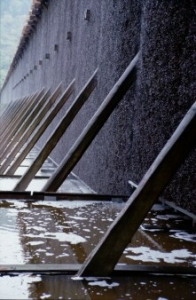
The spa and its history: The saline springs in the Salinental have been known for thousands of years. The numerous Roman coins found at the "Sulzer Hof", where the Sudhaus Theodorshalle now stands, provide grounds for the belief that Romans used these springs. Two of the cooks of the Elector Palatine were given permission in 1490 to refine salt and provide baths in Miinster am Stein. Of great importance for Kreuznach's subsequent rise to become a world-famous spa was the laying-out of the salt-pits, between 1732 and 1742. The pits later became the property of the Electors and were named Karlshalle and Theodorshalle. The French declared them to be state property and Napoleon gave them to his sister Pauline Borghese. The Grand Duchy of Hesse later received them under the Vienna Settlement. Johannes Erhard Peter Prieger, the young Wiesbaden doctor, summoned to Kreuznach to treat a patient in 1817, made the first attempts to use the salt springs for medicinal drinking and bathing. The outstanding success of his treatments led to new prosperity for Kreuznach — it became a spa. The outstanding possibilities were recognized by an enlightened community and its farsighted local authorities. The first pump room was built in its own park in 1843. The new spa soon attracted sick people from all over the world. The international aristocracy, chiefly from England and Russia, congregated here. Many German and other European princes, as the old lists show, were regular visitors to Bad Kreuznach. In 1904 the Kreuznach chemist Dr Karl Aschoff, stimulated by the research of the Curies in France, discovered that the Kreuznach springs had radioactive properties. Not only was he able to show that radium was present in substance in the deposits left by the spring water, but also that the brine and the "radon galleries" contained an emanation produced by decaying radium, radon. From this discovery the spa doctors developed, after years of research, the "Kreuznach treatment" which was adopted throughout the world. Thus Bad Kreuznach became the oldest radium spa in Germany and the oldest radioactive saline spa in the world. A completely new part of the town — the spa quarter — sprang up; hotels, boarding-houses, sanatoria and villas multiplied. With the Oranienpark, an island of roses on the Nahe, nestling between the slopes of the Hardt and the Rhein-grafenwald, a new oasis of peace and natural beauty was created. Upstream the area is bounded by the impressive salt graduation works, a large open air inhalatorium (see below), the modern swimming-pool and the sports grounds. The prosperity of the spa at the end of the last century was so great that it was decided to pull down the old pump room. To take its place Professor Emanuel von Seidl of Munich designed the present pump room in 1913. The new bath-house had been built shortly before. This rapid expansion was abruptly halted by the first world war.
(Above: Open Air Inhalation Structures)
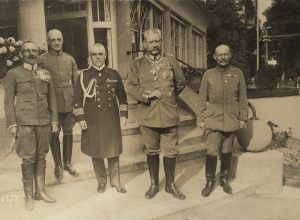
In 1917 and 1918 the main army headquarters occupied the spa buildings. The Emperor lived in the pump room. Field Marshall von Hindenburg and Quartermaster-General Ludendorff, with the general staff, had the Oranienpark as their place of work.
(Hindenburg)
The subsequent occupation, which lasted 15 years, destroyed justifiable hopes of revival. In the second world war Bad Kreuznach again suffered a considerable setback chiefly, once more, by the prolonged occupation of the spa installations by General von Witzleben, among other commanders, and his Army Command. Until 1955 the pump room, the centre of activity in the spa, was occupied by foreign troops. It took a determined policy of reconstruction gradually to make good the severe air raid damage suffered by the town and the spa. In spite of all the suffering and the upheaval of war one thing had not been destroyed — the heavenly blessing of the healing springs in the Nahe valley. On this foundation the old but ever young spa was rebuilt. The medicinal powers of the springs, and their reputation, remained unimpaired, and it soon became clear that the greatly reduced capacity of the spa establishments could scarcely accommodate the influx of people seeking treatment. Since then the number of visitors has exceeded all previous records. Today, some 150 years after the centuries-old springs were first put to use, this spa among the vine- and forest-clad hills is experiencing renewed prosperity. The fame of its remarkable successes in the struggle against the great scourges of humanity is spreading throughout the world. Rheumatic diseases, gynaecological ailments, diseases of children, overstrain, non-infectious diseases of the skin, respiratory catarrh, various disturbances of the endocrine glands, and impairment of the peripheral circulation are some of the illnesses that have been successfully treated here. The little tea-house which Baron von Recum had built on the porphyry rocks overlooking the pump room park is a popular spot with a wide view over the town and its surrounding countryside. Its impressive scenery is one of the factors which make Bad Kreuznach particularly attractive as a spa. The soothing physical effects of the radioactive saline springs combine with the charm of the scenery and a carefully chosen programme of cultural and social events to offer patients a course of treatment that is genuinely beneficial to body and mind alike. Wine-growing, trade, and industry: In the Middle Ages wine was already one of Kreuznach's most important sources of income. The magnificent vineyards, producing high quality wines of international standing, and the size of the area cultivated — the larggest on the Nahe — form the basis for the dominant position it enjoys even today. On the slopes of the Kauzenburg Baron von Recum, at the beginning of the 19th century, tried out in the Nahe area the late vintage system which had already become popular in the Rheingau. A Kreuznach company (Seitz Filters) played an important part in the development of the vintner's art, which turns the unfermented must into fine wine, with its invention of asbestos filters and other wine-making machinery. The building of the Rhine-Nahe railway between 1858 and 1860 also contributed to Bad Kreuznach's industrial prosperity. The oak bark tanneries, a traditional industry of Bad Kreuznach, became leather factories. For a long time Bad Kreuznach had a glassworks. The town's optical industry is known all over the world. A tire factory had addded to its industrial potential. There is also a considerable number of medium-sized factories and workshops producing a variety of goods, which have made Bad Kreuznach's economy stable and resistant to crises. The industrial area (see below) lies far from the spa quarter and to the leeward of it, towards the Rhine. The two areas are separated by the town centre with its shops, blocks of flats and public buildings. The shops are efficient and helpful, coming up to the most exacting standards. Bad Kreuznach not only has to meet the needs of its 45 000 inhabitants but serves as the shopping centre for a large area of the Hunsriick, Rhenish Hesse and the northern Palatinate and for the entire Nahe valley.A central position in the state of Rhineland-Palatinate, good railway connections, fine roads and, last but not least, the classic elegance of its pump room hotel, have made Bad Kreuznach — particularly in the past few years — a popular place for the meetings and congresses of scientific, economic, and political associations. Its central position in relation to the rest of Europe also makes it convenient for international meetings of all kinds. May the magnetism of Bad Kreuznach — felt as it is by sick people in need of treatment, and also by scientists, businessmen and politicians — always be a blessing to the town itself and to the world at large.
Planig In 1969 the towns of Bosenheim, Ippesheim,
Planig (where I live), and Winzenheim were annexed into the city main of Bad
Kreuznach. (When I get more information I will post it.)
|
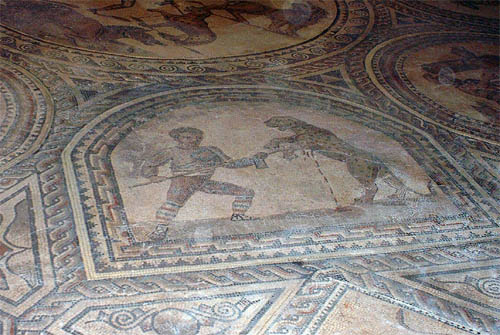 (Mosaic found in the Roman Hall)
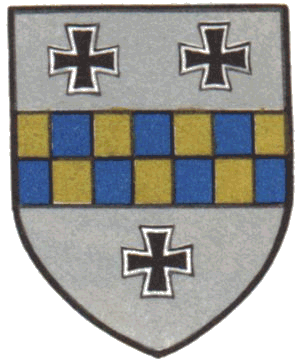 (Bad
Kreuznach Coat of Arms)
(Bad
Kreuznach Coat of Arms)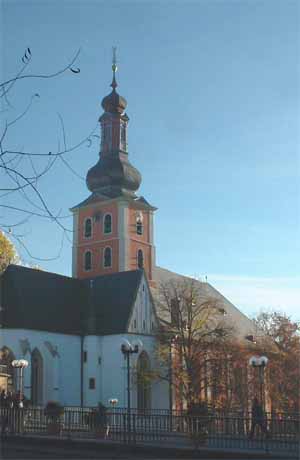 (St Paul's Church)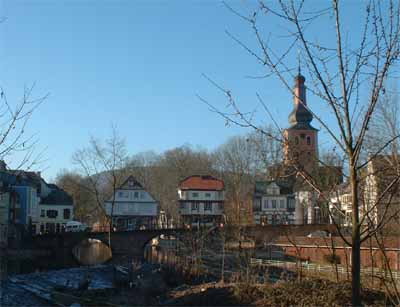
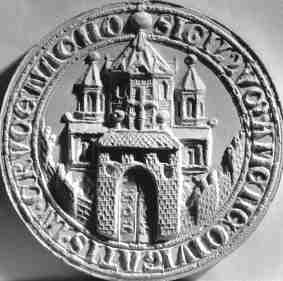 (Seal of Bad
Kreuznach made in 1232)
(Seal of Bad
Kreuznach made in 1232)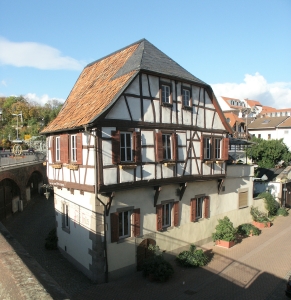 ( Faust's House)
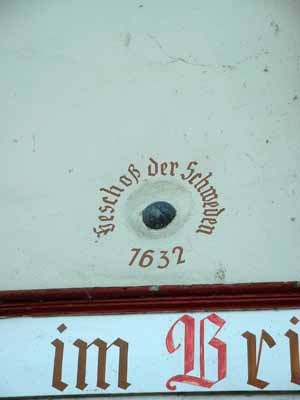 (One of the Bridge Houses still
has a Cannon Ball from the invading Swedish Forces of King Gustavus)
(One of the Bridge Houses still
has a Cannon Ball from the invading Swedish Forces of King Gustavus)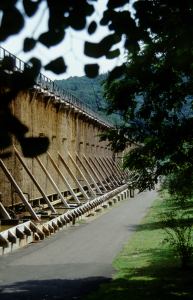
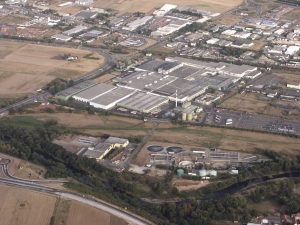 (The
Industrial Area)
(The
Industrial Area)