


Although low angle light scattering techniques are very suitable to study long range correlated fluids, their sensitivity is hampered by the divergence of stry light at small wave vectors. The data presented in [22,23] were collected by using the shadowgraph projection technique. Shadowgraphy has traditionally been used to obtain a qualitative mapping of inhomogeneities in the index of refraction. However, very recently the technique has been reintroduced as a powerful quantitative tool to assess the features of long wavelength fluctuations in fluids [15,16].
The main problem of shadowgraph is the oscillatory behaviour of its
transfer function: see
Eq. (3.37). The scattering
intensities around the zeroes of the transfer function cannot be
measured: for example, in Fig. 3 of [22], the values of
 are missing for
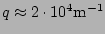 .
Moreove, the region in which the zeroes are too frequent cannot be considered
in the data analysis. The overall wavevector range covered about one
decade.
.
Moreove, the region in which the zeroes are too frequent cannot be considered
in the data analysis. The overall wavevector range covered about one
decade.
We measured the scatterig intensities at different times after the
beginning of the diffusion process.
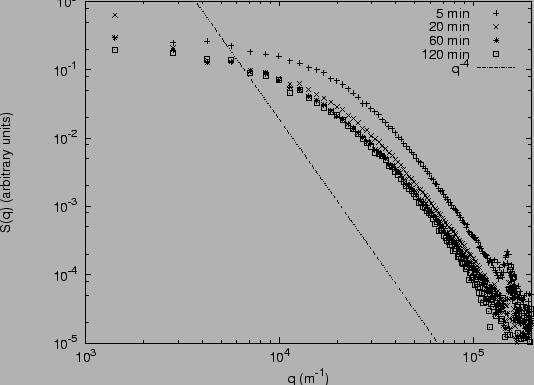
The power spectra measured with SNFS are shown in
Fig. 9.3. They show the  divergence
and the saturation for small wavevectors. The roll off wavevector is
about
divergence
and the saturation for small wavevectors. The roll off wavevector is
about
 , and is compatible with the value given
by Eq. (9.2)
, and is compatible with the value given
by Eq. (9.2)
|
The data cover about two decades in wavevectors: about ten times the range covered with shadowgraph. The quality must be compared with data shown in Fig. 2 of [13], obtained with SALS on a similar, but quite peculiar system: the wavevector range covered by SNFS is slightly more wide. Moreover, it should be noticed that SALS gives no reliable results for the present system, that is for the nonequilibrium fluctuations in the free diffusion of simple fluids, due to stray light, since the scattering is weak and the wavelength associated to the process is quite long. The results we present are the best obtained for such a system up to now.