Diffusion is the fundamental mass transfer mechanism in many natural
and technological processes. The diffusive transport can be
interpreted by the simple molecular random walk model. A more refined
description requires the understanding of direct interaction between
the diffusing particles and possibly hydrodynamic interactions. Both
types of interactions may produce appreciable changes in the magnitude
of the effective diffusion coefficient  but, at any extent,
diffusion is believed to give rise to an intimate and homogeneous
remixing on matter. The general belief is that while the process
occurs over quite microscopic distances, nothing peculiar should occur
at any other lengthscale, except the molecular one where the random
molecular diffusion takes place.
but, at any extent,
diffusion is believed to give rise to an intimate and homogeneous
remixing on matter. The general belief is that while the process
occurs over quite microscopic distances, nothing peculiar should occur
at any other lengthscale, except the molecular one where the random
molecular diffusion takes place.
It has been recently shown that, quite unexpectedly, gigant fluctuations are present during the diffusive remixing of two miscible phases of a binary mixture not too far from its critical point [13]. A fluctuating hydrodynamic description has been developed [20], which indicates that gigant nonequilibrium fluctuations should be present during the diffusive remixing of fluids in general; moreover, it has been shown that the fluctuations can be considered the origin of the whole Fick flow [21].
The presence of the fluctuations has been detected experimentally during the free diffusive remixing occurring in ordinary liquid mixtures and in macromolecular solutions [22,23]. The measurements concerned an ordinary, low molecular weight liquid mixture, an aqueous solution of a low molecular weight solid, a polymer solution and a protein solution, thus giving evidence that these anomalous fluctuations are a universal feature associated with spontaneous diffusion across a macroscopic gradient.
A free diffusion experiment begins filling a cell with the two
liquids, with the denser solution in the lower part to avoid
convective instability. The two horizontal layers are initially
separated by a fairly sharp meniscus. As soon as the two liquids came into
contact, the diffusive remixing begins, and the meniscus repidly becomes
smeared. The concentration profile inside the sample, initially a step
function as a function of the height  , gradually evolves into an
s-shaped function [24], until eventually, after a few
days, the concentration becomes uniform throughout the sample.
, gradually evolves into an
s-shaped function [24], until eventually, after a few
days, the concentration becomes uniform throughout the sample.
During the free diffusion process described above, intense
fluctuations arise. Their power spectrum
 ,
with
,
with  in the horizontal direction, is given by:
 is given by:
 is the gravity acceleration,
  is the kinematic viscosity,
is the diffusion coefficient, and
is the kinematic viscosity,
is the diffusion coefficient, and
 is the solutal expansion
coefficient, a quantity that increases as increases the mismatching of
the two liquids. The gradient
is the solutal expansion
coefficient, a quantity that increases as increases the mismatching of
the two liquids. The gradient  can be assumed roughly
connstant in the region between the fluids, where diffusion takes
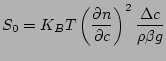
place, and vanishes outside. The sample-dependent prefactor in
Eq. (9.1) is given by:
can be assumed roughly
connstant in the region between the fluids, where diffusion takes
place, and vanishes outside. The sample-dependent prefactor in
Eq. (9.1) is given by:
 is the total concentration difference across the
sample.
is the total concentration difference across the
sample.
The power spectrum
 dislpays a
  power low
divergence at large wave vectors,
power low
divergence at large wave vectors,
 ,
and a saturation at a constant value at small wave vectors,
,
and a saturation at a constant value at small wave vectors,
 . The power low is interpreted as the result of
of the coupling of velocity fluctuations with concentration
fluctuations, while the saturation is due to a stabilizing effect of
gravity on long wavelength fluctuations.
. The power low is interpreted as the result of
of the coupling of velocity fluctuations with concentration
fluctuations, while the saturation is due to a stabilizing effect of
gravity on long wavelength fluctuations.
Moreover, the roll-off wave
vector where the transition between the two regimes occurs gets
smaller as
 , and the the low wave vector value of
the power spectrum
, and the the low wave vector value of
the power spectrum  is roughly constant as free diffusion takes
place, since the concentration near the upper and lower windows of the
cell are initially constant.
is roughly constant as free diffusion takes
place, since the concentration near the upper and lower windows of the
cell are initially constant.
The nonequilibrium concentration fluctuations are originated from the
coupling of velocity fluctuations with concentration fluctuations, due
to the presence of a macroscopic concentration gradient. This can be
understood by simple naive arguments, discussed in detail in
[20] and [25]. Suppose that a small parcel
of fluid of linear size  undergoes a velocity fluctuation. This
fluctuation will displace the parcel until the viscous drag will stop
it in a time given approximately by
undergoes a velocity fluctuation. This
fluctuation will displace the parcel until the viscous drag will stop
it in a time given approximately by
 , being
the kinematic viscosity. If the displacement of the parcel occurs in a
direction parallel to the macroscopic concentration gradient, the
parcel will be surrounded by fluid with different concentration. The
life time of this concentration fluctuation is
, being
the kinematic viscosity. If the displacement of the parcel occurs in a
direction parallel to the macroscopic concentration gradient, the
parcel will be surrounded by fluid with different concentration. The
life time of this concentration fluctuation is
 ,
and is much larger than the viscous time
,
and is much larger than the viscous time
 , as
, as
 . Thus, in the presence of a macroscopic gradient, the effect
of a short living velocity fluctuation is to induce a long lasting
concentration fluctuation. Once a concentration fluctuation has been
created, two mechanisms may contribute to its relaxation: diffusion
and buoyancy. If the spatial extent of the fluctuation is small, then
the fluctuation will soon disappear due to diffusion. This mechanism
gives rise to the divergence of the static power spectrum at
high wavevectors. As the wavevector increases, the velocity
fluctuation lives for a shorter time, and can displace the parcel of a
smaller amount, and this gives a factor
. Thus, in the presence of a macroscopic gradient, the effect
of a short living velocity fluctuation is to induce a long lasting
concentration fluctuation. Once a concentration fluctuation has been
created, two mechanisms may contribute to its relaxation: diffusion
and buoyancy. If the spatial extent of the fluctuation is small, then
the fluctuation will soon disappear due to diffusion. This mechanism
gives rise to the divergence of the static power spectrum at
high wavevectors. As the wavevector increases, the velocity
fluctuation lives for a shorter time, and can displace the parcel of a
smaller amount, and this gives a factor  ; moreover, the
displaced parcel will be dissipated as .
However, if the fluctuation is large enough, the buoyancy force acting
on it will be able to restore the fluctuation in the layer of fluid
having the same density in a time shorter than the diffusive one. This
gives rise to the frustration of the divergence at smaller
wavevectors.
; moreover, the
displaced parcel will be dissipated as .
However, if the fluctuation is large enough, the buoyancy force acting
on it will be able to restore the fluctuation in the layer of fluid
having the same density in a time shorter than the diffusive one. This
gives rise to the frustration of the divergence at smaller
wavevectors.
![$\displaystyle S\left(q\right)= S_0\frac{1}{1+\left[\frac{q}{q_{RO}}\right]^4}.$](img524.png)
![$\displaystyle q_{RO}=\sqrt[4]{\frac{\beta g \nabla c}{\nu D}}$](img526.png)