


In order to evaluate the correlation function of the mean intensity, we average a given amount of images, then we evaluate the correlation function of the obtained mean value. Since the number of images we average is finite, the correlation function will not correspond to that of eq. (5.14). For example, if the stray light vanishes, the mean intensity will still present fluctuations, due to the scattered light. These fluctuations vanish as the square root of the number of the averaged images, and consequently the correlation function becomes flat only for infinite samples.
A similar problem arises when working with a stochastic, gaussian variable.
If we have  values of the stocastic variable
  ,
distributed with probability
,
distributed with probability
![$ P\left(x\right)\propto \exp\left[-\left(x-x_0\right)/
\left(2\sigma^2\right)\right]$](img391.png) , we find that the best value for
, we find that the best value for  is the mean of the values , and the best value for
  is the
root mean square displacement of the values from . On the other
hand, the average on a finite number of elements will be displaced from
of an amount, vanishing as the square root of the number of the
samples , but so that the root mean square displacement of the data from
the mean is alwais smaller than . It is thus necessary to use the
Bessel correction, dependent on the number of the samples .
is the
root mean square displacement of the values from . On the other
hand, the average on a finite number of elements will be displaced from
of an amount, vanishing as the square root of the number of the
samples , but so that the root mean square displacement of the data from
the mean is alwais smaller than . It is thus necessary to use the
Bessel correction, dependent on the number of the samples .
Generally the Bessel correction is obtained in consequence of the ``maximum likelihood'' condition. This means that, given a set of values of a stochastic variable, and given a family of probability distributions, the parameters of the family must be selected in order to maximize the probability of finding the given data. Another approach is to find a suitable algorithm which gives the values of the parameters, from a set of data. The algorithm will be selected in order that the output values will be distributed around the true ones, with minimum square displacement. For a gaussian distribution, the two approaches give the same result. It is easy to show that, for example for a Heaviside distribution, the maximum likelihood condition fails to obtain the best results.
In our case, the distribution function of the intensity is not gaussian. We will use weak condition, that is, we will look for an algorithm giving values which average to the true ones. In other words: we will try to avoid sistematic erroneous evaluations of the correlation function.
We define
 as the mean over samples. In particular
 is the correlation function of the averaged images.
To avoid sistematic errors, we must first evaluate
is the correlation function of the averaged images.
To avoid sistematic errors, we must first evaluate
 :
:
 |
(5.11) |
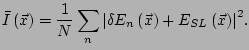
images  is given
by the sum of the field scattered by the sample
is given
by the sum of the field scattered by the sample
 and the field of the stray light
 :
:
 |
(5.12) |
![$\displaystyle \left\{C_{\bar{I}} \left(\Delta \vec{x}\right)\right\} = \frac{1}...
...c{x}\right)E_{SL}\left(\vec{x}+\Delta\vec{x}\right) \right] \right> \right\} }.$](img400.png) |
(5.13) |
We can follow the calculations performed in Section 5.1 to obtain Eq. ( 5.8). In this case we obtain:
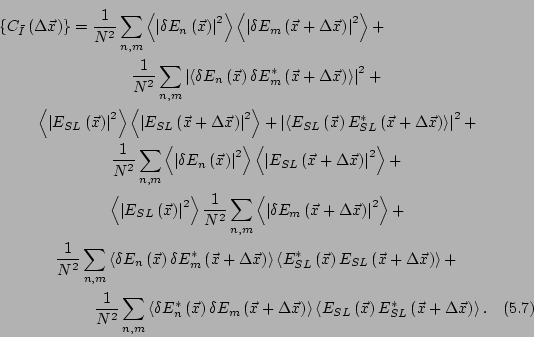
 and
and
 are taken into account:

 :
:
From eq. (5.8), (5.22) and (5.15) we can evaluate the field correlation function:

