next up previous contents
Next: Correction for finite samples. Up: ONFS data processing. Previous: ONFS data processing.   Contents


Effect of the stray light.

From a set of ONFS images $ I\left(\vec{x}\right)$, we can measure the intensity correlation function:

$\displaystyle C_I\left(\Delta \vec{x}\right) = \left\{ \left< I\left(\vec{x}\right) I\left(\vec{x} + \Delta \vec{x}\right) \right> \right\},$ (5.1)

where $ \left<\cdot\right>$ is the mean over $ \vec{x}$, $ \{\cdot\}$ is the mean over different images, and the intensity of the images $ I\left(\vec{x}\right)$ is the intensity of the sum of $ \delta E\left(\vec{x}\right)$, the field scattered by the sample, and $ E_{SL}\left(\vec{x}\right)$, the field of the stray light:

$\displaystyle I\left(\vec{x}\right) = \left\vert \delta E\left(\vec{x}\right) + E_{SL}\left(\vec{x}\right) \right\vert^2.$ (5.2)

So we obtain:

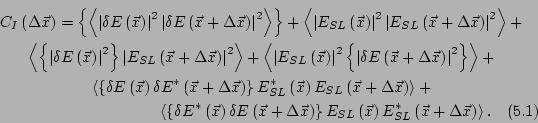
$\displaystyle C_I\left(\Delta \vec{x}\right) = \left\{ \left< \left[ \left\vert...
...ec{x}\right) E_{SL}\left(\vec{x}+\Delta\vec{x}\right) \right] \right> \right\}.$ (5.3)

Since $ \delta E\left(\vec{x}\right)$ is a random, circular gaussian field, the mean over different images of its odd powers vanishes; since $ E_{SL}\left(\vec{x}\right)$ is static, it can be considered as a costant, with respect to $ \{\cdot\}$, the average on the images:

\begin{multline}
C_I\left(\Delta \vec{x}\right) =
\left\{\left<\left\vert\delta...
...\vec{x}\right)E_{SL}^*\left(\vec{x}+\Delta\vec{x}\right) \right>.
\end{multline}

The mean over the images $ \{\cdot\}$ equals the mean over $ \vec{x}$, $ \left<\cdot\right>$, for the field $ \delta E\left(\vec{x}\right)$:

\begin{multline}
C_I\left(\Delta \vec{x}\right) =
\left<\left\vert\delta E\left...
...\vec{x}\right)E_{SL}^*\left(\vec{x}+\Delta\vec{x}\right) \right>.
\end{multline}

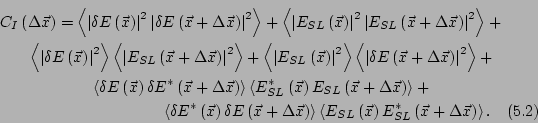
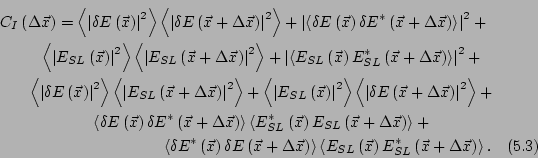
Since both $ \delta E\left(\vec{x}\right)$ and $ E_{SL}\left(\vec{x}\right)$ are gaussian fields, we can use Siegert relation Eq. (3.65) to express four-point correlation functions in terms of two-point ones.
\begin{multline}
C_I\left(\Delta \vec{x}\right) =
\left<\left\vert\delta E\left...
...\vec{x}\right)E_{SL}^*\left(\vec{x}+\Delta\vec{x}\right) \right>.
\end{multline}

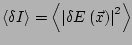
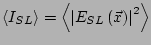
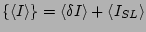
We define $ \left<\delta I\right> = \left<\left\vert\delta E\left(\vec{x}\right)
\right\vert^2\right>$, $ \left<I_{SL}\right> =
\left<\left\vert E_{SL}\left(\vec{x}\right)\right\vert^2\right>$, $ C_{\delta E}\left(\Delta \vec{x}\right) = \left< \delta E\left(\vec{x}\right)
\delta E^*\left(\vec{x}+\Delta\vec{x}\right) \right>$, $ C_{SL}\left(\Delta \vec{x}\right) = \left< E_{SL}\left(\vec{x}\right)
E_{SL}^*\left(\vec{x}+\Delta\vec{x}\right) \right>$:

\begin{multline}
C_I\left(\Delta \vec{x}\right) =
\left<\delta I\right>^2 +
\le...
...^*\left(\Delta \vec{x}\right) C_{SL}\left(\Delta \vec{x}\right) .
\end{multline}

The result is that the stray light field correlation sums to the scattered field correlation:

$\displaystyle C_I\left(\Delta \vec{x}\right) = \left( \left<\delta I\right> + \...
...E}\left(\Delta \vec{x}\right) + C_{SL}\left(\Delta \vec{x}\right)\right\vert^2.$ (5.4)

In order to obtain informations about the correlation of the stray light field, we acquire a great number of images, with different scattered field, and we average them, thus obtaining the correlation function of the mean intensity $ \left\{I\left(\vec{x}\right)\right\}$. Then, we measure the correlation function of the mean intensity:

$\displaystyle C_{\left\{I\right\}}\left(\Delta \vec{x}\right) = \left< \left\{ ...
...x}\right)\right\} \left\{I\left(\vec{x} + \Delta \vec{x}\right)\right\}\right>.$ (5.5)

We evaluate the mean intensity $ \left\{I\left(\vec{x}\right)\right\}$ :

\begin{multline}
\left\{I\left(\vec{x}\right)\right\} = \left\{\left\vert
\delt...
...elta E^*\left(\vec{x}\right) E_{SL}\left(\vec{x}\right) \right\}.
\end{multline}

Since $ E_{SL}$ does not depend on the image:

$\displaystyle \left\{I\left(\vec{x}\right)\right\} = \left\{\left\vert\delta E\...
...t) + \left\{\delta E^*\left(\vec{x}\right)\right\} E_{SL}\left(\vec{x}\right) .$ (5.6)

Using the gaussian properties of the scattered light:

$\displaystyle \left\{I\left(\vec{x}\right)\right\} = \left<\delta I\right> + \left\vert E_{SL}\left(\vec{x}\right)\right\vert^2 .$ (5.7)

Now we can evluate the correlation function of the mean intensity:

\begin{multline}
C_{\left\{I\right\}}\left(\Delta \vec{x}\right) = \left<
\left[...
...{SL}\left(\vec{x} +
\Delta \vec{x}\right) \right\vert^2 \right> .
\end{multline}

Using the gaussian properties of the field $ E_{SL}$:

$\displaystyle C_{\left\{I\right\}}\left(\Delta \vec{x}\right) = \left(\left<\de...
...}\right> \right)^2 + \left\vert C_{SL}\left(\Delta \vec{x}\right) \right\vert^2$ (5.8)

From eq. (5.12), we can evaluate the mean value of the intensity of the images:

$\displaystyle \left\{ \left< I\right>\right\} = \left<\delta I\right> + \left<I_{SL}\right>$ (5.9)

Eq. (5.8), (5.14), (5.15) give some informations about the field correlation of the scattered and stray light. If both the correlation functions are real and positive, the best evaluation of the field correlation function of the scattered field is:

$\displaystyle C_E\left(\Delta \vec{x}\right) = \sqrt{C_I\left(\Delta \vec{x}\ri...
...ft\{I\right\}}\left(\Delta \vec{x}\right) - \left\{ \left< I\right>\right\}^2 }$ (5.10)


next up previous contents
Next: Correction for finite samples. Up: ONFS data processing. Previous: ONFS data processing.   Contents
2003-01-09
Hosted by www.Geocities.ws

1