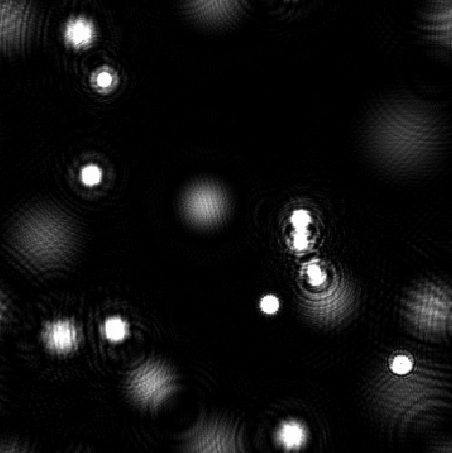
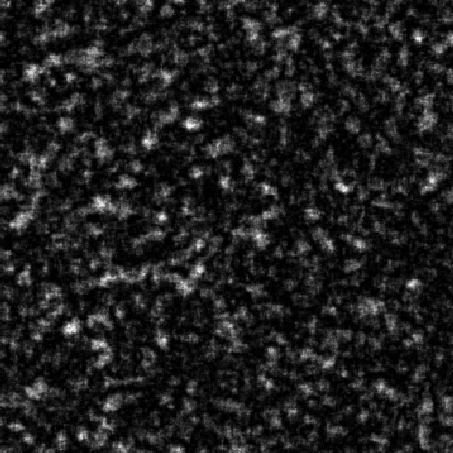
The near scattered field keeps only one feature associated to the observed sample, the correlation function. For example, Figure 3.7 shows a dark field image, and 3.8 shows the corresponding NFS image. The correlation function of the two fields is the same, but looking at the second immage we cannot figure that it comes from a set of discs. With near field scatterig we will never distinguish an amoeba from a paramecium: it is not a microscopy technique. Why using NFS instead of dark field?
The first answer comes from the analysis of Figure
3.7 and
3.8. In Figure
3.7, some of the discs are in the focal
plane, other aren't. If we want to analyze a dark field
image, we must be able to select the particles which are
in the focal plane, and exclude from the analysis all the
others. On the contrary, NFS gives informations which are
never affected by the misfocusing  : it provides
three dimensional informations, and works well for
thin samples as well as for thick ones.
: it provides
three dimensional informations, and works well for
thin samples as well as for thick ones.
If we want to analyze, for example, a colloid by a microscopy technique, we must use a thin sample, in order that the particles can be focused. If the concentration is low, it could be hard to find even one particle. Generally, one microscopic image could show only some particles. On the contrary, NFS can work on thick samples. We can use a given colloid, with any concentration, and put it in a cell so thick that it shows a suitable attenuation.
Another reason leads to use ONFS technique instead of a dark field technique. Dark field image intensity is given by equation 3.29: every calculation based on dark field images will concern the square value of the refraction index fluctuations. In facts, two point correlation functions of the images will represent four point correlation functions of the refraction index fluctuations. We consider a fluid, for which the refraction index fluctuations has a give distribution. We are interested in measuring the two point correlation, but dark field images allow us to work only on four point one. Of course, four point correlation function involves the two point one, but has a non trivial connected contribution. In NFS images, every connected term in correlation functions vanishes: we can measure quantities directly connected with two point correlation functions.