


We have shown that NFS allows the measurement of the light scattered in a quite wide range of angles. If Reyleight Gans condition is met, the scattered intensity represents the power spectrum of the sample, evaluated in the transferred wavevector. For the scattering at small angles, the spectrum is evaluated in the direction ortogonal to the incident beam. A measurement of this componet of the spectrum leads, through a Fourier transform, to the correlation function of the light path through the sample:
 |
(3.74) |
 :
:
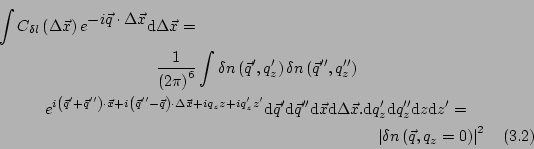
Through a measurement of the scattered light we can know the power spectrum in the plane perpendicular to the direction of the incident beam. This means that the light path correlation function bears less informations than the refraction index correlation function, but the light path correlation function is connected to the refraction index correlation function:

If the sample is isotropic, its power spectrum depends only on the modulus of the wave vector. If we know the light path correlation function, we can evaluate its Fourier transform, extend it to the three dimensions, and then, appling again the Fourier transform, we obtain the refraction index correlation function. This operation is generally performed by using the well known Abel transform.