|
Photonic integrated circuits (PICs) are
the optical equivalents of integrated circuits (ICs) where the
"current" is carried by photons rather than electrons. AIMD's aim
is to equip PICs with important on-board devices currently available only as
separate components, mainly magneto-optic isolators. These devices are
used to protect the lasers used in PICs from back-reflected beam
damage by using a polarizer and a waveguide made of a material which
rotates light depending on the strength and direction of the magnetic field
applied to it. This rotation is known as Faraday rotation. The
beam from the laser passes first through the polarizer, which blocks all but
one polarization of light. The waveguide rotates the beam polarization
to 45° with respect to the original polarization. If any of the light
should be reflected, it would be rotated another 45°as it passed back through the waveguide. The
polarization of the light would then be perpendicular to the polarizer and
would be prevented from reaching the laser.
The current fabrication technique used
to make garnet films, liquid phase epitaxy, cannot be used with semiconductor
substrates, the standard platform for many electro-optical devices. The
integration of magneto-optic materials requires the development of a
low-temperature, low-cost solution for this problem. Two ideas are
being developed. The first involves the use of RF sputtering to
create yttrium-iron
doped garnet films that can be integrated with semiconductors. They
are currently fabricating a prototype waveguide isolator onto a semiconductor
buffer that includes the YIG ridge waveguide, a cladding and a permanent
magnet film.
The second idea, the one which I worked
with, involved the use of Terbium-doped glass. This was done by
using RF sputtering to deposit a mixture of aluminum, terbium, and silicon on
a silicon substrate under the presence of oxygen. My job was to help
characterize the physical make-up of the atomic planes in the films using
X-ray diffraction.
.
|
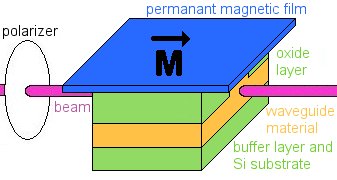
The basic components of magneto-optic isolators integrated with semiconductor
substrates
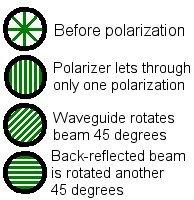
This diagram illustrates how the polarization of the beam changes as it
passes through the isolator
|
