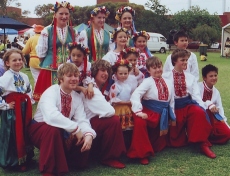
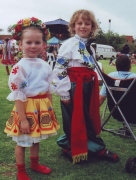
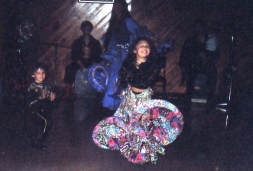
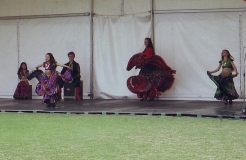
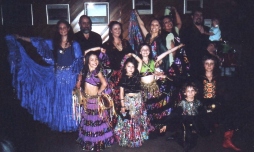
2nd Edition of the International Romani Yag Gypsy Festival in Montreal, Canada. October 11th - 14th 2007
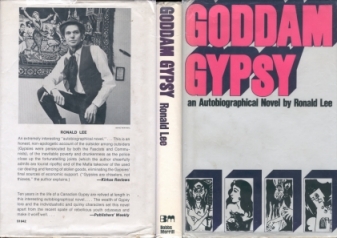
The organisers of the Romani Yag Festival are proud to unveil the programming for the second edition of its festival, a unique event of its kind in Canada, dedicated to the Romani ("Gypsy") culture. Between October 11th and 14th, over fifty artists and speakers, including international guests coming from 5 different countries exclusively for the festival, will offer as many glances on this vast culture, through more then 25 activities over four theme days. This year, Romani Yag will be paying a special tribute to Ronald Lee, the first Canadian Romani author, and great Roma Rights activist for his life's work. He will also be giving a conference on a topic not known to many: The Roma in Canada since 1900 and their adjustment to life in this country. |
William Clinton, president of the United States between 1993-2001, was formerly named William Blythe. He is descended from the brother of the Romani leader Charles Blythe, who was crowned `King of the Scottish Gypsies' at Kirk Yetholm in 1847, and whose brother Andrew emigrated to America. Andrew's son, Andrew Jefferson Blythe, died in 1860 and was President Clinton's great-great-great grandfather. (Excerpt from We are the Romani people (Ame sam e Rromane dzene) Ian Hancock pp 130)
 |
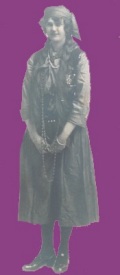
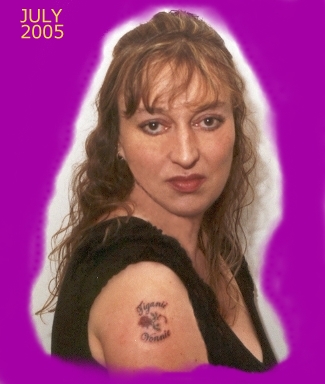
Her name is Dinara Sandu. She is 25 years old and a member of the Chur�ra, a nomadic Gypsy group in Romania known for making and selling cooking utensils. The roots of the Gypsies-or Roma, as many call themselves-run back a thousand years to India. "It is the Indian factors, linguistic, genetic, and cultural that different Rom populations share that makes us at heart one people," says Ian Hancock, a professor at the University of Texas at Austin and a leading adviser on Rom affairs. "But it is the more recently acquired non-Indian factors that divide us." (Extract and photo from National Geographics)
|
More on Romani history based on Ronald Lee's 'Roma in Europe Introduction.'
The countries of western Europe already had strong trades and artisan guilds that resented Romani artisan interlopers and requested the rulers to get rid of them. They drove the Romanies into the hinterlands where they obtained some protection from the nobility who appreciated their services on their vast estates. Thus, the Western-European Romanies were forced into commercial nomadism, which eventually evolved into their traditional way of life. Artisan work, entertainment, middle-men activities, horse trading, fortune telling by the women, begging and other nomadic professions were augmented by smuggling, a widespread practice among non-Roma during this period supported by people in high places and were lumped with the "masterless men and their wenches." After the 17th century they were seen as an undesirable social group rather than an original, ethnic population, even if misnamed "Egyptians," but because of persecution, hangings, banishments and transportation to the colonies of the maritime, empire-building nations, such as Spain, Portugal, later France, the Netherlands and Britain, Romanies in western Europe were never as numerous as those of Central/Eastern Europe and the Ottoman Empire where the greater part of the Romani population was located. Over the course of time, Romanies in the West became divided into sub-groups which were unconnected with Romanies elsewhere as new arrivals from Eastern Europe were few and far between right up until the mid 19th century. Gradually, their Romani dialects decayed until they lost their original grammatical structure and became registers of the vernacular surrounding language. Nomadism was outlawed in Spain and Romanies were forced to settle in gitaner�as in towns and cities. Their ethnic clothing and language were banned and they were ordered to become New Castilians.
As persecution in Britain, France and other countries of Western Europe declined, Romanies became part of the rural scene, colorful and mysterious, if often feared nomads, who passed through villages peddling their wares and plying their trades, trading horses and attending local fairs while the women told fortunes and practiced midwifery and herbal medicine.
On the other side of Europe, beginning in the 14th century in the provinces of Wallachia and Moldavia, Roma were being enslaved and were not totally emancipated until the Slubuzheniya of 1864. Serfdom and even slavery for Romanies existed elsewhere in Europe but not on the totality and scale of the Romanian Principalities of Wallachia and Moldavia. The Roma who had escaped slavery or serfdom existed in numerous sub-divisions, often defined by occupation of the group as a whole, by geographical location or some other factor. They were further divided into extended families and clans and leadership of these sub groups was centered on the "big man," variously called Rrom baro, bulabasha, shero-Rrom, etc., depending on the group and location and whether nomadic or sedentary. Self-appointed and accepted because of their abilities to eliminate problems for the group and to obtain money and favors from the local baron, the church or some other outside source, much like the modern executive directors of citizens; the self-help organizations, they were often referred to as "Gypsy kings" to the outside world, which gave rise to a mythological belief in Gypsy Royalty (sic) among outsiders. The Elders of the group were spiritual advisors and custodians of the traditions, genealogies and culture, while post-menopausal women served as spiritual advisors to the young women and were feared for their knowledge, real or alleged, of magic and witchcraft. This gave rise to the mythical phuri dai in literature, another hackneyed creation by the concocters of the Gypsy myth.
In time, these various groups found an economic niche in their local communities which varied between groups. Nomadic Romanies practiced artisan work, horse trading, entertainment and other skills suitable for nomadic existence. Sedentary jatis and communities also found a niche manufacturing items, blacksmithing, entertainment and agricultural work. Certain extended family groups and clans followed traditional occupations. Some were musician and entertainer groups, others metal working groups, others horse traders down to those who were mere beggars and sharpeners of augers or simply straightened bent nails for resale. Skills changed along with the economies and advancing technology and all Roma had more than one trade or skill they could turn to when another went into slump. Versatility and adaptability in self-employment enabled them to survive the terrible persecutions, but events far more horrific than could ever be imagined were to come which would decimate the Romani people.
The 19th and 20th centuries brought forced assimilation on a mass scale with the removal of Roma children and babies from their parents to be raised in European families and integrated into European life. With this and the cruel hardships of WW1, there was no end to the suffering of the Romani people, yet another war was looming on the horizon that would wreak catastrophic havoc to the Roma and Sinti living in central and eastern Europe. Between 1 and 1.5 million would lose their lives in the ensuing Romani Samudaripen (Holocaust).
Yvonne Slee
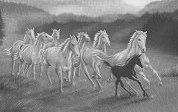 |
"My grandfather had a job in Hungary breaking in wild horses. (grai)"
(Sharon telling Frank about her Gypsy ancestry: Sharon's Sins)
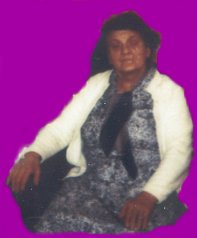
The photo at right: My husband's grandmother, Alice. |
 |
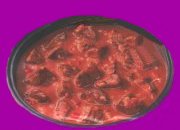 |
Gypsy food: Spicy to hot paprika beef goulash and other meat and vegetable stews or grills which contain different types of paprika, the most often used spice, ranging in flavour from mild to hot. There's also Sarmi, cabbage rolls stuffed with meat and highly spiced. |
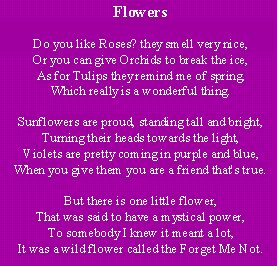
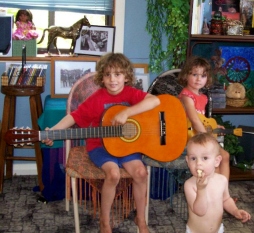
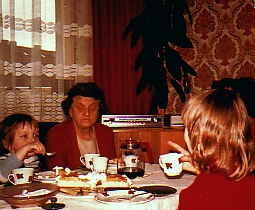
My Grandmother A poem that I wrote Forget-Me-Not Flowers Elsa's greatgrandkids.
My grandmother once told me that because her father's skin was so dark, he reminded her of an Indian bathing in the Ganges River
My grandmother's sayings:
Following the power hungry self centred megalomaniacs is like a flock of sheep following the wolf in sheep's clothing.
The dinosaurs didn't improve nature, neither do racists.
|
 |
Luck Flowers for the Month of your Birthday
January -carnations and snowdrops.
February -primroses.
March -daffodils.
April -daisies.
May -lilies of the valley.
June -roses.
July -water lilies.
August -gladioli.
September -asters.
October -dahlias.
November -chrysanthemums.
December -holly.
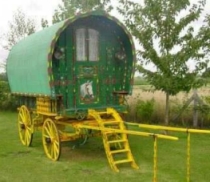
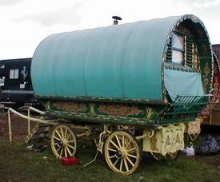
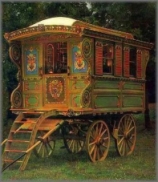
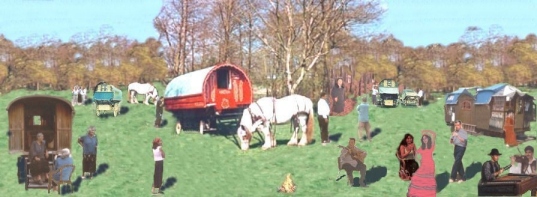
A Nostalgic Camping Scene
 |
A Modern Camping Scene
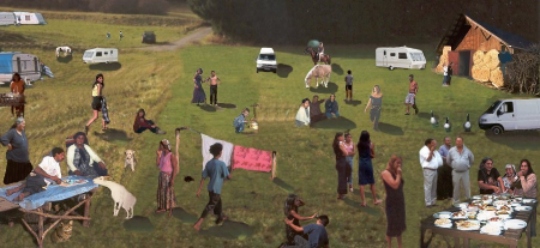
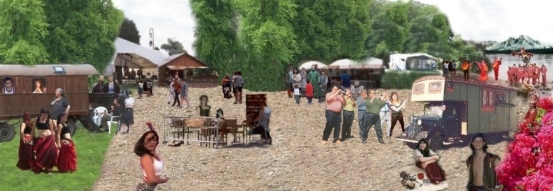
Every year Gypsies gather in the Vosges Hills in France. Perhaps this is what it may look like.
Press Reviews:
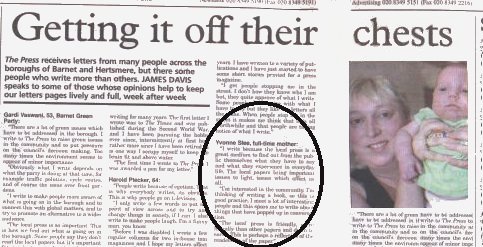
Writer of the Year 2000-Award from THE PRESS NEWSPAPER:
I regularly contributed letters to a few north London newspapers and this particular paper awarded me and four other people with the distinction of Letter Writer of the Year. I wrote about many different issues that appeared in the local papers and recieved many responses from readers. Also, when the Press paper knew we were leaving they did an article and a picture about us to say good bye.
97.3FM Brisbane radio station advertisements:
Weekends�winter days�whenever you have a moment alone, it's wonderful to curl up with an intriguing book.
Like the new novel, "Sharon's Sins" from Yvonne Slee.
Sharon is a free-spirited woman hiding a dark past, who falls in love with the high priest of a church sect. Their relationship grows until a link from her past comes back to haunt her.
Meet author Yvonne Slee and get your copies of "Sharon's Sins" and the sequel "Sharon Sins Again" this Saturday at Dymocks Chermside - from 11 am.
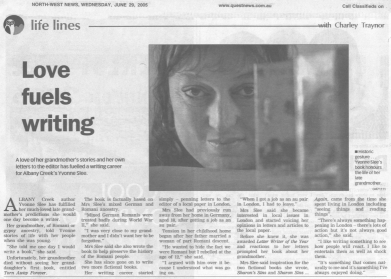
Romani Gypsy Author Yvonne Slee is steadily building a reputation as a writer of distinction; with fiction novels that pull no punches, and the real life recount of her gypsy heritage - Torn Away Forever.
This and other titles by Yvonne Slee are out now at Angus and Robertsons Strathpine and Dymocks Chermside�
Gypsy Author Yvonne Slee is a writer that pulls no punches. Her two novels, Sharon's
Sins and Sharon Sins...Again are evidence of this. Find out for yourself.
Buy these and other titles by Yvonne Slee now, at Angus and Robertson Strathpine, American
Bookshop, The City and other exciting book stores.
The first radio interview I did was in May 2005 at a community station in Redcliffe, QLD. with Heather about my books.
Jake Bower, Romani presenter of the Rokker Radio program on BBCs 3
Counties radio in the UK, recorded an interview with me on the 28th of May about Romanies in
Australia and my Romani cafe.
Thanks for remembering the Romanies in Australia and doing the interview with me.
I just did a radio interview in Melbourne (aired 22 June 2006) at 3CR with Jan Goldsmith about my book, Torn Away, Forever, the cafe, the food and the Romani literature available.
|
 |
Torn Away, Forever Radio Interview (August 2005)
Going to the interview, I felt quite confident but a little overwhelmed by the size of the listening audience as the station was Brisbane's main ethnic radio station, 4EB98.1FM. The interviewer, Bep Torkington was very friendly and chatted with me for a couple of minutes before we went on air. They played sentimental Gypsy violin music to lead into the interview then she introduced me, before asking me a bit about myself and my book, Torn Away, Forever. I spoke of my Romani background and talked about the book, which Bep had read a copy of beforehand and told me that she liked it, found it interesting and had no hesitation in recommending the book to the listening public. I explained how life was for my greatgrandfather, the Rom who was torn away from his natural mother. Bep wanted to know what my grandmother's childhood was like and then the interview led into the subject of prejudice, which, I told her, is still rife in Europe today. She wasn't aware that Romanies were murdered in mass numbers in WW2 before she read my book. I explained to her that half a million Romanies died in the Holocaust and she was shocked and deeply saddened by that. The interview ended on this note leaving the listener with those thoughts and closed with more Gypsy violin music.
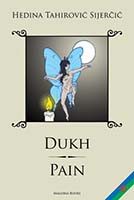
Dukh - Pain. A newly published book of Romani poems.
Available from Magoria Books
'dukh - pain' is Hedina Sijercic's collection of richly evocative poems, weaving together the author's fleeting joys and enduring tragedies with traditional Romani folklore. Hedina's poetry is enlightening in its candidness, which shatters the fanciful myth of the mysterious and ever-carefree Roma, replacing it with lyric images of a people living, loving, and dying, not immune to the caprice of the world that surrounds them. It is through such tragedies that the lingering message of these poems has become simply dukh, pain.
|
 |
 |
"Ame, le Rroma, sam yekh b�ro kop�chi kai si les but kriy�nzhi thai sw�ko kriy�nga si la but v�tsi - We the Romani, are a great tree that has many branches and each branch has many clans." (This ancient tree has its roots in India with many branches or nations while each nation, Kalderash, Kovara, Sinti, Romanichel, Kale, etc., has many clans or subdivisions. The individual Romani person is a leaf on the tree.)
|
Ronald Lee's new language book, Learn Romani is down to earth with plenty of every day phrases and terms that are well explained and easily understood for anyone interested in learning Romani. I even had a chuckle at some of the lighter examples used. It's a good book and I wouldn't hesitate in recommending it.
Goddam Gypsy, Ronald Lee's autobiographical novel, is a fascinating and interesting look at ten years of the author's life in Canada. It makes for good reading. I enjoyed it a lot. Recommended!
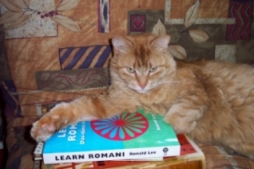 |
To get hold of a copy of Ronald Lee's language book, type in "Learn Romani" on a search engine |
 |
| COOL CATS LEARN ROMANI |
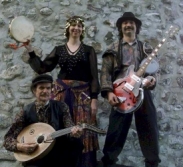
E ZHIVINDI YAG CD |
Evidence from blood groupings

Ongoing studies of Indian and European Romani blood groupings reveals that there is more similarity with Indian blood
groups than with European blood groups despite the 500-year sojourn of the Roma in Europe. A 1987 report in The Lancet,
a British medical journal stated:

Analysis of blood groups, haptoglobin phenotypes and HLA types established the [European and American] Gypsies as a
distinct racial group with origins in the Punjab region of India.

The ABO blood groupings also reveal that the European Romani blood groups are much closer to the Kshatriya or military
castes of India than to the nomadic groups usually referred to as "Gypsies" in India. A recent study concludes that:

The Rajputs occupy the position nearest the Gypsies. The dominant ethnic element in the Doms and Kolis (However) is
not reflected in any sizeable proportion in the genetic makeup of East European Gypsies.

(Ronald Lee)
Links to other Websites:
links to other pages on this site:
Globetrotter
Sharon's Sins 1 & 2 & Torn Away Excerpts
Caravaning
Gypsy Festival
Mystical
Jewellery

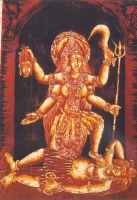
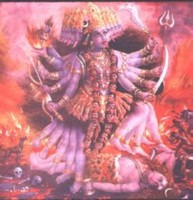
) is a goddess with a long and complex history in Hinduism. The comparatively recent devotional movement largely conceives of Kali as a straight-forward benevolent mother-goddess.