
St. Joseph River
through Mendon
Send email to:
My Mendon
Mendon, Michigan
Located by theSt. Joseph River on highway M-60 in northeastern St. Joseph County, Mendon is a quiet little town on a beautiful river, with a surprisingly ancient and colorful history. (map)


Some Mendon History
The history of the Mendon area centers on the wide, beautiful river that flows past the town. Although today used primarily for recreation, the river that we now know as the St. Joseph has a long history as a main highway and major trade route. People have lived, farmed, traded and worked along the banks of the river for thousands of years.
People first lived along the banks of the St. Joseph River perhaps eight thousand years ago. By four thousand years ago, the St. Joseph River area was part of the mound builder culture, farmers, traders, and city builders about whom little information remains.
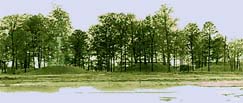 Mounds were were built near what is now Mendon. Mrs. Ella S. Custard waxed poetic about them in 1911: "The mounds, found along (the St. Joseph's) banks, in their vivid green under a summer sunlight, seem like emeralds strung on a silver cord..." Called by archaeologists the "Marantette component", the Mendon mounds were similar to mounds found along the St. Joseph in Colon and mounds found on Dowigiac Creek. Excavated in the 19th century, these mounds were found to contain copper and mica ornaments, copper tools, pottery decorated with stamped and incised patterns, decorated wolf jaws and a bear canine tooth. No mention is made of human remains. If anyone reading this knows where these items are today, or just where the mounds were located, please email me, I'd love to know. (Old photo is actually of similar mounds in Grand Rapids.)
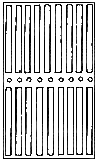 In "St. Joseph in Homespun," published in 1931, Sue Silliman discusses the "Indian Gardens" which she attributes to the mound builders. Given the antiquity of the mounds, and reports that the "gardens" overlaid some of the old mounds, this seems very unlikely; more likely that they were the "gardens" and cleared fields of later Native American farmers. She quotes Bela Hubbard in 1877 describing a nearby one as being "a half mile in length by one third in width...regularly laid out in beds running north and south, in the form of parallelograms five feet in width and 100 in length and eighteen inches deep."
  Most were rectangular and very large, ten to 15 acres, but some were laid out in circles. Thousands of acres of these fields were reported by American settlers, their outlines remaining in the soil until they were plowed up.
(Drawings from sketches made at the time of some "garden" layouts.)