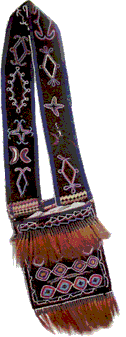
Miami man's carryall bag
c.1800
Send email to:
My Mendon
More Mendon History
By about 1000AD the Miami people lived and farmed along the St. Joseph; they were the people met by Medard Chouart Des Groseilliers in 1654. He recorded their name for Lake Michigan, Michigami, and he also used the Miami name to refer to the Saint Joseph River. 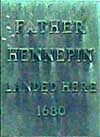 Father Hennepin, the Jesuit explorer and historian for La Salle, is reputed to have landed and said mass for the people there in the Mendon area in 1680; a a "pyramid granite boulder" was placed on the site as a marker by the Mendon Women's Club in the early 1900s. Perhaps there was a village on the site; it would have most likely been the Miami people who lived here at that time. The river bend where he is supposed to have landed was later well known as a ford, the "Grey Wolf Ford." The nature of the curve is such that sand builds up there each season, even today.
No one knows for sure the age of the village of Nottawaseppi, which was located in the vicinity of the present day village of Mendon, but the name is a Pottawatomi word. By the 1700s the Potawatomi were recorded as being in southwest Michigan; a French map dated 1744 shows "Village de Potouatamis" and "Village de Miamis" on opposite sides of the St. Joseph River. The Potawatomi were farmers more than hunters, and they were also middlemen in the fur trade. Being traders themselves, the Potawatomi seemed to have had an easier time than some other tribes adapting to the presence of the Europeans.  They grew corn (they raised enough corn to trade it with other tribes) as well as beans, pumpkins, onions, squash, potatoes and tobacco. They cleared fields in the heavy broadleaf forests by girdling and burning the large trees; "the towering skeletons of girdled trees marked the location of farm villages." Wild rice was an important part of their diet and they planted it along the river banks. They also collected maple syrup in the spring, and fished, collected nuts and other woodland foods. They were also famous for growing medicinal plants and wearing bright-colored clothing; their embroidery and artwork are still distinctive today. Their homes were made of logs with bark roofing. They also lived in temporary dome shelters while on hunting or maple sugaring trips. Where do you suppose they got potatoes?
Thomas Jefferson had initiated the removal of Indians from eastern Michigan to make room for settlers from the United States and prevent future warfare. Michigan became a separate territory in 1805, and in the Treaty of Detroit, in 1807, a sum of four hundred dollars was paid to Potawatomi "as now reside on the river Huron of lake Erie" to leave the area and move west. They were also promised an annual annuity and the services of a blacksmith. Many of these "Huron Potawatomi" moved at that time to the area that is now Mendon, to the village of Nottawaseppi.
Back to previous page More Soon Home