Popular Attractions
The Swiss Plateau |
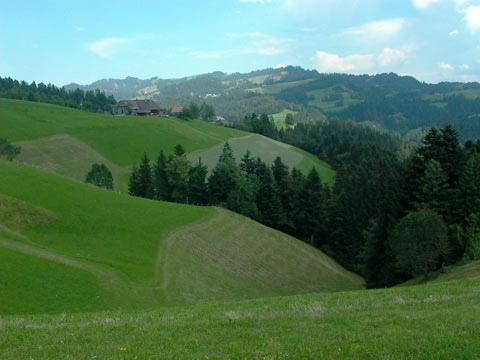
The Plateau stretches from Lake Geneva in the south west to Lake Constance in the north east, with an average altitude of 580 m (1902 ft). It covers about 30 percent of the country`s surface area, but is home to two thirds of the population. There are 450 people to every square kilometre (1,166 per square mile). Few regions in Europe are more densely populated. Most of Switzerland's industry and farmland is concentrated in the Plateau. |
The Emmental in the Bernese Plateau |
Bern |
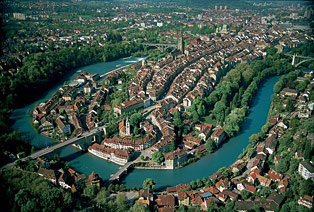
| Bern is the capital of Switzerland. The city was founded in the 12th century on a tongue of land surrounded on three sides by the river Aare. However, the first settlements in the area go back to pre-Roman times. It grew rich as a trading centre, and subsequently became an aggressive political and military power, ruling over a number of subject territories. It was one of the leading members of the old Swiss Confederation. Although the French invasion of 1798 put an end to the system of rulers and subjects, Bern retained its leading position, and in 1848 was chosen as the permanent capital of the modern Swiss state. |
Bern: the old city surrounded by the Aare |
Geneva |
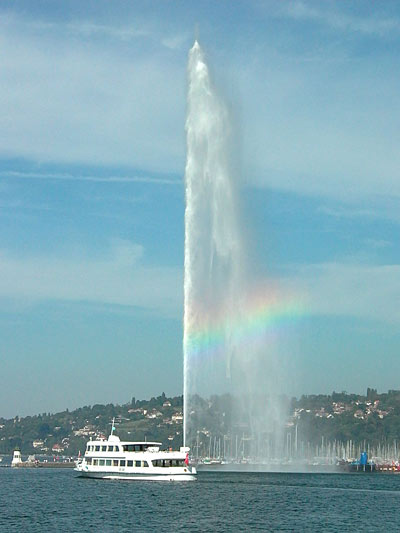
| Lies in the south-west, near the border with France, at the western end of Lake Geneva, where the Rhone flows out of the lake. Geneva is also well known for its watches. The Geneva Seal, or Poinçon de Genève, is a quality hallmark which is only granted to a select range of luxury watches according to strict criteria. Each year Geneva holds an exclusive fair, the International Salon for Prestige Watchmaking. |
Geneva's jet d'eau lake fountain |
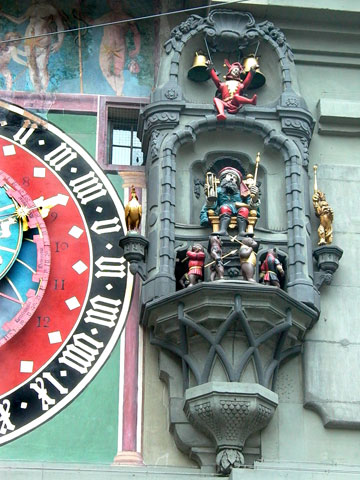
Bern's Zytglogge |
| One of the main tourist attractions in Bern is the clock tower, or Zytglogge. The tower itself was part of the original city walls at the beginning of the 13th century. The great bell was cast in 1405. The clock is more recent, but it is nevertheless one of the oldest town clocks in Switzerland: its mechanism dates back to 1530. For those who know how to read it, the astronomical clock beneath the main face shows not only the hour of day, but also the day of the week and of the month, the month itself, the zodiac and the phases of the moon. |
The carousel on Bern's Zytglogge |
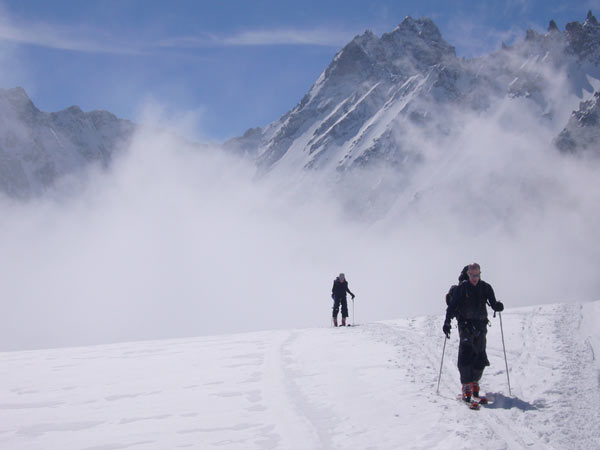
| Haute Route, Swiss Alps |
| This self-guided trek links the villages of the Mont Blanc region and the western Swiss Valais, crossing through the highest mountain range in western Europe, the Pennine Alps. You will hike through two distinct cultural regions, the French speaking and German speaking Alps. Starting in the bustling alpine center of Chamonix under the dramatic flanks of Europe's highest summit, Mont Blanc, and its spectacular Aiguilles, you will hike eastward into Switzerland and cross the Valais by a number of high passes that connect a number of small villages with their blackened timber houses and slate roofs. Finish in the incomparable Zermatt set beneath the soaring pyramidal flanks of the Matterhorn. This dramatic and often remote hiking tour sees surprisingly little traffic, and you will enjoy the most spectacular views of the western hemisphere from quiet footpaths between Chamonix and Zermatt. Because luggage transfers between countries are expensive and inconvenient, hikers should be prepared to carry up to three days' changes of clothing at a time. |
Skinning on Haute Route |