Culture
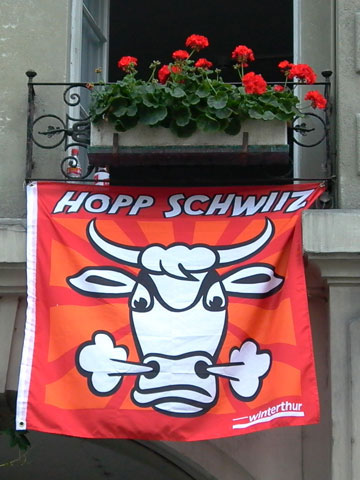
Football Switzerland is looking forward to the Euro 2008 football tournament, which it is hosting jointly with Austria. As a host country it qualifies automatically. In the 2006 football World Cup played in Germany, in the first round Switzerland came out top of its group which also included France (the tournament's beaten finalist). But its dreams ended when it lost to Ukraine in a penalty shoot-out in the first stage of the knock-out rounds. The national team's trainer, Köbi Kuhn, was elected Swiss of the Year by the Swiss TV viewing public in 2006 in recognition of the team's achievement. |
Hopp Schwiiz - Go for it, Switzerland. The chant of German Swiss foootball fans. |
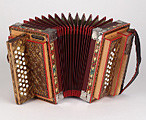
Music Yodelling and the alphorn are likely to spring to mind at the mention of music in Switzerland, although neither is exclusively Swiss. It is believed that yodelling began during the early stone age and has a long tradition outside Switzerland - in Poland, for example. In Switzerland, it is said to have developed from a form of long-distance communication and cow-calls. The alphorn originated in northern Asia and was brought to Europe by nomadic tribes. Originally a call and signal instrument, it was first used to play tunes at the end of the 18th century. Add instruments such as the Schwyzerörgeli (a type of accordion), the Hackbrett (hammered dulcimer) and the Trümpi (Jew's Harp), and you have some basic ingredients of traditional Swiss folk music.
|
Instrument commonly used, called the Schwyzerörgeli (a type of accordion). |
Dance The Prix de Lausanne was founded in 1973 by the Swiss industrialist Philippe Braunschweig and his wife Elvite. Philippe, although not a dancer, became interested in dance as a young man. His Russian dancer wife developed his interest further. The Braunschweigs created the competition after noticing the lack of financial support to young dance students, particularly those from small regional schools, wishing to attend professional level programs. He started by approaching Rosella Hightower and Maurice Bejart who drew up the rules for the competition. What started as small event has grown into an internationally acclaimed institution that draws candidates from all over the world. Over the past few years the competition has seen a big boom in Asian candidates. Because of the great demand by Japanese students to study abroad, an office was also set up in Japan. The Braunschweigs announced their resignation at the end of the Prix in 1996. In March 1997, as the competition came to its 25th anniversary, the philantropists handed over the Prix' s direction to an executive committee composed of the Swiss Secretary of State, Franz Blankart and an artistic committee headed by Jan Nuyts, who worked with the Prix for many years. Mr Charles Gebhard is in charge of finances and Ms Patricia Leroy heads the actual organization. The Braunschweigs remain available as consultants and have managed to maintain the original mission of the competition. |
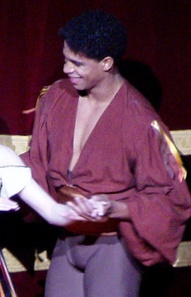
Carlos Acosta after dancing Tzigane , Royal Opera House , March 2008 |
Food Foods often associated with Switzerland include cheese and chocolate . Swiss cheeses , in particular Emmental cheese , Gruyère , Vacherin , and Appenzeller , are famous Swiss products. The most popular cheese dishes are fondue and Raclette . Both these dishes were originally regional dishes, but were popularized by the Swiss Cheese Union to boost sales of cheese. Rösti is a popular potato dish that is eaten all over Switzerland. It was originally a breakfast food, but this has been replaced by the muesli , which is commonly eaten for breakfast and in Switzerland goes by the name of "Birchermüesli" ("Birchermiesli" in some regions). For breakfast and dinner many Swiss enjoy sliced bread with butter and jam . There is a wide variety of bread rolls available in Switzerland. Bread and cheese is a popular dish for dinner. Tarts and quiches are also traditional Swiss dishes. Tarts in particular are made with all sorts of toppings, from sweet apple to onion . There are a great number of regional dishes in Switzerland. One example is zürigschnätzlets —thin strips of veal with mushrooms in a cream sauce served with rösti . Italian cuisine is popular in contemporary Switzerland, particularly pasta and pizza . In the Italian speaking part of Switzerland, the Ticino area, one will find a type of restaurant unique to the region. The Grotto is a rustic eatery, offering traditional food ranging from pasta to home made meat specialties. Popular dishes are Luganighe and Luganighetta, a type of artisan sausages. Authentic grottoes are old wine caves re-functioned into restaurants. Due to their nature they are mostly found in or around forests and built against a rocky background. Typically, the facade is built from granite blocks and the outside tables and benches are made of the same stone as well. Grottoes are popular with locals and tourists alike, especially during the hot summer months. Cervelat or cervelas is considered the national sausage, and is popular all over Switzerland |
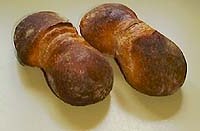
Bürli
Bürli are small breads served for breakfast or at BBQ parties |