





|
|
The Case Against John F. KennedyBy Martin Michaels
Introduction John F. Kennedy is the most celebrated and admired president of the past 50 years. If one examines the true history of Kennedy's presidency, and the aftermath of his actions, one cannot help but wonder why he is so admired. The goal of this thesis is to simply look at the facts, and draw conclusions based solely on those facts. I believe that if one studies the actual record of events, one will find that John F. Kennedy was, at best, a clueless twit, and at worst a figment of the population's collective imagination. This thesis will seek to achieve it's goal by studying some of the key moments in JFK's presidency and examining the actual events, as well as noting the consequences of those events when necessary. Let's examine the evidence, shall we? JFK and Cuba If JFK was such a genius, why were we hours away from nuclear war with a neighbor less than 100 miles off our shore? If he was such a brilliant leader, why did he allow the Bay of Pigs disaster to happen? Surely, if he was truly the leader of "Camelot", he could've come up with a better way of fighting a small island. Sending men to the slaughter with no air support is not exactly brilliant military strategy. Without a shadow of a doubt, JFK's legend is tarnished by this historical record.
JFK and Women JFK was the original Bill Clinton. One reason our society is so sexually immoral is because of the example set by our leaders. President Clinton took his cues from his hero, John Kennedy. Amazingly, JFK's sexual philandering is rarely brought up as a negative; if anything, it's an afterthought, or part of the legend that is Kennedy. However, under objective examination, one can see that JFK lacked marital discipline, and was easily tempted by sins of the flesh. He could not resist the most beautiful woman of his times, and therefore is a failure as an example of morality.
JFK and Vietnam How quickly people forget that the machinations of war in Southeast Asia started under Kennedy's administration. Where many will assign credit to JFK for man reaching the moon (an event that took place almost 7 years after his death!), few will speak of a war that started shortly after Lyndon Johnson took office. The defenders of Kennedy will tell you that he would've stopped the war from continuing. There is little evidence to support this. Others will tell you that Kennedy was assassinated for his anti-war stance by CIA and other war-hawks. Again, there is little to no empirical evidence to support this. John F. Kennedy failed in his duty to protect American lives by allowing the Pentagon to explore the possibility of war in Vietnam. Had he been as wise as people believe, many American lives would've been spared.
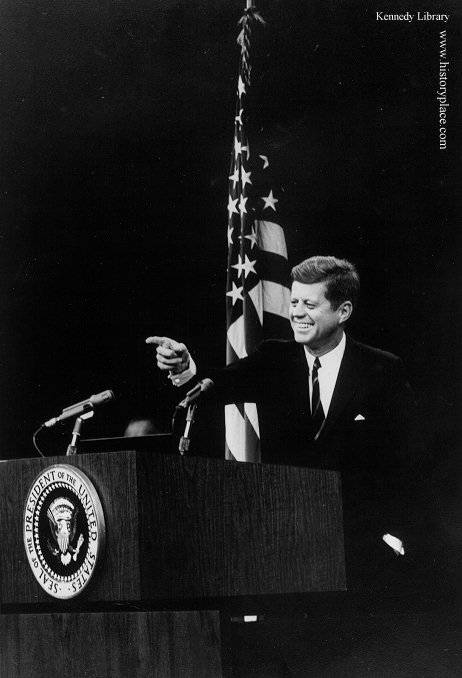
JFK and Television John F. Kennedy is credited with revolutionizing the way politicians are seen on television. The debate with Nixon in 1960 is the stuff of legend. Looked at through unbiased eyes, one can see the fallacy in the legend. First of all, politicians have become more unreliable and, for lack of a better term, fake in the past 40 years. The seeds for this progression were planted by Kennedy on that fateful debate in 1960. Kennedy started a political revolution where superficial looks and how one sounded was more important than the character of the person. Again, we can look at Bill Clinton, who idolized Kennedy, and see the truth in this. Clinton was known for his great speeches and handsome features, much like his hero. Another point of conjecture is Kennedy's famous speeches, which are oft-replayed at museums and schools around the country. Did he write the words he spoke? Doubtful. If anything, JFK was nothing more than a well-placed actor, reciting his lines perfectly. Again, the ripples of Kennedy can be seen in 1980, where Americans openly admitted they prefer actors to real humans, and elected Reagan.
JFK and Dallas Which brings us to our final sub-topic: what is the importance of JFK's death in Dallas, really? Did his death prove that there was some mass conspiracy in the government? The answer is no. There is much unsubstantiated proof, debate, and even a major motion picture saying yes, but the empirical evidence remains the same: there was only one bullet, magic or not, that killed President Kennedy. And this bullet was shot from a window overlooking the road by Lee Harvey Oswald. There is no proof (other than confused eyewitness accounts, which are easily discounted when considering the echo effect of a rifle blast) that a shot was fired from the grassy knoll. Many will point to the conspiracy theory of Kennedy's death, and say that the conspirators destroyed evidence, making it impossible to know what really happened in Dallas that day. I prefer a more reasonable theory. The bureaucracy of the federal government, led by an incompetent President, led to his death.
There is no hidden conspirator: only a government filled with workers who wished to protect their jobs by any means necessary. When groups fail to work together as a team, massive failures in policy and security are bound to happen. 40 years later, we see that the fascination with conspiracies has grown, with shows like the X-Files and Roswell, as well as UFO conventions and books. However, none of the conspirators were told by their alien friends about 9/11/2002. The terrorist attacks were like cold water on our collective faces, waking us up to our precarious situation. Again, many of the security failures that led to 9/11 occurred under Bill Clinton's presidency, who is the heir to the Kennedy legacy of failure. Even though JFK's death has raised him to legendary status, one must examine the facts if one is to ask the proper questions. For example, why was JFK's security team unable to prevent the assassination from take place? Again, the blame must fall on the leader. Had JFK been the great and wise head of Camelot that the majority of Americans think of him as, he certainly would've cared more about who he surrounded himself with. He would've made sure he had the best security possible.
On a side-note, Kennedy would've also been more careful about who his Vice- President was. Lyndon Johnson, the historical record shows, was an extremely poor choice of as running mate in 1960. LBJ's Great Society policy almost lead to financial ruin for our country. And, lest we forget that Vietnam officially started under his watch -- many Americans died because of JFK's poor choice for Vice-President. Dallas was the final failure of a clueless President. He did not surround himself with proper security, befitting a Head of State, and he did not have a proper replacement ready, in the case that he died. Conclusion In the beginning of this thesis, we set out to prove the seemingly impossible: that America's most beloved President of the past 50 years was, in fact, a clueless twit and a complete failure as president. If you simply examine the facts, with no bias or use of faulty human recall, you cannot help but see the truth. The consequences of Kennedy, and America's adoration of him, have been far-reaching. My one hope is that people will begin to examine the facts, and realize that Kennedy is not a man to be imitated and admired, but scorned and ignored. There are far better men that we can turn into heroes. |