SANTIAGO OF CALI

SANTIAGO OF CALI
Location
The Hermitage
Bolívar Promenade
Belalcazar Viewpoint
Mudejar Tower
Three Crosses Hill
Christ King Statue
Saint Antonio Chapel
The Merced ChurchGlobal and local maps
Click on the titles to see images
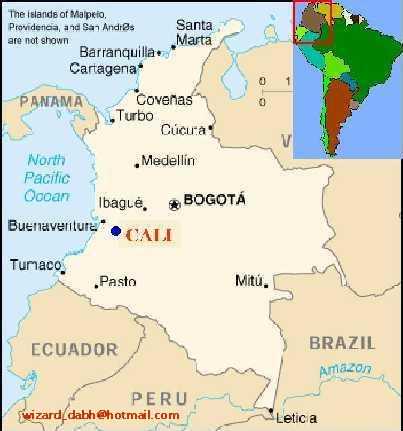
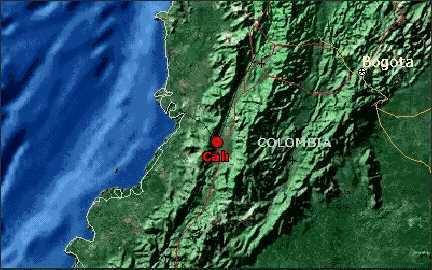
Version en españolThis beautiful city is located in the South West Colombian at three hours by land from Pacific Ocean, with temperatures that oscillate between 23 to 28 oC. For being it established beside the western mountain range has soft breezes that makes of the Valley of the Cauca capital a quite welcoming city. (Geographic map, city map [107K])
If the fundamental part of the conquest had begun by entering the Spaniards under the control of Jimenez of Quezada for the Pacific coast, for the road of Dagua toward the interior, very possibly another had been the history of Colombia, because Quezada would have seated the Spanish king's domains, in the New Granada, in the Valley of the Cauca and Cali had been the capital of Colombia.
But the reality is that Belalcázar, on July 25th of 1536, "put the first foundations of the village that denominated Santiago of Cali", in the apostle's memory and the name of Quechua origin given to the river Cauca for the Gorrones tribe that means plain. Quechua are also the words Jamundí, Guachinte and Yotoco that mean blowpipe, and many others that still subsist in the Valley of the Cauca. The word Cali or cari means caribes and Belalcazar took it from the Indians that incorporated in his troops.
Belalcazar wanted, with great vision and natural convenience, to find a communication between the recently founded town and the Pacific Ocean. To the effect, he sent the Lieutenant-governor Miguel Muñoz to cross the western mountain range, zeal that was frustrated, circumstance that motivated to move Cali to the place that occupies at the present time, on a hill that dominates the esplanade. " Its aspect is of oriental city, for the contrast between the green of the hill on that it stands and the blue of the mountain range on which seems recumbent, with its white cover of red roofs shadowed by fruit-trees and slender palms." His majesty, according to Ocariz, gave to the city on June 17th of 1559 coat of arms whose original is in the National File and he granted it the title of "Loyal" seven days later.
At the present time it boasts with the title of Sultana of the Valley that pages with its modified Moorish style, represented in notable form in the facade of Saint Francisco's temple.
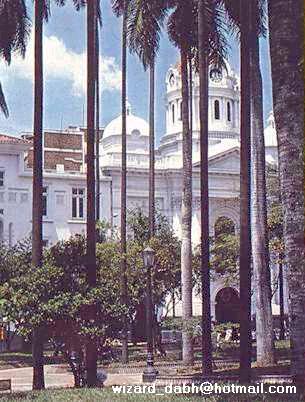
As all the cities, Cali has its central park: The Caicedo Square, heart of the commercial and civic life of the city.
Adorned by tall palms that remember the Colombian and tropical old parks, the square is place of multiple occupations: bootblacks, actuaries, dealers in lottery tickets and street sellers, maraud for its benches in search of clientele.
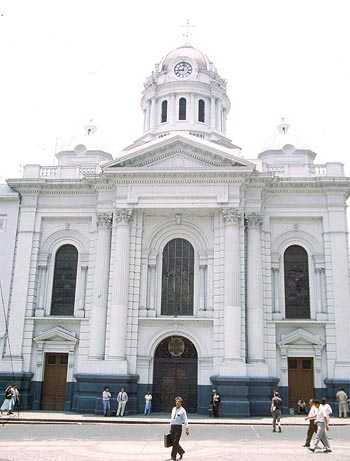
A contrast of old and modern buildings surrounds the square, standing out the Metropolitan Cathedral and the National Palace.
The Caicedo Square, called this way in memory of the Eminent Caicedo and Cuero, is the reference point for any place of the city.
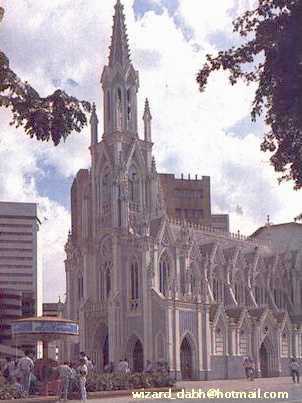
Together with San Francisco's temple, this beautiful temple Gothic is one of the main religious centers of the city. Located beside the river and in the center of the city. The Hermitage constitutes a reference point for visitors and inhabitants, since most of the citizenship circulates over here.
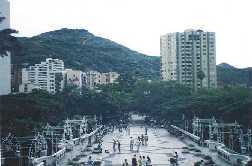
The María Statue and Bolívar Promenade
Between the bridge Ortíz and the Sixth Avenue, Cali conforms a sector of the most varied atmospheres.
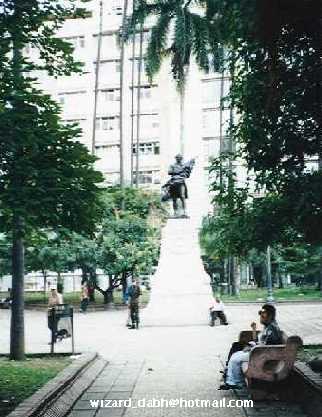
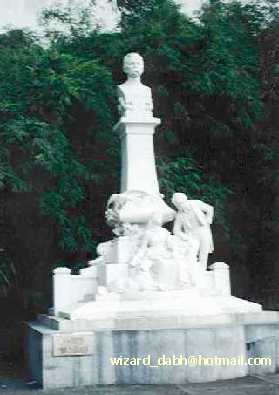
There we find the Municipal Administrative Center and its small square, the Council building with its modern lines, the monument to Jorge Isaacs with the reproduction of the romance between Efrain and Maria, and the statue of Liberator Simon Bolívar .
With its benches and fresh sources it constitutes a placidness complex that is supplemented with the rumor of the river Cali.
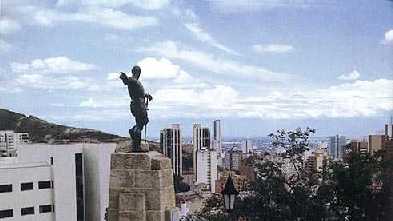
It is common that the cities have viewpoints, places from where can be contemplated its panorama. Cali has several. Of them, the most important is Belalcazar´s, located inside the city in the highest part in the imposing Circunvalacion Avenue.
The viewpoint is exactly in the place where is erected the statue to city founder, Don Sebastian of Belalcazar whose figure, inevitably in the postal, has become a symbol of the city.
To arrive until the Belalcazar viewpoint means to visit one of the sectors of most tourist attraction, since the Aqueduct Park, Saint Antonio's Church, The Theater of the Crystals and the Old neighborhood of the Peñon are at its surroundings.
Mudejar Tower and San Francisco Small Square
Of the places of Cali the Mudejar Tower is maybe the most admired by the visitors, precisely for being the best in South America in its style.
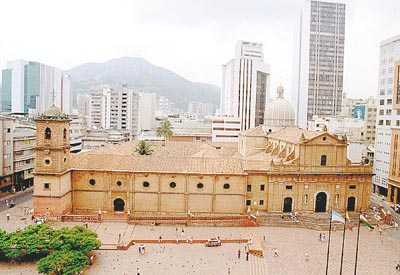
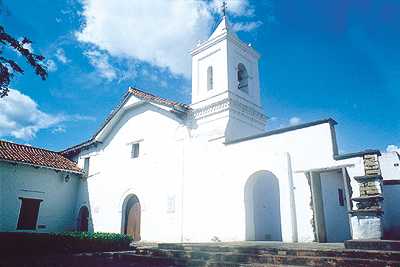
The Mudejar Tower is part of the chapel of the Immaculate, contiguous to Saint Francisco's temple, another of the architectural relics of the Cali citizens.
In front of the two monuments extends San Francisco Small Square or Civic Square, Integrated by the Departmental Palace, forced step for the commercial and administrative activities.
They are many the histories that are knitted round the origin and the construction of the chapel and its tower. But the truth is that it was built toward the year 1764, by initiative of Franciscan Fray Fernando of Jesus Larrea, born in Quito.
The father Larrea came to Cali to found a convent for the Franciscan order. He counted on the priest Nicholas Hinestroza´s support, one of the richest men in the district, who collaborated him giving the land, facilitating him money, materials and tools, and donating several slaves for the construction of the work.
The founder's enthusiasm was soon blocked by the bishop of Popayan (belonging to another religious order) who got at last that the father Hinestroza retired his support, but not that the father Larrea culminated his zeal.
The Mudejar style of the work is explained by the presence as slaves' boss, of Pedro Umbas, a liberated slave of Moorish origin. Umbas had been born in Seville (Spain), one of the cities where the Arabs carried out some of their most extraordinary architectural works.
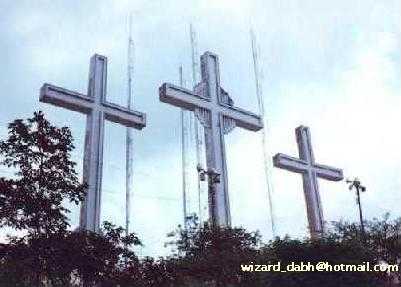
The most eloquent panorama of a strong Cali can be observed from this small hill in whose summit are guardian three big crosses.
Although it exists a road that drives to the monument, the visitors prefer to climb the hill on foot.
The Easter Week is the epoch of most affluence of people that ascend, some for religious promises and others for simple distraction, forming an attractive parade.
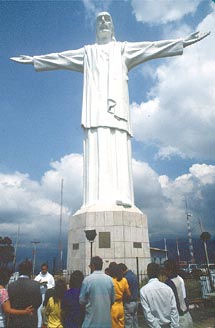
The range of mountains that borders Cali gives us another guardian hill. There is erected Christ King monument whose imposing dimensions can be admired from any place of Cali.
This place and its surroundings are not only good to contemplate the city, but also to have the opportunity to have a good time in the elegant restaurants that are in the access road to the summit.
Although it is traditional to ascend on foot, a picturesque road has transformed this area into a night place of amusement without any problem of transport.
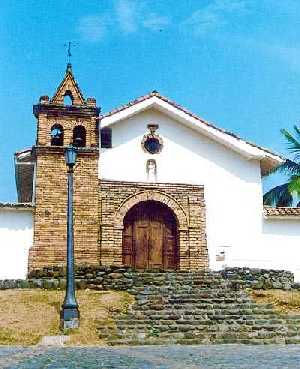
Dominating the most beautiful sector of what is known as "Old Cali", Saint Antonio´s chapel, an authentic colonial relic is in the high of the hill that takes its name.
Next to the religious tradition of the place, the chapel is valuable for its mayor altar of Baroque style, for the authenticity of the epoch of its images and for its old bells.
The whiteness of its facade contrasts with the green of the hill that is conserved intact, becoming for the Cali citizens in one of the places of most concurrence and rest. From its foundation, in 1744, as homage to the saint of Padua, the chapel stays as the nearest viewpoint in the city.
To talk about The Merced, is to travel through the history of Cali. In its place the first mass, one day after the foundation of the city, was celebrated.
Who knows the history of Cali, cannot ignore that round to this relic, located downtown, in the place of its name, happened the most important facts in all the times.
Its recent restoration allows to see the corridors, windows, floors and altars, remodeled, but with the possibility that the visitor can know part of the original construction.
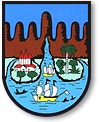
It was created by Doctor Nicholas Ramos Hidalgo, being him Santiago of Cali Mayor in 1928 and the doctor Carlos Holguin Lloreda, Governor the Valley . It was official on May 31st of 1954.
Its colors:
Blue. It symbolizes the sky and the seas that bath the native country.
Reds bands. They represent the love to Cali and the blood poured by the patriots caleños that gave us the freedom, On July 3rd of 1810.
White. The purity of the Cali citizens´ soul and the river that furrows from occident to east the city.
Green. The prairies, the green areas and the fields that surround the city.
For real identification on June 17th of 1559, it was granted to Santiago of Cali, coat of arms.
Don Francisco Ponce of Leon, credited by the town council requested to the king Don Philip that, for the lend services to the Crown perpetually could call and entitle: "VERY NOBLE AND VERY LOYAL CITY."
"This was granted and the corresponding Identification that is dated in Madrid on August 20th of 1559, takes the princess's Mrs. Joanna's signature from Portugal, governor (Regent) in absence of her brother's Philip.
: Carolina Cruz
The red devils City´s soccer team Trade The best place to invest City´s page General Information News The newspaper of our people Historic Review Other interesting places


![city map [107K]](grisaceo.jpg)