PHYSICAL PROPERTIES OF THE FLUIDS
Density Específic weight Específic volume RelativeDensity Viscosity Absolute o dinámic viscosity Kinematic viscosidad Pressure of a fluid Measure of pressure Demostrations *
The density of a fluid is its mass per unit of volume, while the specific volume is its weight per unit of volume.
The specific weight, w, represents the force exercised by the graveness on the unit of volume of the fluid and it is measured, therefore, in unit of force per unit of volume, for example, New.m-3.
The density and the specific weight of a fluid are related of the following way:

Specific volume,v, is the volume occupied by the unit of weight of the fluid. This concept is especially applied in the case of the gases and its unit is m3Kg-1: The specific volume is the reciprocal of the density. Thus,
Relative density, S, of a liquid is the rate of its density to the one of the pure water to normal temperature. The physics use 4oC as normal temperature, but the engineers prefer, in general, 15.5 oC.
A hydrometer is used to measure the relative density of a liquid directly. Two are usually used as hydrometric scales, that is:The scale API that is used for petroleum products.
The scales Baumé that in turn uses 2 types: one for denser liquids than water and another for slighter liquids than water:
The relationships between these hydrometric scales and the relative density are:
For petroleum products:

For slighter liquids than water:
For heavier liquids than water:

The weight specific relative of a gas is the rate from its density to the one of air or the nitrogen, taken these, to given temperature and pressure.
Viscosity
The viscosity express the easiness that has a fluid to flow when applies it an external force: The absolute viscosity coefficient, or simply the absolute viscosity of a fluid, is a resistance measure, to the slip or to suffer internal deformations. The molasses is a very viscous fluid in comparison with the water.
It can predict the viscosity of most of fluids: in some the viscosity depends on the work that has been carried out on them. The printing ink, the wooden pulp masses and the tomato sauce, they are examples of fluids that have tixotropic properties of viscosity (its viscosity diminishes by the action and duration of an applied effort, when cease it the viscosity returns to its initial state).Absolute viscosity or dynamics
The unit of dynamic viscosity in the international system (IS) is the pascal second (Pa.s) or also newton second per square meter (N.s/m2), that is to say kilogram per meter second (kg/ms): This unit is also known with the name of poiseuille (Pl) in France, but it should be kept in mind that it is not the same one that the poise (P) described as follow:The poise is the corresponding unit in the system CGS of units and it has dimensions dina second per square centimeter or grams per square centimeter. The submultiple the centipoise (cP), 10-2 poises, is the most unit used to express dynamic viscosity since most of the fluids possess low viscosity. The relationship between pascal second and centipoise are:
1Pa.s = 1 N.s/m2 = 1 kg/(m.s) = 103 cP
1cP = 10-3 Pa.s
Kinematic Viscosity
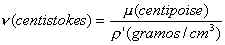
It is the quotient between dynamic viscosity and density: in the international system (IS) the unit of kinematic viscosity is the square meter per second (m2/s). The corresponding unit CGS is stoke (St), with dimensions of square centimeter per second and the centistoke (cSt), 10-2 stokes that is the used submultiple.1m2/s = 106 cSt
1cSt = 10-6 m2/s
Other properties of the liquids
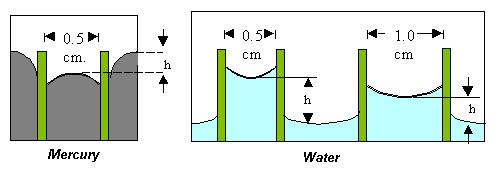
The liquids have properties of cohesion and adhesion, forms both of the molecular attraction. The cohesion allows to the liquid to resist traction efforts, while the adhesion allows it to adhere to other bodies. The capillarity is at the same time consequence of the cohesion and the adhesion. When the first one has smaller effect that the second, the liquid wets the solid surfaces with that it is on contact and rises on the contact point; if the cohesion prevails, the liquid surface descends at the contact point. For example, the capillarity makes that the water rises in a glass tube, while the mercury descends below the true level.
It understands for pressure, the force exercised by area unit. It can be expressed in Newton per square meter or kilograms force per square centimeter, or as it will be seen next in meters of water, meters of air, mm of mercury, etc.
Pressure expressed as height of a column of fluid.
Let us imagine, fig. 1, a liquid body on whose free surface there is not pressure, although in fact the minimum pressure that can have on a liquid is the pressure of its own vapor. Leaving aside, by the moment, this pressure, the pressure at the depth h is according to the following equation:
P = w.h where w: I weigh specific Ec. 1.0



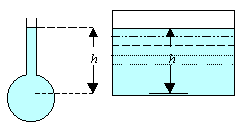
Fig. 1.
If it is supposed that w is constant, there is a defined relationship between P and h. That is to say, the pressure (force per area unit) is equivalent to a height h of certain fluid of constant specific weight. It is convenient often to express a pressure in terms of the height of an equivalent liquid column that like a force for area unit.
When the surface of the liquid is low certain pressure, is necessary to transform this pressure into equivalent height of the fluid in question and to add this value to h, as it is indicated in the figure 1, to obtain the total pressure as height of a liquid column.We have referred to a liquid in the above-mentioned, but it is equally possible to use this approach for gases and vapors specifying previously certain constant specific weight w for the gas or vapor in question. This way, the pressure P can be expressed as height of column of any fluid by means of the relationship:
Measure of the pressure
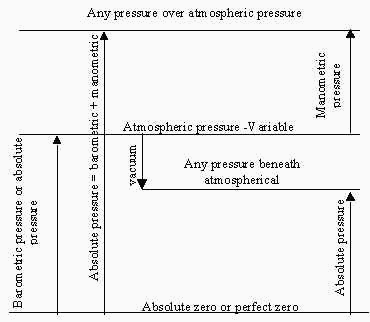
It calls absolute pressure the one that is measured on the absolute zero of pressure. The pressure manometric is the one that is measured taking the atmospheric pressure as reference. This is because practically all the meters of pressure or manometers indicate zero when they are communicated with the atmosphere and they indicate alone the difference of pressure between the fluid with which they are communicated and the ambient air.If the pressure is smaller than the atmospheric is called vacuum and its manometric value is the value of the pressure in that it is below the atmospheric pressure. A "high vacuum" is in fact a low absolute pressure. The absolute vacuum would correspond to zero.
All the values of absolute pressure are positive in the fluids, because a negative value would indicate a state of tension, what is considered usually impossible in the fluids. The manometric pressures are positive if they are for up of the atmospheric pressure and negative otherwise.
The atmospheric pressure is also called barometric pressure, and it varies with the altitude.
Barometer
The absolute pressure of the atmosphere is measured with the barometer. If a tube as the one of the fig. 2. has its inferior end submerged in a liquid that is exposed to the atmospheric pressure, and the air of the tube is eliminated, the liquid ascends for this. If the air was extracted, the only pressure over the surface of the liquid in the tube would be that of its own vapor and the liquid would reach the maximum possible height.
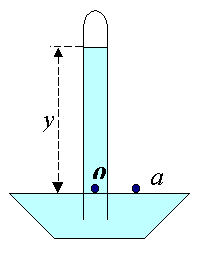
Fig. 2
The pressure in O inside the tube and on a in the surface of the liquid is the same one. That is to say Po=Pa. If it was worthless the pressure of vapor on the surface of the liquid in the tube, we would have, by the Ec. 1.0.
Po = wy = Pa
It is used, in general the mercury like liquid, because its density is sufficiently high as so that a tube of reasonable longitude can be used and also because its tension of saturated vapor is worthless to ordinary temperatures. If water were used, the height of the tube would be inconvenient, and, since its pressure of vapor to the ordinary temperatures is appreciable, it would be impossible to obtain a perfect vacuum in the superior part of the column. The height reached by the water would be, therefore smaller than the true barometric height and it would be necessary to apply a correction to the readings. With the purpose of reducing to the minimum the errors of capillarity, the diameter of the tube should be at least, of 12.5 mm.
As it has been said, the barometric pressure varies a lot with the altitude, but at the level of the sea the normal values of atmospheric pressure are:
1,033 kg/cm2, 760 mm of Hg, 10,33 m of water
Absolute pressure = manometric pressure + atmospherical pressure
English units Metric units 1 atm = 14.7 psi 1 atm = 34 feet of cold water column
1 atm = 1.023 bar 1 atm = 1013 mbar
1 atm = 10.33 m of cold water column