 |
stamps issued in 2001 november |
|
stamps issued in 2001 november |
[Home][About Us][Membership][Member
List][Links][Kids][Feedback][Magazines][Dealers][Societies][Articles][WhatsNew]
|
|
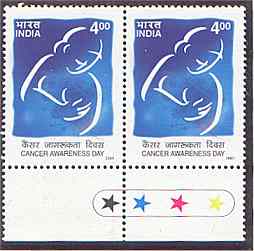
Cancer Awareness Day Cancer Awareness Day is being observed on 7th November. The day happens to be the birthday of Madame Curie who made significant contributions to the treatment of malignant tumours by her discovery of radium. Cancer, a malignant growth of the epithelial cells, is one of the major non-communicable diseases spreading its tentacles all over the world and its growth incidence is a cause for alarm. Cancers in all forms are causing about 12% of deaths throughout the world. In the developed countries, cancer is the second leading cause of death accounting for 21% of all mortality. Cancer has become one of the ten leading causes of death in India. It is estimated that there are nearly 15-20 lakhs of cancer cases at any given point of time. National Cancer Control Programme was initiated by the Ministry of Health in 1975 with the objectives of spreading education and awareness, early detection by screening and self examination methods, strengthening of existing treatment facilities, skill upgradation of doctors and paramedical personnel. India Post has time and again affirmed its commitrnent to spread important messages on subjects of interest and relevance to the common man through issue of postage stamps.
|
| Maharaja Ranjit
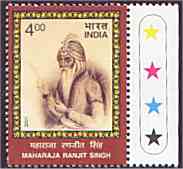
Singh Born in 1780 AD, Maharaja Ranjit Singh has been rightly called the founder and architect of secularism in India. His father, Mohan Singh, a chieftain, died when Ranjit Singh was hardly eleven years old. He had to face a Herculean task from the very beginning and to take the sword at a very young age. The country was torn by internal dissensions and jealousy. Hostile eyes were looking greedily at Punjab and it was left to Ranjit Singh to protect it from its many enemies. By sheer dint of cour- age, sagacity and wisdom, he rallied a disunited people, roused them to a supreme effort and made them masters of the land. Maharaja Ranjit Singh raised a most powerful fighting force and, for the first time in a thousand , years of Indian history, brought the traditional invaders of India to their knees. In the history of the world it would be hard to find another ruler who never took life in cold blood yet built up such a large empire. Considerations of caste or creed never weighed with him and he, meted out justice impartially to all his subjects, regardless of their religious affiliations. Maharaja Ranjit Singh passed away at Lahore in June, 1839. He has left an indelible mark on the pages of history.
|
 |
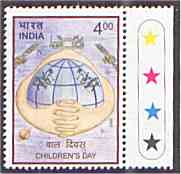 |
Children's Day Children are our treasures, the greatest source of promise and potential for the country. The Universal Children's Day which falls on 14th November every year celebrates the unique strengths and achievements of children and the way that children's lives enrich our own. It is an occasion to renew our commitment to the cause of children and rededicate ourselves to fulfilling their basic needs and rights. Children's Day coincides with the birthday of India's first Prime Minister, late Pandit Jawaharlal Nehru, fondly called Chacha Nehru by the children of India. Panditji's love and affection for children were well-know and was the delight of every parent and an inspiration to all. The Department of posts has been issuing a special stamp every year to emphasize the country's social and moral responsibilities towards the needs and rights of children. The department has also been adding colour to the private worlds of children through the postage stamps which it issues on important subjects. As a hobby which starts in childhood stamp collecting has a world wide fascination. It is a hobby that makes children more aware about what is happening in the world around us and helps them to grow in life. In recent years it has become customary to issue stamps on children's day depicting prize winning entries from nation wide stamp design competitions organised by the department. These stamps thus also provide and insight into the minds of the younger generation into issues which are of concern to them. The designs of the stamp and the first day cover for this years children's day depict the theme of the role of information technology in bringing the world together. The fresh and imaginative minds of children interpret the technology revolution that is sweeping the world today from different perspectives. The design of the stamp based on a painting by S. Jayesh Pillai, depicts the earth cosily resting in the protective embrace of technology. The work is at once striking for its apt symbolism and skill of execution. The first day cover carries another prize winning entry from the competitions executed by Neelam Anil Thakur giving a child's view of to days age of information technology.
|
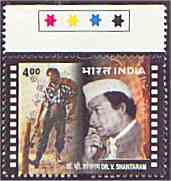
| Dr. V. Shantararn Dr. V. Shantararn (1901-1990) created 105 films and used the medium of cinema to advocate social messages, winning the acclaim of both connoisseurs and commoners. Hailing from Kolhapur in Maharashtra, Shantararn' s Initiation into cinema was through the Maharashtra Film Company of Babu Rao Painter, one of the great pioneers of Indian cinema. Initially a mere studio hand, he progressed through hard work to become a filmmaker. In 1929, Shantararn and some friends launched their own concern called Prabhat Film Company, which steadily grew in reputation and became a major force in Indian cinema. The films of Shantaram were noted for their visual beauty and powerful narrative. The subjects varied from film to film, and were drawn from contemporary life as well as mythology. The young Shantaram was not afraid to express his nationalist feelings through films even in troubled decades of 1930s and 1940s, despite the severe censorship of the British rulers. Themes of social relevance like untouchability, poverty etc. were also dealt with in his films. The enterprising filmmaker kept abreast of the technological developments in the industry happening elsewhere in the world. Films like Dharamatma(1935), Sant Tukaram(1936) and Aadmi(1939) were not just commercial successes, but also won critical acclaim. In 1941, Shantaram parted ways with the Prabhat Studtos. He formed his own studio under the name Rajkamal Kalamandir in Bombay. A series of hugely successful films like Shakuntala(1943), Dr Kotnis Ki Amar Kahani(1946), Jhanak Jhanak Payal Baje(1955), Do Ankhen Barah Haath(1957) and Navrang(1959) were produced under this banner, making him a legend in the film industry. His masterpiece was perhaps Do Ankhen Barah Haath, which, apart from winning the President's Gold Medal for the best film and several other awards at the national level, was recognised abroad also. He made significant contributions to the Children's Film Society of India, of which he accepted the honorary Presidentship in 1978. The V. Shantaram Motion Picture Scientific Research and Cultural Foundation which he set up in 1977 continues to serve Indian cinema through technical research and cultural advancement. Many awards were conferred upon this great movie maker, the prominent among them being the Padma Vibhushan (awarded posthumously), the Dada Saheb Phalke Award and honorary Doctorate of Nagpur University.
|
 |
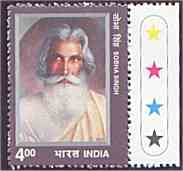 |
Sobha Singh Sobha Singh (1901-1986) created a Sikh idiom in Indian art and brought Punjab into the mainstream of the art movement in the country. Though the young Sobha Singh joined the British Army as a draughtsman, he soon realized that the world of colours was his true calling. He sacrificed the security of a career in the Army to take up painting as a full time profession. His initial years as a professional artist saw him moving from Amritsar to Lahore, and further to Delhi, He made a mark wherever he went, and set up an art studio in Delhi in 1942. During this period he produced some unique paintings on Indian Railways and the Posts and Telegraphs Department. He also worked as an Art Director for some films. An unfortunate incident when about 300 of his valuable art pieces were destroyed by fire proved to be a turning point in his life. He moved to the sylvan surroundings of Andretta in the Kangra hills, where he established the now world famous "Sobha Singh Art Gallery" in 1950. His paintings based on romantic tales such as Sohni-Mahiwal, Heer-Ranjha, Sassi-Punnu and Miza-Sahiban are well known. His paintings of the poets, writers, martyrs, saints and saint-warriors of Punjab as well as Sikh Gurus are also famous. A documentary film titled "Painter of the People" throws more light on his life and works. The British Broadcasting Corporation also made a documentary on him in 1984. Numerous awards and distinctions were conferred on him, the prominent being the title of' State Artist' of the Punjab Government, honorary Doctorate of the Punjab University and the Padmashri of the Government of India.
|
Ovr Sz - Overall Size Pr Sz - Printed Size
 |
 |
 |
[Home][About Us][Membership][Member List][Links][Kids][Feedback][Magazines][Dealers][Societies][Articles][WhatsNew]
Copyright
(c) Dakshina Kannada Philatelic Association
http://www.geocities.com/dakshina_kan_pa