 |
stamps issued in 2001 october |
|
stamps issued in 2001 october |
[Home][About Us][Membership][Member
List][Links][Kids][Feedback][Magazines][Dealers][Societies][Articles][WhatsNew]
|
|
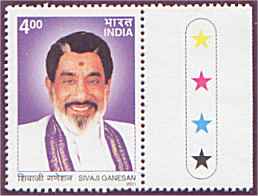
Sivaji Ganesan Sivaji Ganesan (1928-2001) is one among the most charismatic film actors of all time. Hailing from a middle class family of Villupuram in, Tamil Nadu, the young Ganesan was fiercely independent even as a child. He left home at the age of six to pursue a career in acting. Joining a theatre group, he went on to establish a good reputation as an actor. He was subsequently christened 'Sivaji' after his outstanding portrayal of the great Maratha warrior in the play Sivaji Kanda Hindu Rajyam. Sivaji Ganesan made his debut into the film industry with Parasakthi. which was a huge success at the box office. His histrionic skills -body language, dialogue delivery and facial expressions -were clearly a departure from the prevailling schools of film-acting marked by wooden performances. A remarkable feature of his illustrious career spanning 301 films was that he played the protagonist in most of them. The sheer range of roles he handled is breathtaking. Sivaji Ganesan was also a philanthropist who took up numerous worthy causes and worked wholeheartedly for them. A diehard nationalist, he would rush to entertain and liven up the morale of the country's armed forces wherever the need arose. Some of his foreign tours were memorable, when he charmed the people of countries like the USA and Mauritius as a cultural ambassador par excellence. He also served as a Member of Parliament (Rajya Sabha) from 1983 to 1986. Many awards and distinctions were conferred on this multifaceted personality, prominent among them being the Padma Bhushan (1984), Chevalier of Arts title of the French Goverment (1995) and the Dada Saheb Phalke Award (1996).
|
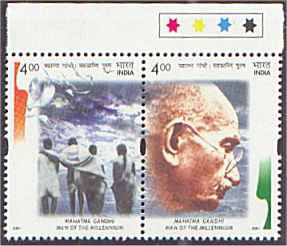
| MAHATMA GANDHI : MAN OF THE MILLENNIUM
"Gandhi was inevitable. If humanity is to progress, Gandhi is inescapable. He lived, thought and acted, inspired by the vision of humanity evolving towards a world of peace and harmony ". -Dr. Martin Luther King Jr. Mahatma Gandhi's major political goal -and eventual achievement -was to rid India of British rule through a campaign of non-violence. A proud and grateful India acknowledges him as the Father of the Nation and looks up to his teachings for guidance at every hour of crisis. The free and harmonious society in which we Indians live today is his legacy to the country. The department of Posts is honoured to issue a postage stamp in homage to the Mahatma on the occasion of the first Gandhi Jayanti of the new millennium. The stamp seeks to underline the message and relevance of Mahatma Gandhi which transcend the boundaries of time and space and are as relevant in the new millennium as in the earlier.
|
 |
|
Personality Series: Poetry and Performing
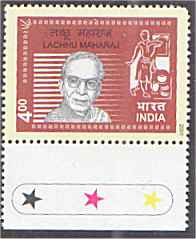
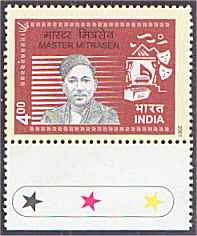
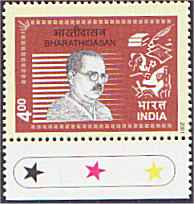
Art Bharathidasan (1891-1964) was one among the re- suscitators of Tamil poetry in the twentieth century, who also used it as an effective medium for social reform. Starting his life as a teacher of Tamil in Pondicherry, contact with his senior contemporary and mentor, Subramania Bharathi and Sri Aurobindo, drew Bharathidasan into the National Movement. He was imprisoned by the French Government in Pondicherry on the charge of treason. Later, Bharathidasan joined the Self Respect Movement led by Periyar and used his poems as a vehicle for rationalistic ideas. For the poetic intensity with which he expressed his reformist ideals and his profound humanism that embraced the whole of mankind, Bharathidasan deserves a pride of place in world literature. Lachhu Maharaj (1901-1978) came from a family of illustrious Kathak exponents in Lucknow. He was fortunate to receive extensive training in Kathak from Pandit Bindadeen Maharaj, his uncle and the court dancer of the Nawab of Awadh, for nearly ten years. He also learnt the Pakhawaj; the Tabla and vocal music, which helped to add many ornamentations to his style of dancing. He later moved to Bombay, where the emerging film industry helped him to establish his credentials as a modern master of Kathak. Lachhu Maharaj was acclaimed for the choreography of dance sequences in movies like Mahal, Mughal-e-Azam and Pakhiza as well as his ballets like Goutam Buddha, Chandravali and Bharatiya Kissan. He served as the founder Director of the Kathak Kendra started by the Uttar Pradesh Government in Lucknow. He also won many prestigious awards like the Presidents' Award and the Sangeet Natak Academy Award. Master Mitrasen (1895-1946) was a versatile artist who earned great fame as a poet, playwright, folk singer and short story writer. Hailing from Himachal Pradesh, he joined the armed forces at an early age. After his discharge from the army in 1918, he took up various creative pursuits like classical music and theatre. He raised the "Himalaya Theatre Company" in 1926, which went on to stage some immensely popular shows in Urdu and Hindi. He travelled widely in India and Nepal, addressing the Gorkha community and striving to raise them to a higher moral and cultural plane. The self respect and patriotism which he infused into the community is believed to have been instrumental in the Gorkha troops in Malaya joining the Indian National Army during the Second World War.
|
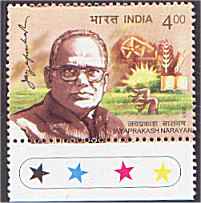
| Jayaprakash Narayan Jayaprakash Narayan ( 1902-1979) combined in his public life the selflessness of a sage and the acumen of a political strategist. J.P., as he was popularly known, hailed from the Sitabdiara village in Bihar. While a student at the Patna College he threw away his text books in disgust after the Rowlatt Act and Jalianwala Bagh massacre and refused to pursue a British-style education. Later, in 1922, he sailed for the United States and joined the University at Berkeley (California). He had to work hard to pay for his needs. From Berkeley he moved to lowa State University and later to the Universities of Wisconsin and Ohio. During his seven years' stay in America, he become a thorough Marxist. He had already married Shrimati Prabhavati in 1920. She was adopted as daughter by Gandhiji and stayed in the ashram at Wardha during the absence of Jayaprakash. On his return from America, he plunged headlong into the freedom struggle with the blessings of Gandhiji. Later he set up the Congress Socialist Party with Acharaya Narendra Dev as President and himself as Secretary, to promote Socialist ideals in the country. After Gandhiji's death in 1948, Jayaprakash Narayan formed an independent Socialist Party. However in 1954, he made the dramatic announcement of total withdrawal from politics to join Vinobha Bhave's Bhoodan Movement. J .P. was a gifted theoretician and a forceful writer who produced thought provoking works on freedom, socialism and democracy. His important works are : Why Socialism (1936), Towards Struggle (1946), In the Lahore Fort (1970), A Plea for the Reconstruction of Indian Polity (1959), From Socialism to Sarvodaya (1959) and Swaraj for the People (1961).
|
 |
|
|
|
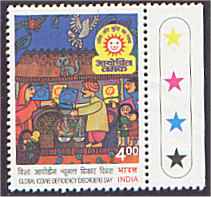
Global Iodine Deficiency Disorders Day
The importance of Iodine in the human body and the adverse effects of its deficiency are well known. Just a teaspoon full of iodine taken over the course of entire life span can prevent a spectrum of disor ders ranging from goitre to still births and mental retardation, collectively known as Iodine Deficiency Disorders (IDD). It has recently come to light that Iodine deficiency is the greatest single cause of preventable mental retardation among children. This has led to a world- wide focus on elimination of hitherto lesser known IDD. It is estimated that world over 1.6 billion people risk physical and mental impairment due to lack of tiny amounts of Iodine in their diet, out of which 500 million are children and about 10% of these cases are from India alone. Iodisation of salt has been found to be the easiest and cheapest method of Iodine supplementation as salt is consumed by all sections of the people. India adopted a policy on Universal lodisation of edible salt in 1983 following the recommendation of Technical Goitre Review Committee (TGRC), although the programme known as National Goitre Control Programme (NGCP) was in force since 1962 in a limited way. Every year Global Iodine Deficiency Disorders Day is observed on 21st of October to highlight the progress achieved in the elimination of IDD and to identify the problems that remain to be addressed.
|
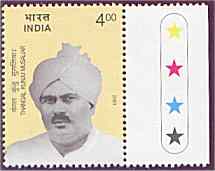
| Thangal Kunju Musaliar Thangal Kunju Musaliar (1897-1966) is remembered for his contributions as an industrialist, educationist and philanthropist. Hailing from the Kollam District of Kerala, circumstances forced him to travel to Sri Lanka, Brunei, Singapore and Malaysia early in life, in search of employment opportunities. After the sojourn that lasted a decade he returned home, rich in experience and bubbling with ideas. He started a small cashew nut processing unit which soon grew into a big industrial enterprise. Within a decade, Musaliar set up twenty six cashew factories and provided employment to twenty five thousand workers, finding a mention in the Fortune Magazine as the world's biggest single employer. Some of the labour welfare measures introduced by him, like fixed periods of work, wage rate system based on turn over and special incentives during festive occasions were trend setters for private sector enterprises of the country. A man of remarkable foresight, Musaliar was quick to realise the importance of higher education in the emerging society of independent India and also the future role of non-governmental initiatives in the field of education. The Thangal Kunju Musaliar College of Engineering was born out of his efforts in 1958. The educational Trust founded by him today manages a network of institutions, catering to the aspirations of thousands of students pursuing diverse subjects of study. Musaliar was also a writer of repute, having authored books like, Prayogikadwaitam (the English version of which was titled Man and the World) and Communism, Socialism and Capital- ism in the Present Context. He made a successful venture into the world of journalism with the weekly, Prabhatam, which was subsequently converted into a daily.
|
 |
Ovr Sz - Overall Size Pr Sz - Printed Size Set. - Setenant
 |
 |
 |
[Home][About Us][Membership][Member List][Links][Kids][Feedback][Magazines][Dealers][Societies][Articles][WhatsNew]
Copyright
(c) Dakshina Kannada Philatelic Association
http://www.geocities.com/dakshina_kan_pa