 |
stamps issued in 2001 december |
|
stamps issued in 2001 december |
[Home][About Us][Membership][Member
List][Links][Kids][Feedback][Magazines][Dealers][Societies][Articles][WhatsNew]
|
|
| International
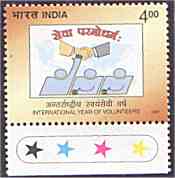
Year of Volunteers Volunteer service has been a part of virtually every civilisation and society. Defined in the broadest terms as the non-profit contribution that individuals make for the well-being of their neighbour, community or society at large, voluntary service can range from traditional customs of mutual self help to responses in times of crisis. The concept includes local and national volunteer efforts, as well as bilateral and international programmes which operate across frontiers. Volunteers have come to play a significant part in programmes of humanitarian assistance, technical cooperation, promotion of human rights, democratisation and peace. Volunteering is also the basis of much of the activity of non-governmental organisations, professional associations, trade unions etc. The idea for an International Year of Volunteers (IYV) ,to be proclaimed as the world entered the 2lst Century, arose in deliberations of several major international organisations and the United Nations General Assembly in its 52nd session declared to designate the year 2001 as International Year of Volunteers. The objectives of the International Year of Volunteers are increased recognition and facilitation of volunteers, networking through different media for wider publicity and promotion of volunteers and their activities. Designation of an International Year of Volunteers by the UN General Assembly has provided a valuable framework and established a favourable environment for the growth and more strategic use of voluntary contributions. It is hoped that this initiative will generate enough awareness to ensure that the Year extends beyond Governments and the UN to touch all sectors of society.
|
 |
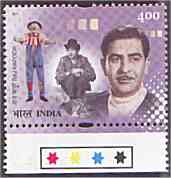 |
Raj Kapoor Raj Kapoor (1924-1988) carved out a niche for himself inthe history of Indian cmema. Son of the illustrious Prithviraj Kapoor, the legendary film and theatre personality, Raj Kapoor made his debut as an actor at the age of eleven in, Inquilaab, directed by Debaki Basu. By the time he directed his first film, Aag in 1948, he had already acted in eight more films. In 1950, he established the RK Studios at Chembur near Bombay which went on to become one of the best in the country. The following year saw the release of Awara, considered by many as the masterpiece of Raj Kapoor. The narrative of the film which established the power of truth and love in a decadent society struck a chord with viewers not just in India, but in different parts of the world. It was dubbed into a number of languages. Boot Polish and Jaagte Raho were two of his productions noted for their quality of direct realism, making them worthwhile documents of the prevailing social situations. Another popular film of Raj Kapoor was Shri 420, in which the character of the 'lovable tramp', already established with Awara, took on Chaplinesque undertones. Sangam, produced, directed and edited by Raj Kapoor in 1964, was his first in colour and turned out to be a big success at the box office. The nineteen seventies and eighties saw sweeping changes in the film industry and a whole new breed of filmmakers came and established themselves. However, Raj Kapoor still continued to hold his sway over the audience with films like Satyam Shivam Sundaram and Prem Rog. His themes were deeply rooted in the soil but his treatment gave them a look of modern fables and fairy tales. Many awards and distinctions were conferred on him, the most prominent being the Dada Saheb Phalke Award and Padma Bhushan.
|
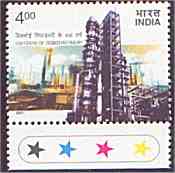
| 100 Years of Digboi Refinery History was made more than a century back in a remote corner of Assam in the midst of dense jungle when a group of Italian Engineers, commissioned by the Assam Railways and Trading Company to build a railway line from Dibrugarh to Margherita accidentally discovered oil. It was here in Digboi that the first commercially viable oil well in India, known locally as well No.1, was successfully drilled in September 1889 and the first modern refinery in India was built and commissioned in December 1901. Digboi Refinery is India's first refinery and one of the oldest operating refineries in the world. In fact, it was the only refinery in India till mid 1950s. The capacity of the refinery was expanded over the years in order to process the increasing crude oil production from the Digboi Oil field and subsequent discovery of Nahorkatiya fields in 1953. Earlier owned and operated by the Assam Oil Company Limited, a subsidiary of the Burmah Oil Company Limited, Digboi Refinery was vested with the IOCL by an Act of Parliament on 14th October 1981. Digboi, is now the headquarters of the Assam Oil Division of the Indian Oil Corporation Limited (IOCL) also. A modern Crude Oil Distillation Unit along with associated utilities and offsite facilities was commissioned in 1996. Subsequently, a Catalytic Reformer Unit, a New Delayed Coking Unit and a Wax Hydrofinishing Unit were commissioned between 1997 and 2001 and the refinery capacity was also enhanced. A state-of- the-art Vacuum Residue Short Path Distillation Unit for producing improved quality Bitumen and feedstock for high melting Point Microcrystalline Wax was commissioned in April 2001. The refinery is already certified for ISO-9002, ISO-14001, BS-8800 and has an ISRS rating at level 5 in the baseline audit. The refinery produces a wide range of petroleum products including wax, bitumen and also a number of speciality products. The paraffin wax produced in the refinery is one of the finest in the world. Over the past 100 years, petroleum industry of India with Digboi Refinery as its nucleus has been an integral part of our country's march towards self-reliance.
|
 |
|
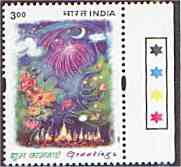
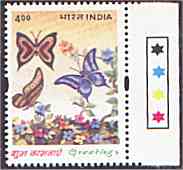
Greetings Greetings are an important medium of conveying thoughts and feelings. In a subtle way, they celebrate and strengthen relationships. Over the centuries, greetings have assumed myriad forms and shapes from letters written on leaf and bark scrolls, to greetings on gold, silver and copper plaques and modem day greetings by post and electronic medium. History has recorded the prevalence of greetings in ancient Egypt and Rome where the New Year was marked by the exchange of symbolic presents of scent, laurel or olive branches coated with gold leaf etc. This practice continued and further developed in the early days of Christianity. A fresh impetus was given to this form of expression with the advent of the printing press and with the coming of the penny post in 1840, greetings became a common feature and have ultimately become a part of the social matrix, gathering increasing connotation as they passed through the centuries. In India too, the practice of sending illustrated greetings through the post picked up over the years. Almost all festivals, Diwali, Holi, Pongal, Durga Puja, Baisakhi, Christmas, Id and now even Raksha Bandhan and Valentine's Day are marked by sending of greetings cards through the post. Department of Posts is happy to release these special stamps on greetings to reinforce and complement the greeting within the envelope and to add greater depth and meaning to the message. In a small but significant way, these postage stamps hope to show the feelings that have gone into sending the missive at the first glance.
|
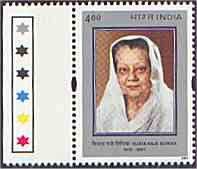
| Vijaya Raje Scindia Rajamata Vijaya Raje Scindia (1919-2001) left an indelible mark in the socio-political life of the country. Born in an aristocratic family, her early education was at Sagar. She went on to complete higher education from the Dr. Annie Besant Theosophical College, Benares and the Isabel Thorborne Col- lege, Lucknow and later, received an Honorary Doctorate from the Vikram University, Ujjain. She was married to Maharaja Jivajirao Scindia, the Scion of the royal family of Gwalior in 1941. Rajamata's advent into politics began in 1957, when she won the elections to the Lok Sabha on a Congress ticket. She went on to win several elections to the Lok Sabha, Rajya Sabha, as well as State Assembly, and was one of the most respected political leaders of the country. For her, politics was just a means to serve the society: She faced the personal tragedy of the loss of her husband in 1961 with rare dignity and poise. The remaining part of her life was spent in working for various social and political causes close to her heart. In 1967, she resigned from the Congress on , matters of principle and ideology, and joined the Jan Sangh. Despite being actively involved in politics, Rajamata Vijaya Raje Scindia remained equally committed to the spread of education and helping the poor and downtrodden. She was closely associated with the formation and development of many reputed educational institutions. She also worked for the upliftment of women and initiated many projects for the benefit of the weaker sections in and around Gwalior.
|
 |
|
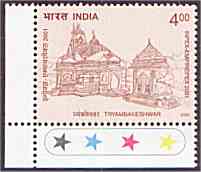
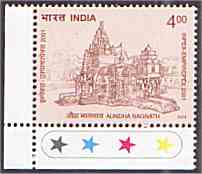
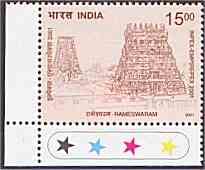
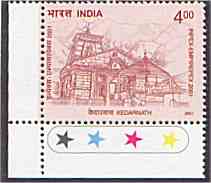
Temple Architecture Religion has been a formative influence on every form of human activity in India, particularly art and architecture. Thus, the evolution of the temple over two thousand years offers a fascinating subject to students of architecture. The different; styles of Indian temple architecture also offers insight into the economic, cultural, social and climatic factors that were predominant in different historical periods. However, there was enough scope for architectural elements and sculptural forms that are so characteristic of Indian temple architecture and which have few parallels in the entire world. The different architectural styles of the temples of India have been traditionally classified into three, viz. The Nagara or 'northern' style, the Dravida or 'southern' style, and the Vasara or hybrid style which is seen in the Deccan between the other two. There are also distinct and localised styles in areas like Bengal, Kerala and the valleys of the Himalays. Four temples noted for their antiquity and architectural features have been included in the set of four stamps. These are also popular pilgrimage centres and form part of the twelve Jyotirlinga temples considered to be the abodes of Lord Shiva. The first stamp depicts the temple at Kedarnath, set against the majestic Kedarnath range of mountains in Uttaranchal. It is a handsome building with a neat facade, incorporating architectural features typical of the Himalayan region. The Tryambakeshwar temple, featured on the next stamp is situated in the district of Nashik in Maharashtra. It is built in black stone and follows the Nagara style of architecture. The third stamp is on Aundha Nagnath temple, located near Nanded in Maharashtra. The temple is famous for its exquisite carvings. Spread over an area of 60,000 sq. ft., it follows the style of architecture called Hemadpanthi. Figuring on the fourth stamp, the temple of Rameshwaram is famous of its majestic pillars and well fashioned corridors. Built around the twelfth century A.D., with its beautifully embellished Gopurams and towers, it is a classic example of Dravidian architecture.
|
Ovr Sz - Overall Size Pr Sz - Printed Size
[Home][About Us][Membership][Member List][Links][Kids][Feedback][Magazines][Dealers][Societies][Articles][WhatsNew]
Copyright
(c) Dakshina Kannada Philatelic Association
http://www.geocities.com/dakshina_kan_pa