INTER-THEATER DEPLOYMENT
(30 NOV 90 - 2 JAN 91)
12 PLANES, 17, 400 SOLDIERS, 44 SHIPS, and 8050 VEHICLES
THE INTERMEDIATE STAGING AREA (ISA)
“Andersonville East”
For most 1st AD soldiers the deployment to Saudi Arabia entailed
an eight-hour plane flight, interrupted by a maintenance halt in
Rome. After arrival at either Dhahran or King Fahd Airfield,
soldiers experienced a 100 kilometer bus ride to the Intermediate
Staging Areas (ISA) near the port of Jubayl or Dammam. All recall
the tense atmosphere of the flight to the theater of operation.
The crowded bus ride, in day or night, did little to allay this
anxiety. Nor did the initial bustle and confusion upon reaching
the ISA with the hazards of finding living space and carrying two
duffel bags, weapon, kevlar, rucksack LBE and protective mask to
the right, and sometimes wrong, tent.
The division occupied two ISAs: ISA North at Al Jabayl, and ISA South at Dammam. Conditions at the ISA North left much to be desired. The "Scud Bowl" was dusty, crowded (10,000 or more soldiers crammed 16-20 persons in each tent), and often unsanitary. Contracted food ranged from acceptable to poor, and caused some illness. Conditions at the ISA South were somewhat better. Both camps contained some amenities: a WolfBurger stand, Baskin Robbins, a PX, MARS phones and occasional mail. Some units spent Christmas at the ISA by contracting for their own food and preparing it themselves. The emphasis on individual training continued, as leaders held classes on desert survival skills. In many ways, the ISA prepared soldiers for desert life, because it forced them to face up to dust, moisture, sanitation and maintenance problems. Everyone learned that discipline in the desert was a prerequisite for survival.
While soldiers trained and maintained, division and brigade staff officers continued planning. Planners devised an operational concept, which they wargamed and refined vigorously. The All Source Intelligence Center (ASIC) received, processed and disseminated useful intelligence products, templates and maps. Maps remained a key issue- 1AD needed 1: 10,000 maps, but ARCENT opted for 1:50,000 maps as the theater standard, a decision unacceptable for mobile armored warfare.
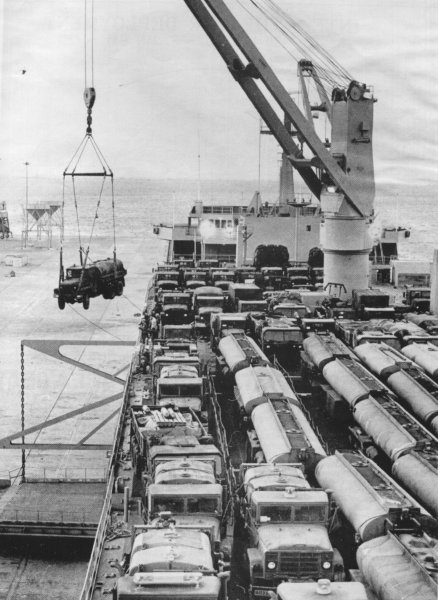
The division's ships docked between Dec. 18, 1990 and Jan. 19, 1991. Transports arrived late and out of order. Wheeled vehicles arrived last rather than first; units often had to retrieve them from both Jubayl and Dammam. Strong leadership at all levels alleviated unavoidable confusion. As equipment was lifted to the docks, units dispatched quartering parties and prepared to convoy to Tactical Assembly Area (TAA) Thompson. Units issued small arms ammunition, CARC painted vehicles in desert camouflage, and waited patiently for heavy equipment transporters (HETs). Convoys usually loaded at 10 p.m. for a 2 a.m. departure, allowing the 16 hour trip to the TAA to occur mostly in daylight, for reasons that became obvious once units hit the Tapline Road.