DEFORGER
Departure of forces from Germany
On Nov. 8, 1990, President Bush alerted "OLD IRONSIDES"
for deployment to Southwest Asia (SWA), providing the MNC an
"offensive option," should Saddam refuse to withdraw
from Kuwait. This provided an abrupt change of focus for Iron
Soldiers, from U.S. forces "build down" in Europe to
"buildup" in Southwest Asia.
Division leaders and soldiers reacted swiftly to the new mission in three critical areas: planning, training and unit deployment. Planning offered two unprecedented challenges. First, the division had to be shipped to Saudi Arabia in a logical order to support the build up for combat operations. European heavy divisions had never practiced this monumental task. The 1st AD was fortunate, however, to have an abundance of commanders and staff officers that had recently participated in REFORGER. exercises.
Accepting the challenge, commanders and their staffs rapidly integrated new equipment into their units for deployment to the Persian Gulf region. Problems in shipment of equipment were overcome by the excitement of combat operations yet to come.
Second, the division needed to orient war plans towards a new theater. While division planners prepared for combat operations, advance party personnel shuttled between the KTO and FRG to receive initial planning guidance from the Army Component of the U.S. Central Command (ARCENT) staff and to form first impressions about desert combat operations. The division also prepared to receive new units: 3rd Brigade, 3rd Infantry Division replaced 1st Brigade, 1st Armored Division. Round-out units such as the 312th Support Center (RAOC) composed of reservists from throughout Germany, also joined the division. Other units, such as the 54th and 19th Engineer battalions, the 218th Military Police Company, and the 7th Support Group, joined 1St AD in the KTO.
The division faced a huge training task prior to deployment. All units concentrated on individual and unit training in the few weeks available prior to personnel deployment, concurrently preparing vehicles for overseas movement. Pre-eminent among these activities was gunnery and maneuver training. The division qualified 355 tanks and 300 Bradley crews on Tables VII and VIII, conducted division artillery howitzer section gunnery, fired modified Vulcan Table VIII and qualified Stinger and Chaparral crews. Battle drill rehearsals and wargaming seminars were also part of the rigorous training agenda.
Vehicle deployment provided another challenge for the division. "OLD IRONSIDES" transported equipment by rail, wheeled convoy, and rotary wing self -deployment. These movements unavoidably occurred on short notice or in bad weather amidst many changes. Units labored long days, including weekends, to deploy. The first trains departed for port the last week of November 1990, a movement that continued into the second week of December 1990.
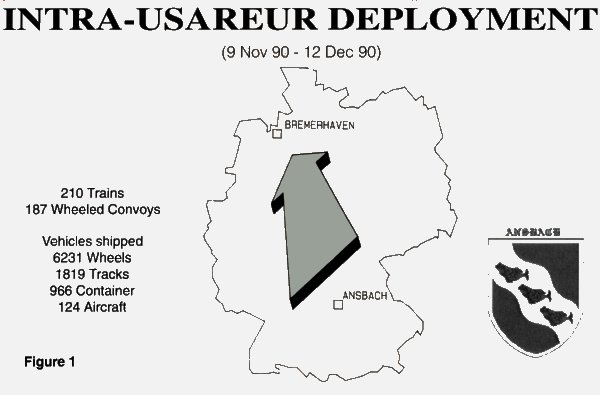
Ultimately, the division used 210 trains and 187 wheeled convoys (see Figure 1) to reach the ports of Bremerhaven, Antwerp and Rotterdam. Despite frustrating shifts in the deployment schedule, the division overcame great challenges to move its 8,050 vehicles and 17,400 soldiers (see Figure 2) to the KTO by Jan. 24, 1991.
These all-absorbing activities occurred amidst a much disrupted Thanksgiving and Christmas holiday period. Units valiantly attempted to mark the season with traditional Thanksgiving and Christmas meals (celebrated early) in division dining facilities. A festive yet emotional environment prevailed as soldiers snatched quality time with their families while working up to 18 hours a day. Family support centers were established to help families left behind in a foreign country. Chaplains, psychologists, and health care professionals provided invaluable services as 1st AD families girded for an uncertain future. unquestionably, Saddam was the "Grinch who stole Christmas" in 1990, a dubious distinction not lost on Iron Soldiers when they crossed the line of departure.
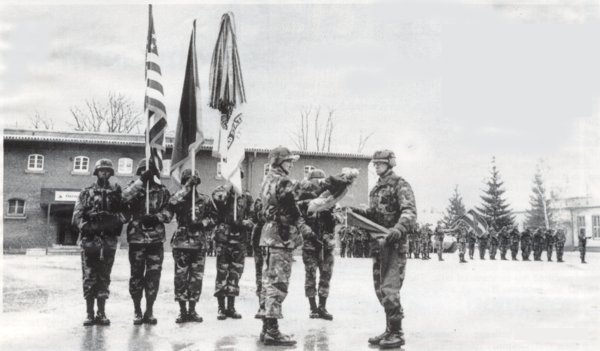
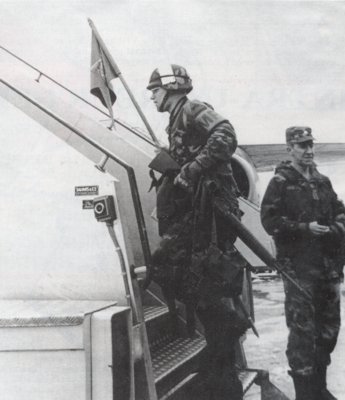
Political and military events gathered momentum equal to 1st AD's deployment. The UN Security Council pressured Saddam with a Jan. 15 ultimatum to leave Kuwait. Soon after issuing the ultimatum, Mr. Bush offered to hold direct talks with Iraq. Saddam did not take this offer seriously and played a cat-and-mouse game of counter proposals that lasted throughout the deployment. At the same time, he increased his defenses in Kuwait by an estimated 20,000 soldiers and 20 divisions. In a society already suffering from the cancer of militarism, Saddam called up hundreds of thousands of reservists and continued to prepare for the "Mother of All Battles."
After vehicles departed, division leaders renewed emphasis on individual training up to the day of departure: common tasks, NBC protective measures, physical training, first aid and weapons training. By Dec. 14, 1990, when 1st AD soldiers began to flow into KTO, the division had shipped 1,819 tracked vehicles, 6,231 wheeled vehicles, 966 Sea-Land containers and 17,400 soldiers to the Kingdom of Saudi Arabia on 44 ships and 124 planes. Such a condensed deployment, occurring under intense pressure, was a truly magnificent achievement.