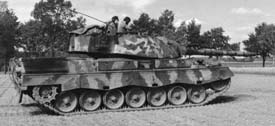
A Cougar 2 on training manuevers somewhere in Poland
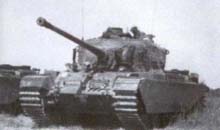
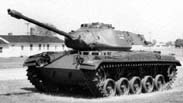
Prototypes of the British Centurion(left) and the American Pershing 2(right)
Reinhard Heydrich - head of the Reich's Sicherheitspolizei, the gestapo and the criminal police - worked diligently at his desk, responding to a host of inquiries from gestapo officials in the Polish provinces. Things were quiet there now, but there were occasional disputes as to the status of certain 'Germanic Poles'. Sometimes these disputes required his attention, and Reinhard's general tendency was to label the Pole in question as 'Feind des Reiches', 'enemy of the Reich'. The stamp, bold black text overlaid with the red swastika of the party, was a license for local officials to do as they saw fit. Deportation, forced labor, possibly liquidation. This was becoming increasingly unnecessary as undesirable elements had largely been purged over the past few years.
Not that Reinhard wasn't kept busy. There remained a small but virulent resistance movement in France, even the occasional incident in the lowland countries. There was the important work of counter-intelligence to root out Alliance and Soviet spies, and the attempts to help establish reliable spy networks around the world. No, Reinhard was a busy man, and powerful. By many accounts he was the third most powerful man in the Reich. Reinhard took a moment to turn on the 'Fernsehen' device he had obtained several months before. Its small viewing screen was marred by static and the sound quality wasn't up to the standards of Radio Berlin, but it was a marvel none-the-less. To actually see the speaker, to see news reels broadcast live, it truly was a marvel. Goebbels was still only experimenting with the new communications medium, but Reinhard was certain the device would do wonders for state propaganda.
On the screen a stiff-faced announcer, blond haired and blue eyed, stared out at him from a rather bland desk while talking of the latest news from the front, the Swastika prominent on the wall behind him. Occasionally a short news reel, showing anonymous Aryan soldiers in gray fighting valiantly, would illustrate the events of which the announcer spoke. There was an interview with the pilot of a jet aircraft credited with over one hundred kills on the Norwegian and Channel fronts. Reinhard was beginning to look over reports of gestapo activity in the new Baltic provinces, formerly the Baltic States, when the clicking noises of the teletype grabbed his attention. The slip of paper that emerged was short, its message to the point. Reinhard's face did not betray a hint of emotion.
It would seem that Reinhard had just become the second most powerful man
in the Reich.
February 7th 1947 to 14th July 1947
February 7th 1947
Heinrich Himmler, head of the powerful SS and most of the Reich's intelligence infrastructure, is killed by a well placed bomb on the route of his motorcade through Paris. Himmler had been overseeing the formation of several 'French Aryan' SS units. Berlin quickly blames the assassination on the still-active French resistance. Reinhard Heydrich, now the leader of the Gestapo, criminal police, SS, and 90% of the Reich's intelligence apparatus, orders a brutal crackdown across the former France. The next few months will be a time of purges and general terror throughout France - driving the French resistance into a largely dormant, underground, status.
February 8th 1947
The British Grand Fleet sorties off the eastern coast of Scotland to the alarm of the Kriegsmarine. The huge fleet, composed of four aircraft carriers, four battleships, and numerous cruisers and destroyers, begins steaming due east as fast as practically possible. Dönitz is more than a little worried by this turn of events, but he also sees some possibilities. The German surface fleet, at port in the Baltic and German-held Norway, receives orders to begin assembling in the seas south of Oslo. Two Reich class battleships and several cruisers, along with numerous destroyers, begin leaving ports in northern Germany and German-held Norway.
February 12th 1947
In the largest surface engagement in the Pacific to date, U.S. and Japanese warships clash in the northern Solomons, in the battle of Santa Cruz. A Japanese force of one battleship, one carrier, and several cruisers and lesser ships, had been probing east of Santa Isabel in an effort to intercept a U.S. convoy in-route to Guadalcanal. Facing them are three U.S. cruisers, an escort of several destroyers, and a single older aircraft carrier. The battle is a Japanese victory, and the U.S. convoy is forced to divert south and make for Australia. However, it marks the first case in which U.S. naval forces manage to give as good as they take. The Japanese lose a cruiser and the single battleship and carrier are both moderately damaged by U.S. carrier aircraft. The damaged Japanese carrier would be sunk a week later by a U.S. submarine. In return, the U.S. loses a cruiser and two destroyers.
(To clarify the situation in the Solomons, the Japanese hold New Britain(and with it Rabaul), New Ireland, and Bougainville. Allied forces retain everything southwest of Bougainville, and Guadalcanal is a major center of U.S. and British airbases and depots. The Japanese have been probing towards Guadalcanal but have been stretched too thin elsewhere to launch an offensive. )
February 16th 1947
British aircraft, operating from bases in the extreme north of Norway, attack several key airbases in southern Norway and Sweden. The raids are heavily contested by Luftwaffe squadrons in the area. The British attacks are not very successful and losses are heavy, but more importantly the Luftwaffe in the region is kept occupied.
During the large air engagements occurring over southern Norway and Sweden - British naval aircraft, operating from the carriers of the Grand Fleet, attack the German surface fleet in the waters south of Oslo. British dive and torpedo bombers lightly damage a Reich class battleship and succeed in sinking a cruiser and a destroyer. The German admiral in charge of the fleet panics and turns his force southeast and begins steaming for the safety of the Baltic.
February 18th 1947
The first British troop transports begin arriving in the ports of Vardo and Hammerfest in northern Norway. By the end of the month a British relief force of some 100,000 well-equipped soldiers will have landed in Alliance-held northern Norway.
Back in Germany, Dönitz is furious. The German surface fleet should have been in place, under a screen of land-based aircraft, to block the British reinforcements, but the British air attack on the fleet had spooked the admiral on the scene. In the one area in which the surface fleet had proved useful thus far, it had now failed. The debacle of the 'Oslo chicken run', as the British are calling it, is a huge blow to the already damaged prestige and morale of the Kriegsmarine. Dönitz needs to do something to win back some of that prestige, something spectacular. He privately makes a few calls, and certain training schedules are dramatically accelerated.
February 19th 1947
On Luzon - combined U.S. and Philippine forces launch an attack into Japanese holdings on the northwestern portion of the island. From starting points on the high ground west of Baguio, an armored division composed of a mixture of Pershings and late-model Shermans begins advancing down towards the coast. Behind them are 30,000 Philippine infantry and an additional 5,000 U.S. troops. The target is San Fernando, the key to the entire Japanese position in northwestern Luzon.
February 22nd 1947
After three days of heavy and brutal fighting the U.S./Philippine attack has come within site of San Fernando, but the Japanese forces in the area are putting up a terrific fight and are being supported by Japanese warships off shore. General Douglas Mac Arthur, encouraged by the progress being made in the push for San Fernando, authorizes the second part of his general counter-offensive to proceed. The bulk of U.S. armored forces remaining on Luzon begin moving northeast from Bambang in a movement intended to drive down the Cagayan River towards Aparri on the north tip of Luzon. U.S. aircraft, which have been carefully hoarded for some time, begin hitting Japanese forces across northern Luzon from bases in southern Luzon and other islands.
The Japanese, thinking that U.S. air forces in the Philippines were largely destroyed or grounded, are caught by surprise - thus the high command orders the transfer of several carriers from the central Pacific to the Philippines theatre over the objections of commanders in the central Pacific who are worried that the U.S. fleet in Hawaii seems to be rapidly growing in strength.
(A few U.S. and British transport planes have been making it through to Manila to deliver key spare parts, and a trickle of fighter and bomber aircraft have been arriving as well, not enough to replace all aircraft losses, but enough to maintain a fighting air presence in the theatre. The IJN has only five carriers left in the central Pacific area of operations, the others have now been transferred to the south Pacific, the Philippines region, and the East Indies to keep an eye on the Alliance fleet in Singapore)
March 2nd 1947
With Alliance forces in northern Norway now numbering roughly 220,000 troops, Churchill demands an offensive. Expecting just such a demand, the British and Norwegian commanders there have been planning a limited offensive, one that could win back some key territory but prevent Alliance forces from over-extending themselves. Churchill, chomping at the bit for any kind of offensive to push back the enemy, agrees to the relatively limited offensive. Operation 'Goodman' is set to commence on March 25th.
March 13th 1947
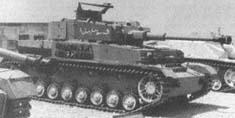
Germany begins mass production of the long-delayed Cougar II. Outfitting of units in the field should be well underway by the second half of the year. Original plans had called for an 88mm cannon, but British and American efforts to close the 'tank gap' convinced the Germans that a larger gun was required, thus the delays in getting the Cougar II into production.
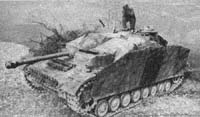
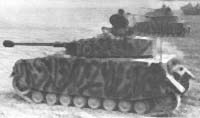
The Cougar IIb, the first production run of the new panzer, is armed with a powerful 105mm cannon, firing the latest armor-piercing tungsten-based ammunition. The Cougar IIb also has a totally new engine, suspension system, fast turning hydraulic turret, infra-red vision as a standard feature, improved air filters designed to withstand chemical warfare, improved sloping frontal armor and generally more armor protection all around, auto-stabilization of the main cannon, and many other smaller improvements derived from lessons learned from use of the Cougar I in the field. All of this combines to make the new panzer extremely fast, agile, lethal while moving and at extremely long ranges while idle, better protected, and generally more deadly as a main battle tank. In addition to the Cougar IIb, the Germans are also beginning to introduce a variety of self-propelled artillery guns, mobile rocket launchers, and 'tank killers' based around the Cougar I chassis. This marks the beginning of the phase out of the trusted old MkIV though it will continue on as an export weapon for the lesser Axis Powers, and the MkIV chassis will continue to be used in many roles including anti-aircraft platforms, tank killers, mobile artillery, mine clearers, etc. The British are hard at work on their 'Centurion' project, the new main battle tank designed to replace their current front line tanks, the Liberator MkII and the A.34 Comet. The Americans are also working on a new main battle tank to replace the Pershing, imaginatively named the Pershing II, or M29. The Pershing II is an enhancement of the Pershing, with an improved 100mm cannon, better optics, more horsepower, and moderately thicker armor.
To envision the Cougar II, think of a bigger, yet slicker looking, Panther, with a bigger main gun, and that incorporates many aspects of the experimental E-100 that was never completed in OTL. The 'Centurion' tank mentioned here is equivalent to the Centurion MkII of OTL, it will be the first heavy British tank to fully make use of sloping frontal armor and will be armed with a deadly 17 pounder main gun. The Pershing II mentioned here really has no analog in OTL since the U.S. stopped further production of the Pershing after WWII in OTL. The Pershing II will basically be a Pershing I with a slightly more powerful cannon and thicker armor, a bit heavier than the Pershing I but still as mobile thanks to a more powerful engine. Many Shattered World tanks of 1948 will be equivalent to the tanks of the 50's and 60's of OTL, with the exception being the electronics of course.
March 17th 1947
In Borneo, British and Dutch forces clinging to the southeast portion of that island, aided by air support and re-supply from out of Celebes, Guinea, and Australia itself, manage to bring Japanese forces there to a halt. The Japanese hold 75% of Borneo, but have been unable to dislodge Alliance forces in the southeast of the island.
March 20th 1947
On Luzon - McArthur's counter offensive has been a moderate success, allowing U.S. and Philippine forces to effectively contain the Japanese on the northern stretches of the island. Losses were extremely high due to fanatic Japanese resistance but San Fernando is in U.S./Philippine hands as well as much of the Cagayan river valley. McArthur begins to request assistance from the Pacific Fleet to 'root out the Japanese along the northern coast'. President Dewey, being assured that the Japanese are no longer capable of seizing Luzon, orders the U.S. Navy to begin planning offensive operations in the Pacific theatre.
March 25th 1947
Alliance forces in northern Norway launch operation Goodman, a limited offensive designed to retake Narvik and secure defensible territory to the south and east of Narvik. The operation begins with a surge of Alliance aircraft over the front lines - bombing entrenched German positions and forward supply depots. On a relatively narrow front - north of Narvik - British, Norwegian, and some Free French forces begin pushing into German lines following brief but intense artillery and rocket barrages. The Germans, well aware of the arrival of British reinforcements, have been expecting some sort of attack towards Narvik and are well prepared.
March 27th 1947
The fighting in the air over northern Norway is largely a stalemate, with both sides attempting to bomb front line units, depots, and transportation hubs. British and Norwegian land-based aircraft are being assisted by British carrier aircraft operating from two carriers stationed off the coast of free northern Norway. On the ground, Alliance forces have numerical superiority and are slowly pushing ahead towards their objectives with heavy casualties.
Back in Berlin, Hitler is demanding that the general staff act to stop the Alliance offensive. The Führer is becoming increasingly frustrated by the Alliance toe hold in the extreme north of Norway. Transport aircraft have already begun to shuttle German reinforcements into Oslo but from there they have a long ride by road and rail to get to the front.
April 3rd 1947
Japanese forces, aided by massed human-wave assaults by puppet Chinese and Thai forces, enter devastated Singapore. The combined British/Free French/Dutch fleet at anchor there has no choice but to leave. The powerful fleet, under an umbrella of carrier and land-based aircraft, leaves the harbor in full sight of Japanese observers.
April 8th 1947
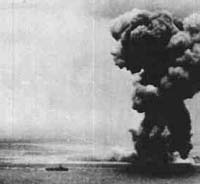
After several days of cat and mouse skirmishes, the Imperial Japanese Navy manages to bring the combined Alliance Asian fleet into open combat in the Battle of the Java Sea. The initial phase of the battle is a dual of carrier aircraft. This is largely a stalemate, with both sides losing a carrier. By mid-afternoon the two fleets come within range of each others heavy guns and an old fashioned slugging match ensues.
In the end, a Japanese Yamato class battleship is sunk as well as two cruisers and several lesser ships. Several other capitol ships suffer damage ranging from light to extreme. In return, the Alliance fleet is heavily wounded as well. The King George V class battleship 'Prince of Wales', along with an older battleship, are sunk, as are several destroyers and a cruiser. The Dutch and Free French lose a cruiser each, and several destroyers between the two of them. The second British carrier in the Alliance fleet is also sunk late in the day by Japanese dive bombers, leaving the Alliance fleet with no air cover. When nightfall comes the battered Alliance fleet is able to break off contact and flee to the southeast with Australia as their ultimate destination. The Japanese fleet, also heavily wounded, moves towards Singapore to begin shelling the costal defenses still protecting the harbor. The battle is technically a Japanese victory in that they heavily battered the Alliance fleet and forced it to flee to Australia. But the IJN lost four capitol ships in the battle, among them a precious carrier and one of its few Yamato class battleships, a price it cannot afford to pay.
April 9th 1947
In Norway, British and Norwegian infantry enter the northern outskirts of Narvik but the Germans have dug themselves into the city's center and have been reinforced by fresh troops up from Oslo.
April 12th 1947
Japanese warships begin shelling Olongapo on southern Luzon, roughly 40 kilometers west of Manila, in the pre-dawn hours as Japanese marines begin moving towards shore. By 11:00 AM the Japanese have secured several beach heads around Olongapo and are beginning to move inland. The Japanese high command's long delayed second Luzon landings are underway.
McArthur, caught off guard by the new landings, realizes none-the-less that the Japanese must be stretching their resources very thin. If he can contain the second landing zone then he can put a permanent dent in Japanese planning. He sets out to do just that.
April 15th 1947
Britain launches a salvo of 20 'Vengeance' V1 guided missiles towards the Rhine valley in Germany. The missiles, launched from aging B-17 bombers over the North Sea, are wildly inaccurate and cause little real damage. However, the British now have the means to retaliate in some small measure against the 'Rain of Steel' experienced by Britain since mid-1945. The Germans will come to call the V1 the 'Summenbombe', or buzz bomb, due the distinctive noise the V1 missile produces while in flight. This marks the beginning of a campaign of small, but frequent, V1 attacks against northern Germany.
April 16th 1947
On southwestern Luzon the Japanese landings are quickly turning into a disaster of epic proportions. U.S. fighters, operating from Luzon and other Philippine islands, are able to contest the skies enough to allow wave after wave of British and American B-31 bombers to carpet bomb the beach heads. The USAAF and the RAF had been massing a huge armada of B-31's, as well as escorting P-51's to protect the bombers for much of the distance covered to get to Luzon, in northern Australia and Celebes in anticipation of supporting a final U.S. counter-attack in northern Luzon to drive the Japanese out. The Japanese marines, under heavy carpet bombardment during daylight hours, have not been able to push very far inland, indeed they have been contained by U.S. and Philippine forces. Douglas McArthur knows when he has his opponent on the ropes and, with a private thanks to the Army Air Corps and Royal Air Force boys, prepares to hurl every reserve he has against the small Japanese beach head around Olongapo before the Japanese can land any additional forces.
Distance from Darwin to Manila : ~2000 miles
Range of B-31 : ~4400 miles
Luzon is just within range of B-31's operating out of northern Australia
and Celebes, but just barely. Bomb loads are reduced to gain a small
reserve of fuel.
April 19th 1947
After a particularly devastating three hour artillery and bomber bombardment, U.S. and Philippine troops hurl themselves against the southern Japanese beach head. By the early afternoon, Japanese forces are bravely dieing by the thousands rather than surrendering. Constant bomber attacks have prevented any sort of large-scale Japanese evacuation.
April 21st 1947
The last Japanese marines in southwestern Luzon are dead or, rarely, in U.S./Philippine hands. 10,000 of Japan's best marines have been lost in what will become known as the 'Olongapo Slaughter' by the western allies. Stories of Japanese marines drowning themselves in the surf rather than surrendering will become legendary. This disaster is a loss that the Japanese marines will be hard pressed to ever recover from.
April 24th 1947
After three weeks of bloody fighting, most of Narvik remains in German hands. The Alliance counter-attack has succeeded only in taking some ground and giving free northern Norway a little bit of extra breathing space. However, the cost has been high. Some 75,000 British and Norwegian troops have been killed or wounded since late March.
April 27th 1947
In Tokyo a stormy high level meeting takes place involving the high commands of the Navy, Air Force, and Army. After much debate a general change in strategy is agreed to. Focus will shift from an offensive doctrine to that of a defensive and consolidation strategy. The East Indies will be mopped up and secured with large commitments of Naval and Air Force forces in order to ensure continued access to the oil fields there which are just beginning to come back online after being heavily damaged by withdrawing Alliance troops. The disastrous invasion of the Philippines is to be cancelled, and the forces remaining on northern Luzon evacuated, in favor of a naval blockade of the islands. The Central Pacific islands, Borneo, and the northern Solomons possessions will serve as a shield against the inevitable counter-thrusts of the rapidly expanding U.S. Pacific fleet. Admiral Yamamoto will be charged with engaging the Americans in a decisive carrier battle, one that will wreck the current U.S. fleet carriers before their new ones come online over the next eighteen or so months. Midway will be held as long as possible to tie up U.S. naval forces in that area. It is also agreed that it is imperative to prevent the allies from gaining any bases that place their long range bombers within practical bombing range of the home islands.
May 1st 1947
The British garrison in Singapore surrenders after a month of brutal urban combat. Largely in revenge of the disaster at Olongapo, the Japanese will commit many atrocities against their British prisoners.
May 7th 1947
In his headquarters in Cairo, Wavell is putting the final touches on plans for the upcoming offensive into Libya. It is a joint creation of his staff and himself, and involves two sharp armored thrusts; one along the coast and another further to the south. The two elements are to drive forward and then link up deep behind the frontier, trapping the largely static Italian army massed along the heavily fortified border. Wavell plans to use his superior armor to full advantage. His Liberator II's and Pershings outclass the Italian MkIV and MkIII, and he has a sizeable reserve of older Shermans and Crusaders as well. The plans also call for the use of massive air power and the Royal Air Force has been building up a large air fleet of Meteor jet fighters, late model prop planes, and bombers of all types. In Tunisia the Italians are preparing for a renewed offensive of their own. They have stripped forces from the border with Egypt in order to amass an army of 300,000 soldiers and some 600 tanks in southern Tunisia. More importantly, a good portion of this army now consists of veteran fighters among the non-commissioned ranks and lower-level officer corps. Italy's Tunisian army is no longer the inept force that smashed head long across the border with little skill or experience in 1945. Its main weakness is outdated equipment, but the Free French forces they are facing aren’t the best equipped either. There is also the matter of brewing dissent among the Muslims of French North Africa.
May 10th 1947
The last Japanese forces on northern Luzon are withdrawn under a screen of carrier aircraft to keep away U.S. bombers. At the end of the day McArthur visits the beach, surrounded by thankful Philippines and pool reporters, where the first Japanese marines landed back in August of 1946. In front of the cameras McArthur vows that the Japanese 'shall never return' to the Philippines.
Note that a major factor in the defeat of the Japanese in the Philippines was due to U.S. submarines severely harassing Japanese supply lines, and by the ability of the U.S. and British to ferry in key spare parts via air transport. Also, there was a slow but steady influx of allied replacement aircraft from Australia. Poor Japanese convoy tactics and superior U.S. submarine tactics were ultimately decisive in forcing the Japanese to withdraw from their positions in northern Luzon. The allies won the logistical battle against steep odds.
May 18th 1947
Admiral Yamamoto, heading a fleet containing the Central Pacific Command's remaining five carriers, is patrolling south of Midway when his scouting aircraft detect a U.S. fleet. This was exactly what he had been hoping for. Yamamoto correctly assumes that this U.S. taskforce includes the surviving Essex Class carrier. What he doesn't know is that the taskforce also includes the Lexington, rapidly repaired and sent north. The scene is set for the Battle of Midway.
In a day of ferocious strike and counter strike, the Japanese Imperial Navy suffers a heavy blow. Yamamoto loses two of his best fleet carriers, and another is heavily damaged. The U.S. loses the Hornet and another older carrier is severely damaged and will be sunk by a Japanese submarine several days later. The exchange favors the U.S. and forces Yamamoto to withdraw his fleet to the west and the safety of the central Pacific. He cannot afford to risk any further carrier losses. Midway is now defended by a garrison of 5000 Japanese army troops and a small force of obsolete fighters and dive bombers. Their orders - hold Midway at all costs in the name of the Emperor.
May 20th 1947
In the latest, and the largest by far, bombing raid against Iraq - British Lancaster, B-17, and B-31 bombers succeed in the near-total destruction of the major Iraqi oil fields at Karkuk. The Iraqis are virtually helpless against the British attacks, their AAA is aging and their small air force has largely been destroyed by roving bombers and fighter sweeps by P-51's and Meteor jet fighters. Luckily for Iraq, the British have thus far limited their bombing attacks to oil fields, air bases, and oil-distribution infrastructure. The Iraqis have been lobbing a few A2b's into Palestine, Kuwait, and the Arabian peninsula, to little effect other than frightening civilians in those regions. With oil production in Iraq being nearly brought to a halt, Hitler orders Goering to do something about it. Within the week orders begin to go out for the transfer of several interceptor squadrons to Iraq, including some of Germany's best jet fighters. In addition, the Iraqis are to receive shipments of more modern anti-aircraft systems along with technical advisors and prop fighters to revive their own air force. For the first time, Hitler begins to contemplate taking direct action in the middle east to secure his vulnerable southern flank once and for all. The general staff is urging him not to get Germany directly involved, but rather to back the Italians and Iraqis with arms and air support.
June 4th 1947
Across French North Africa, from Casablanca to the wastes of southern Algeria, a Muslim revolt erupts in a 'Day of Rage'. In major cities French government and security buildings are bombed or come under assault from suicide squads of young men seeking to become martyrs. In Tunis, a major new rail head is set upon and heavily damaged, the train station itself is burned to the ground. The rail line across northern Algeria is cut in over a dozen locations. In Oran several Free French warships are heavily damaged by small, explosives-laden, boats. In the vast countryside homes of French settlers are looted and burned, the settlers themselves killed or taken hostage. In Algiers, the capitol of Free France, heavy house to house fighting erupts between Free French forces and Muslim rebels. Chants of 'God is Great' ring across French North Africa.
The Italians, well aware of the impact this revolt is going to have on Free French supply lines into Tunisia, have already begun to mass reinforcements along the presently static front. Indeed, Italian and German agents have played a key role in helping to engineer the nationalist Muslim uprising.
This revolt has been brought on by harsh French policies in French North Africa. De Gaulle has been seeding the countryside with French settlers and rapidly building up infrastructure without regard to native concerns. This backlash has been building since the Free French government established itself in Algiers and hundreds of thousands of French soldiers and civilians began arriving. It was also brought on by Italian promises of weapons, money, and an independent Algeria.
June 7th 1947
Italian forces launch their latest offensive into Tunisia, this time attempting to sweep northwest in a large flanking maneuver. Italian infantry slam directly into the Akarit Line while Italy's best armored divisions, equipped mostly with MkIV's and aided by German advisors, cut northwest with the intention of capturing the key central Tunisian city of Gafsa.
The Free French air force, bolstered with planes and pilots from the RAF, manages to seriously contest the skies over Tunisia in the face of a major surge of Italian and Luftwaffe aircraft.
The Germans have sent a few squadrons of older fighters and bombers to support the Italians, a part of Germany's growing presence in the theatre.
June 9th 1947
Following several days of massive off-shore bombardments and heavy bomber raids to wreck the one operating airfield, U.S. marines land on Midway with simultaneous landings on both Sand Island and East Island.
June 14th 1947
Wavell's Egyptian army group, built around the British 8th army, launches its planned summer offensive into Libya. The attack consists of two main thrusts. The northern element, consisting of the bulk of 8th army's armor(mostly Pershings and Liberator II's) thrusts directly along the coast from out of the Egyptian city of 'As Sallum' along the heavily fortified border. The thrust is designed to capture Tobruk before turning south to rip into the Italian rear.
The southern thrust, led by Canadian armor(Pershings and late-model Shermans and Crusaders) and South African and Indian mechanized infantry, is attacking from front-line rail heads west of Siwah with the intention of advancing west and north to link up with the 8th army which, if all goes well, will be turning south from Tobruk to meet them. In the center, along the long front, Commonwealth troops and native Egyptian troops will launch minor probes to hold the Italians in place. In support of the operation, the Royal Air Force surges 800 aircraft into the skies over eastern Libya, destroying many Italian aircraft on the ground as heavy bombers carpet bomb the densest Italian troop concentrations. In all, some 200,000 British and commonwealth soldiers are on the move. Facing them are the well entrenched but less mobile forces of Italy's eastern Libya command, some 180,000 troops. That number had been higher, but some divisions were transferred west to reinforce the offensive in Tunisia.
June 17th 1947
With British armored spearheads crashing into the Italian lines in eastern Libya, the new German guided anti-tank rocket sees its first use in the field. German advisors had earlier been sent to the area, and the X-9c 'Tank Defense Rocket' had been assigned to several 'elite' Italian infantry divisions in eastern Libya. In their first day of operational use, fourteen British tanks are destroyed by the new weapon, mostly on the narrowly focused northern pincer of the British attack. The age of the guided anti-tank rocket has arrived.
With the aid of the new guided rockets, but mostly due to dense fortifications, the British attack in the northern sector is being blunted, but not stopped altogether. British progress in the southern attack is swifter, but still behind their time tables. The British and Americans are working on guided anti-tank rockets of their own but they are still months away from field testing.
June 21st 1947
In Norway, at the insistence of Churchill, Alliance forces begin a renewed push to the south in an attempt to surround Narvik. Both sides have been sending in additional reinforcements and the fighting is intense across the entire front as British and Norwegian troops begin to move forward once again.
June 23rd 1947
After a brutal two week battle - Midway is back in U.S. hands. Of the 5000 Japanese soldiers defending Midway, only eighty four remain alive. The rest died in the name of the Emperor. U.S. losses in this campaign were heavy, some 1500 dead and twice that wounded. The battle saw the first use of a new, and deadly, weapon called 'napalm'. U.S. aircraft used napalm to help 'burn out' well-entrenched and fanatical Japanese defenders.
U.S. president Dewey hails the victory in Midway as 'the leading surge of a great tide of victory against the Imperial Japanese'.
June 24th 1947
British and U.S. heavy and medium bombers strike Rabaul, severely damaging airfields and harbor facilities there. This bombing marks the beginning of a campaign to suppress Japanese offensive capacity in the northern Solomons. U.S. and Australian forces are massing around Guadalcanal for an offensive into the northern Solomons.
July 2nd 1947
With the British offensive grinding slowly, but steadily, into Libya Hitler decides to lend aid to his 'friend' Mussolini. The general staff reluctantly begins making preparations to send a mechanized army to Libya, under Guderian who performed brilliantly in the Greek campaign. Also on the drawing board are plans for sending ground forces to Iraq, but Hitler hasn't committed to this yet and the general staff is strongly opposed to this.
In Libya, the British attempt to encircle the Italian armies on the frontier has failed due to the sluggish advance of the northern armored prong of the offensive. However, British forces are threatening to enter Tobruk and the Italians have been pushed back in the central and southern sectors of the front as well.
July 5th 1947
In their first significant breakthrough in the Tunisian campaign, Italian forces have captured the central-Tunisian city of Gafsa. The Free French, with their supply lines being severely harassed by the ongoing Muslim uprising, have been forced to pull back to positions north and east of Gafsa, allowing the Italians to gobble up most of central Tunisia.
In Free French North Africa De Gaulle has 'taken the gloves off' in attempting to crush the rebellion. Free French patrols are burning villages, hanging locals 'in response to acts of terrorism', bombing suspected rebel-neighborhoods in larger cities, etc. Ironically, and perhaps sadistically, the Free French are looking at German methods in occupied Russia for ideas on how to crush the rebellion. Indeed, a few 'prisoner camps' have begun to pop up around Free French North Africa, where radical Muslims(those caught committing acts of terrorism and some 'suspected' of such actions) are being concentrated for 'more efficient prisoner administration'.
July 10th 1947
The U.S. and the Soviet Union, setting aside a decade of non-relations, re-establish full diplomatic relations and sign a series of sweeping agreements which pave the way the way for U.S. weapons and supplies to begin flowing into the Soviet Union.
The Soviets are already getting some much needed supplies, weapons, and equipment from the British via their northwestern ports(with Soviet convoys fighting an 'unofficial' war against prowling German submarines) and the new Trans-Afghan railroad line.
(The U.S. is hoping to gain Soviet entry into the war against Japan. British motivation for supplying the Soviets is clear cut: much needed hard cash from the Soviets and the prospect of future Soviet entry into the war against the Axis Powers)
July 14th 1947
In the northern Solomons a combined U.S./British fleet engages a
Japanese fleet of similar size in the Battle of Bougainville. Both fleets
lose several capitol and lesser ships, but at the end of the day the
U.S./British fleet is forced to withdraw to the south. Both sides are
short on carriers in this theatre and the battle is, for the most part, a
classic duel of the big guns. U.S. plans for an invasion of the island of
Bougainville are put on hold due to failure of the navy to drive off
Japanese heavy surface units from the area.
The bodies hanging from a hastily built stockade in the center of the tiny village were just beginning to go putrid, the sent of rotting flesh drawing vultures and swarms of dark flies. The soldiers standing near the stockade, with makeshift scarves dipped in scented oils to mask the smell, had already given up on driving the vultures away. Better to let them fight over the dangling corpses than to exert effort in the hot dessert wind. Most of the soldiers were recent arrivals, drove in on several ragged trucks from an outpost on the Mediterranean coast. They were men born in France, used to the mild climate of their beloved, but German-held, homeland. A few were ‘Franceses colonos’, hard men with dark skin not much different from the locals themselves.
All carried rifles, Fusil d'infanterie modele 1916 M34, or the compact Mitraillette MAS modele 38 submachine gun with its unusual partially bent look. The lucky ones had both, or at least a cigarette or two. Mounted on a tripod behind a sandbag bunker two men crewed a Fusil-Mitrailleur modele 1924/29 machine gun, one casually smoking his cigarette while the other, younger, looked nervously in all directions. All had seen combat in the past weeks, most bore minor wounds dubbed too small to earn non-combat duty, not in a Free France desperately short on men and pushed to the limits of its endurance.
The former market they occupied was empty now, a few carts stood empty around the periphery, no inhabitants of the village had come out of their homes since the suspected rebels had been hung in the early morning hours.
The sounds of many trucks broke the general malaise and brought the soldiers to attention. Trucks, at least, were safe. Rebels would come on horses or camels, hooves pounding the desert sands as high pitched yells cut the air. The trucks entered and passed through the market square, ten of them, two dozen, and more. Each was filled to overflowing with ragged appearing locals, looking broken and dejected. Obviously captured rebels, although there appeared to be some women among them, and some of them looked a bit young for rebel material. "Fichus Musulmans" one of the soldiers muttered, others nodding in agreement.
The trucks were heading south, towards the camps that were rumored to be under construction that way. A few stared at the passing trucks, curiosity or hatred etched in their features. Some might have wondered how the prisoners would be fed when they themselves hadn't received new rations in eight days, had been forced to steal what they could from the locals to keep from starving. Such matters were for the army to deal with, or maybe the government in far away Algiers. Eventually the convoy passed through, leaving only swirling dust devils and tire tracks to prove that it had ever existed. In the market square, vultures pecked at exposed flesh as flies buzzed around them.
To Be Continued...
Back to Part 37