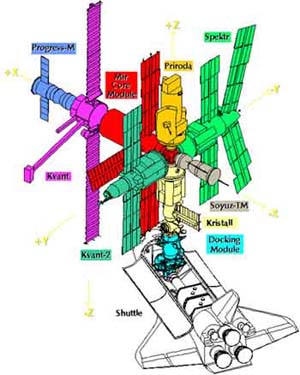
| Mir has a mass of 140 tons. It consists
of seven modules launched separately and brought together in space over
a 10 year period. Experience gained by Russia during Mir assembly and has
provided valuable experience for Intentional Space Station assembly.
Mir has been in orbit for 15 years, and staffed continuously for most of that time. Mir measures more than 107 feet long with docked Progress-M and Soyuz-TM spacecraft, and is about 90 feet wide across its modules. Mir Space Station Components:
|
 The Mir CORE module
| The 20.4-ton Core Module, Mir's first building
block, was launched in February 1986. The Core Module provides basic services
(living quarters, life support, power) and scientific research capabilities.
It has two axial docking ports, fore and aft, for Soyuz-TM manned transports
and automated Progress-M supply ships, plus four radial berthing ports
for expansion modules.
The Mir Core Module is the central portion of the Mir Complex. The Core Module supports the design concept of a Mir Complex as an assembly of separate pressurised modules with both core and specific functions. The working compartment is the main habitable volume on Mir and is made up of two concentric cylinders connected by a tapered conical section. The interior of the working compartment is divided into an operation zone and a living area. Mir crew prefer a spatial orientation of floor and ceiling with the sides arranged in a bottom-to-top orientation despite the formal irrelevance of the terms in the absence of gravity. The floor of the operations area is covered with dark green carpet, the walls are light green and the ceiling is white with fluorescent lamps. The arrangement of equipment and the interior finish of the working compartment are designed to reinforce this bottom-to-top orientation. The living area uses the same spatial orientation concepts, but soft pastel colours are used to imply a home-like atmosphere. The living area of the working compartment provides the necessities for long-term human missions. The living area contains a galley areawitha table, cooking elements, and trash storage. Individual crew cabins, which include a porthole, hinged chairs and a sleeping bag are found next as one moves axially through the working compartment. The aft end of the working compartment contains the personal hygiene area with toilet, sink, and shower. |
 The
KVANT-1 module
The
KVANT-1 module
| Kvant-1 was added to Mir core's aft port
in 1987. This small, 11-ton module contains astrophysics instruments, life
support and attitude control equipment.
The purpose of the Kvant-1 module is to provide data and observations for research into the physics of active galaxies, quasars, and neutron stars. This data is gathered with devices which measure electromagnetic spectra and x-ray emissions. The Kvant-1 also supports biotechnology experiments in the areas of antiviral preparations and fractions. The Kvant-1 module is divided into a pressurised laboratory compartment and a nonpressurised equipment compartment. The laboratory compartment iis further divided into an instrumentation area and a living area, which are separated by an interior partition. A pressurised transfer chamber connects the Passive Docking Unit with the laboratory chamber. The nonpressurised equipment compartment contains power stabilizers. |